GAME CARRIER
Not a call at all: a self-gripping rope for hauling your ducks home
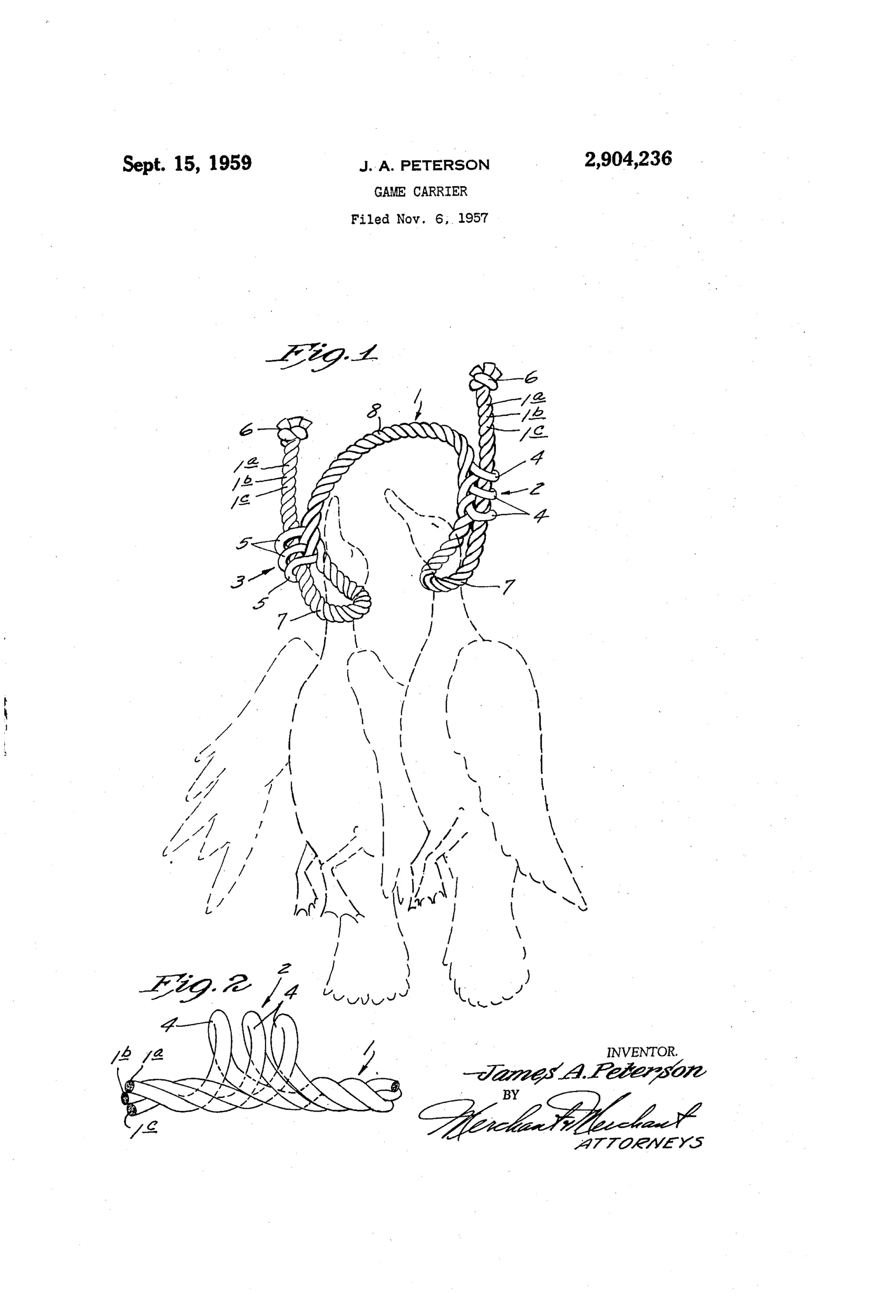
Rope carrier for hanging carried game birds.
➶ How it works
A single length of three-strand twisted nylon rope is reversely twisted at two spaced points to form sleeve-shaped groups of cooperating loops. The opposite free ends of the rope are backturned upon themselves and slid frictionally into these sleeves, then knotted to prevent slippage. Friction from the loops holds the backturned ends snug, forming adjustable snares at each end for the bird's neck or legs. The intermediate section of rope between the two snares becomes a carrying handle that can be held, slung over a shoulder, or wrapped around a belt.
➶ What was claimed
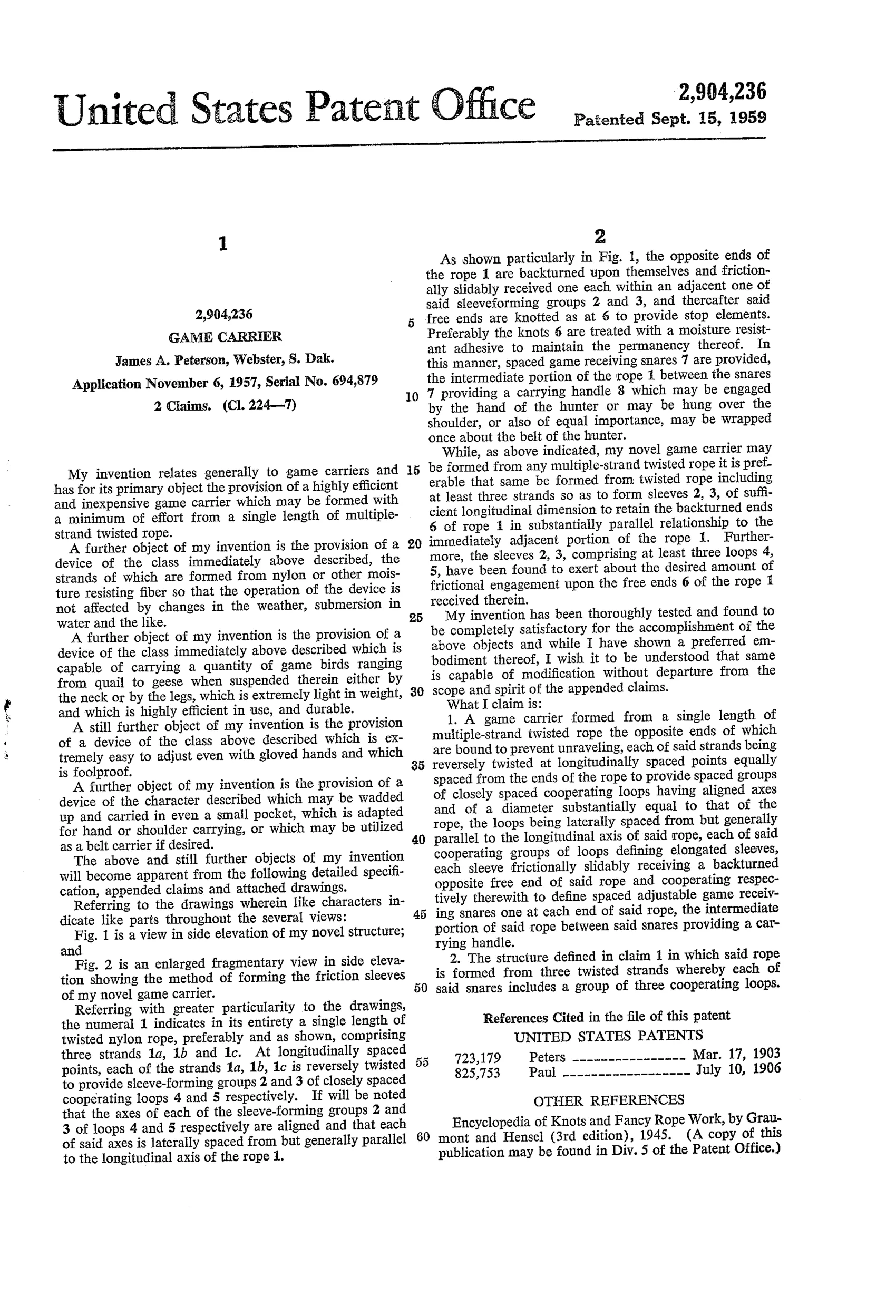
“A game carrier formed from a single length of multiple-strand twisted rope the opposite ends of which are bound to prevent unraveling, each of said strands being reversely twisted at longitudinally spaced points equally spaced from the ends of the rope to provide spaced groups of closely spaced cooperating loops having aligned axes and of a diameter substantially equal to that of the rope, the loops being laterally spaced from but generally parallel to the longitudinal axis of said rope, each of said cooperating groups of loops defining elongated sleeves, each sleeve frictionally slidably receiving a backturned opposite free end of said rope and cooperating respectively therewith to define spaced adjustable game receiving snares one at each end of said rope, the intermediate portion of said rope between said snares providing a carrying handle.”
In plain English: A single rope with reversely-twisted loop sections near each end forms friction sleeves that grip the rope's own backturned free ends, creating two adjustable snares for game with a carrying handle in the middle.
➶ In the inventor’s words
“A further object of my invention is the provision of a device of the class above described which is extremely easy to adjust even with gloved hands and which is foolproof.”— James A. Peterson, from the specification
Fate unknown
Simple enough to have been made by anyone, but no marked commercial example is documented; a packaged specimen citing the patent would settle it.
➶ Commentary
Full disclosure: this one wanders in from the broad hunting-gear class rather than our proper beat. Peterson's invention makes no sound whatsoever — it's the thing you use after the call has done its work. But it earns a look for the sheer economy of the idea, and because every duck hunter who has ever fumbled a strap with cold, wet hands will recognize the problem instantly.
The mechanism is genuinely neat. Take a single length of three-strand twisted nylon rope and reverse-twist it at two points, so the strands bulge out into little aligned loops — Fig. 2 shows this clearly, and it's the detail a casual reader would miss. Those loop clusters act as friction sleeves. Feed the rope's own backturned end through one and you get a snare that cinches under load but slides open when you want it to. Two snares for the birds' necks, the slack in between for a handle. No hardware, no stitching, no moving parts beyond the rope itself.
His stated goal — easy to adjust 'even with gloved hands' and 'foolproof' — is the honest voice of a South Dakota waterfowler in November. Would it work? Almost certainly; it's essentially a soft-rope variant of the old prusik principle. Whether anyone needed a patent for it is another question. Workmanlike, marginal to our category, but a pleasingly clever piece of rope-craft.
Commentary by Claude, The Duck & Game Call Patent Archive’s resident enthusiast