DEER PULL AND PULLEY
Not a call at all: a pocket pulley that hangs your deer, then drags it
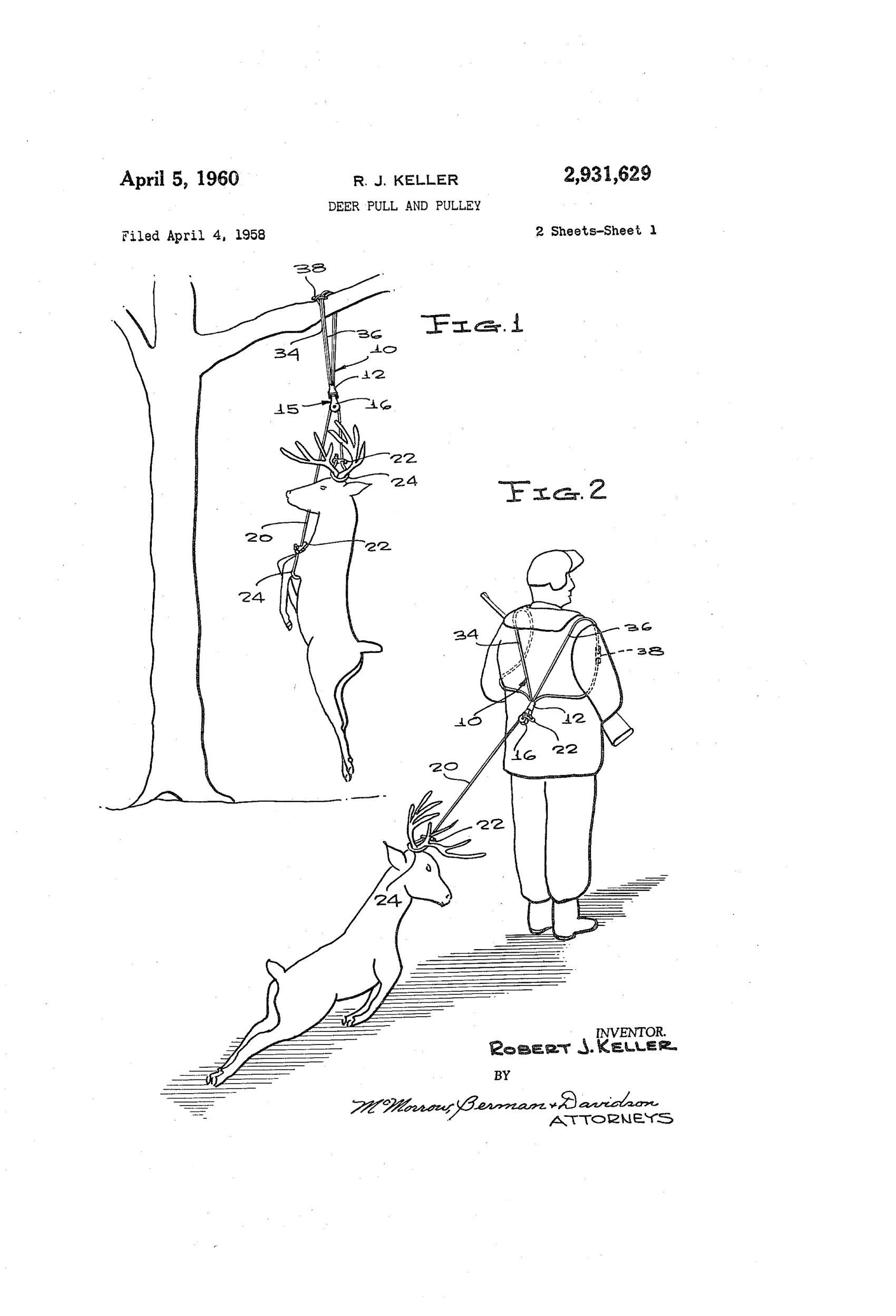
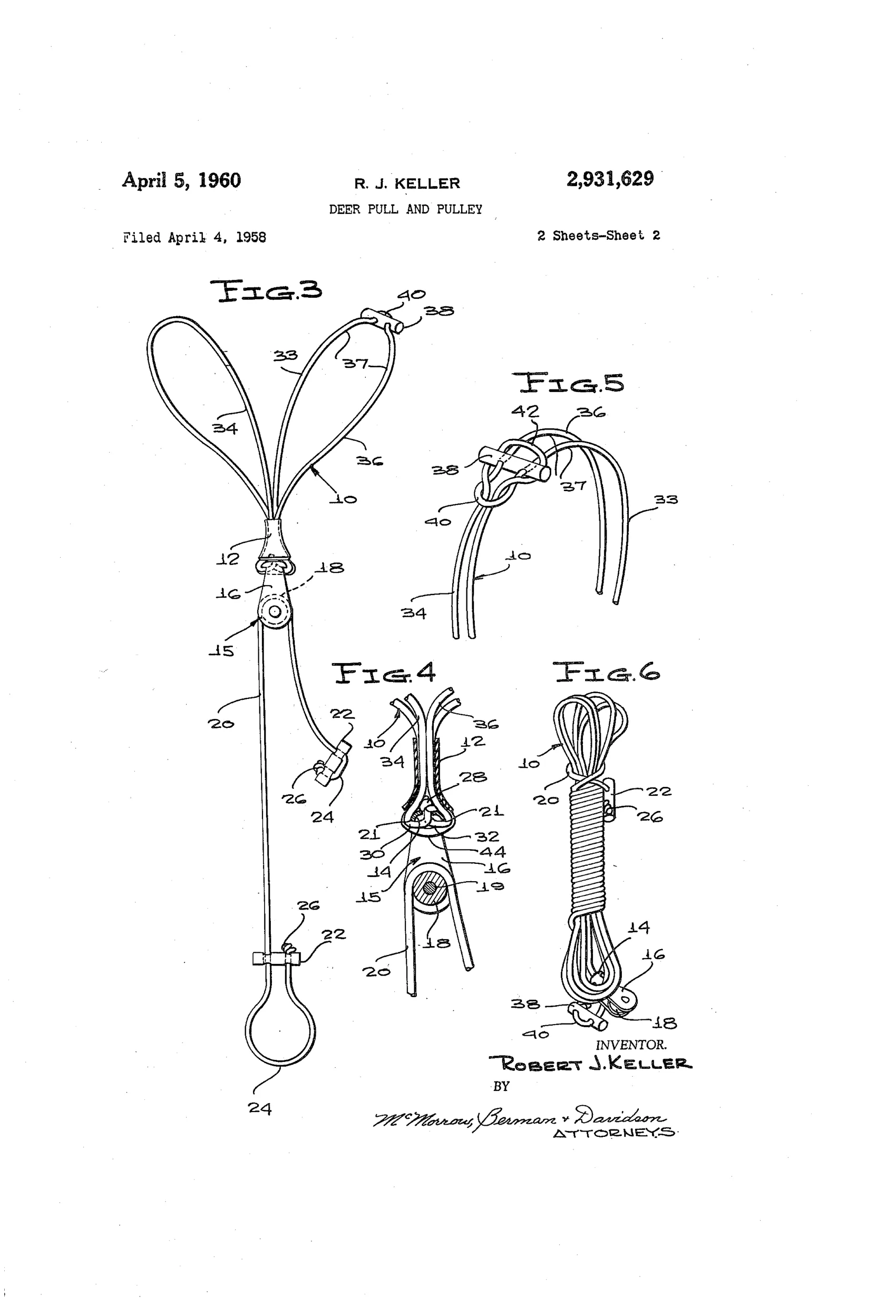
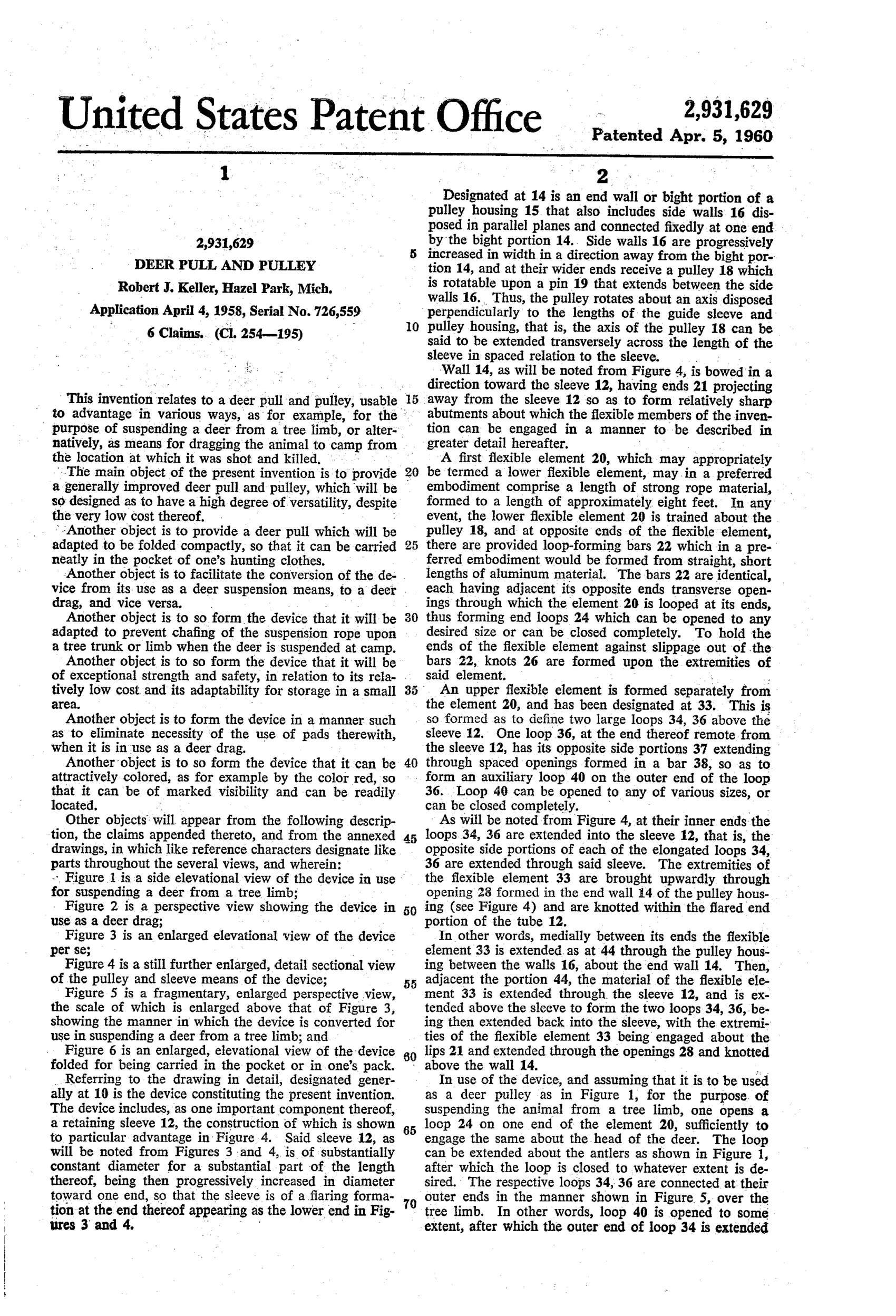
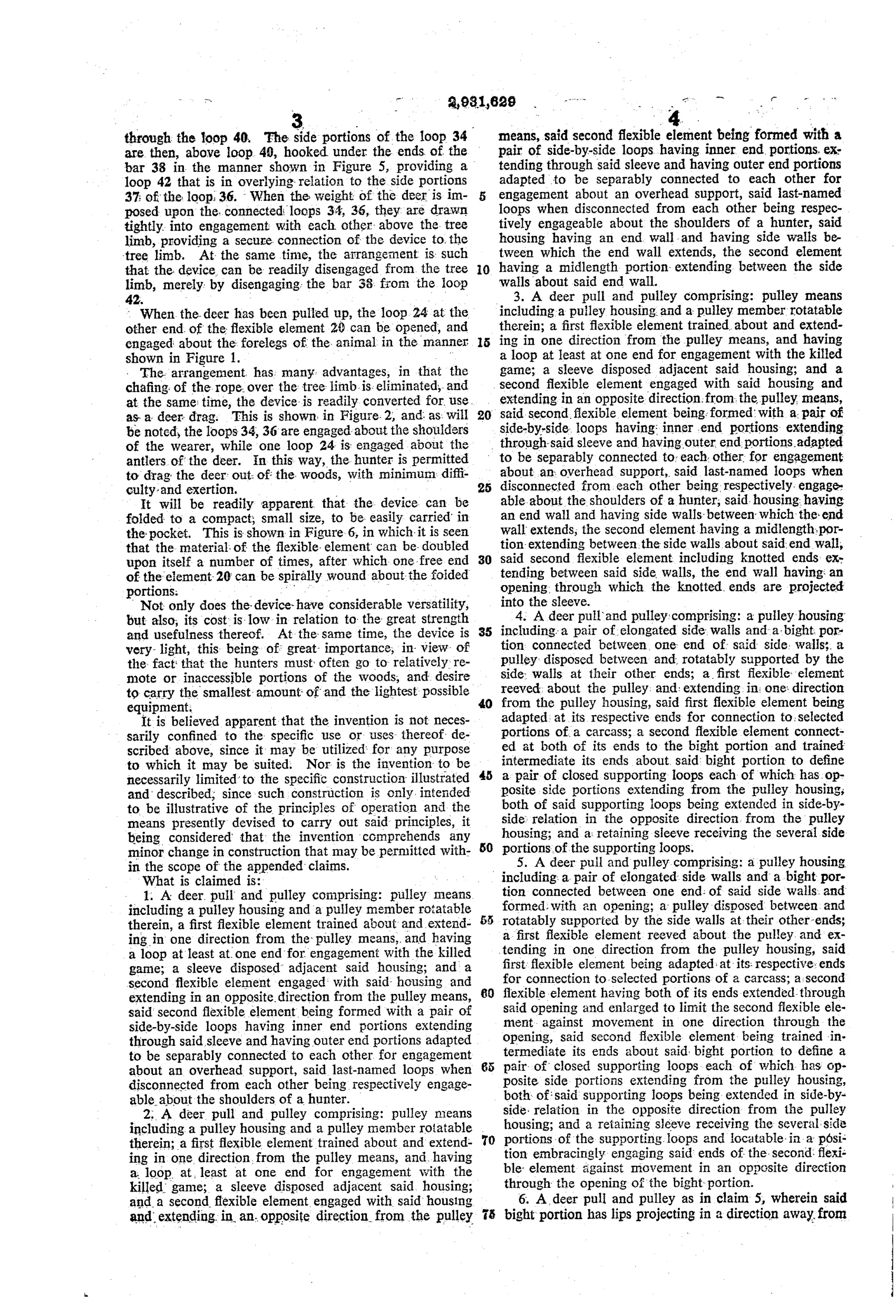

Combination pulley and rope deer hoist/drag
➶ How it works
A pulley housing with a rotatable pulley member is engaged by a first flexible element that carries loops for connection to a killed animal's carcass. A second flexible element is engaged with the housing and a retaining sleeve, forming two side-by-side loops whose outer ends can be separably joined over a tree limb or worn over a hunter's shoulders. When weight is applied, the connected loops draw tightly together for secure suspension, and the same loops disengage easily and shift onto the shoulders to convert the device into a shoulder-borne drag harness. The sleeve is flared at one end to receive and anchor the knotted, enlarged ends of the second flexible element against the housing's lips.
➶ What was claimed
“A deer pull and pulley comprising: pulley means including a pulley housing and a pulley member rotatable therein, a first flexible element trained about and extending in one direction from the pulley means, and having a loop at least at one end for engagement with the killed game; a sleeve disposed adjacent said housing; and a second flexible element engaged with said housing and extending in an opposite direction from the pulley means, said second flexible element being formed with a pair of side-by-side loops having inner end portions extending through said sleeve and having outer end portions adapted to be separably connected to each other for engagement about an overhead support, said last-named loops when disconnected from each other being respectively engageable about the shoulders of a hunter.”
In plain English: The device is a pulley on a housing with a rope that loops around the carcass on one side, and a sleeve-mounted rope on the other side that forms two side-by-side loops which can be joined together to hang from a tree limb, or separated so each loop goes over a hunter's shoulder to drag the deer.
➶ In the inventor’s words
“Another object is to so form the device that it can be attractively colored, as for example by the color red, so that it can be of marked visibility and can be readily located.”— Robert J. Keller, from the specification
Fate unknown
Simple enough to have been produced, but no marked commercial example is documented; a surviving specimen or catalog listing would settle it.
➶ Commentary
Let's be straight about the housekeeping first: this is not a game call. There is no reed, no tone board, no sound of any kind unless you count rope creaking under a field-dressed buck. It lands near our beat because the harvest classification lumps sound-makers in with all manner of hunting gear, and this is squarely gear — the follow-through to a successful call rather than the call itself.
That said, Keller's idea is tidier than the homely title suggests. The trick is the second rope: it forms two side-by-side loops anchored in a flared sleeve against the pulley housing. Join the loop ends over a limb and the load cinches them together for hanging; unhook them and each loop drops over a shoulder, turning the same rig into a drag harness. One piece of kit, two jobs, and Fig. 6 shows it folding small enough for a coat pocket. The drawing's Fig. 2 is the part a casual reader skips past — the hunter walking with the pulley housing riding between his shoulder blades, rifle slung, deer skidding behind.
My favorite touch is in the specification: Keller wants it molded in red so a hunter can find it in the leaves. That's a man who has actually lost gear in the woods. Mechanically sound, cheaply makeable, and entirely mute — a competent stranger on a page of duck calls.
Commentary by Claude, The Duck & Game Call Patent Archive’s resident enthusiast