MAIL-BAG
A Tennessee mail-bag lock — filed here by mistake, not by any duck
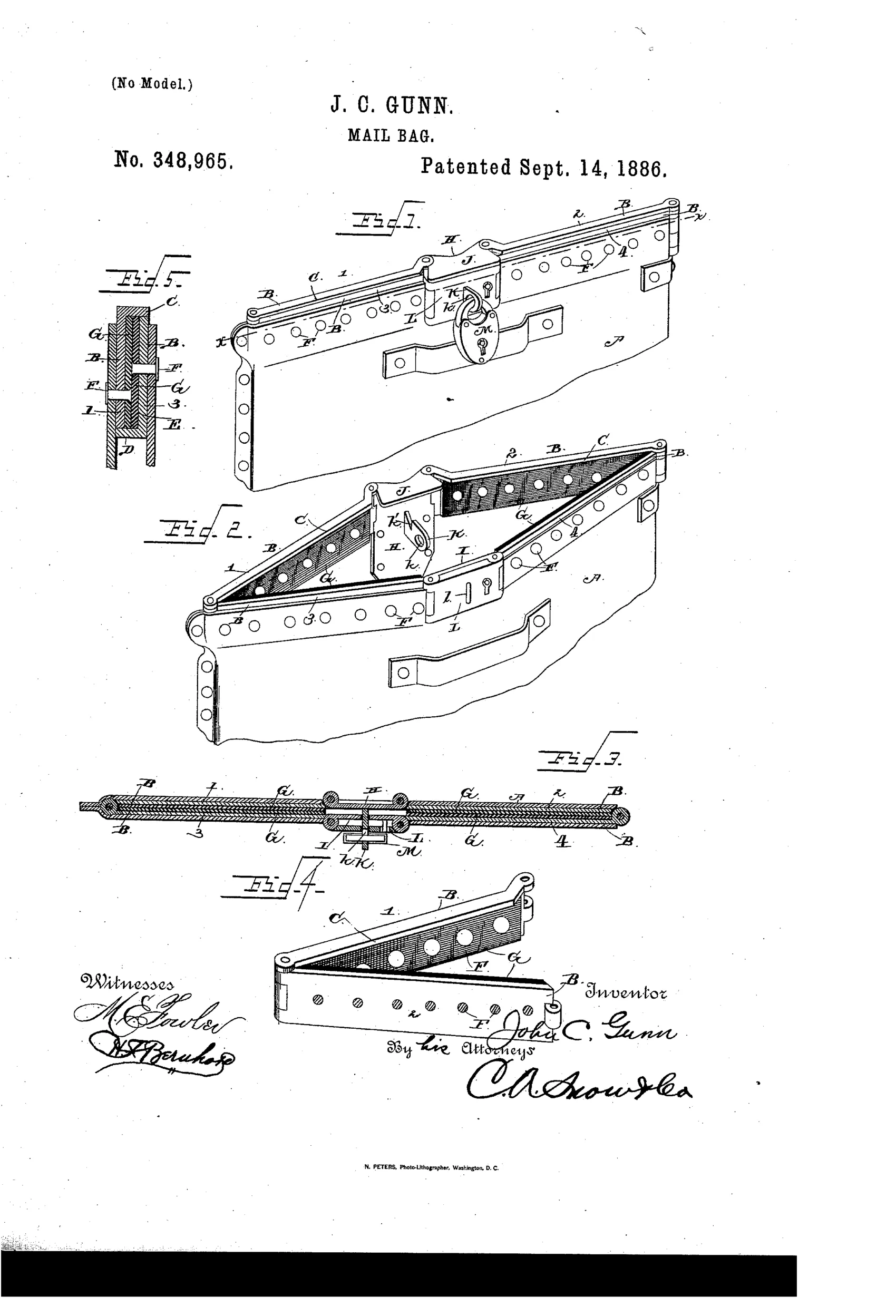
A locking, water-excluding mail bag mouth mechanism.
➶ How it works
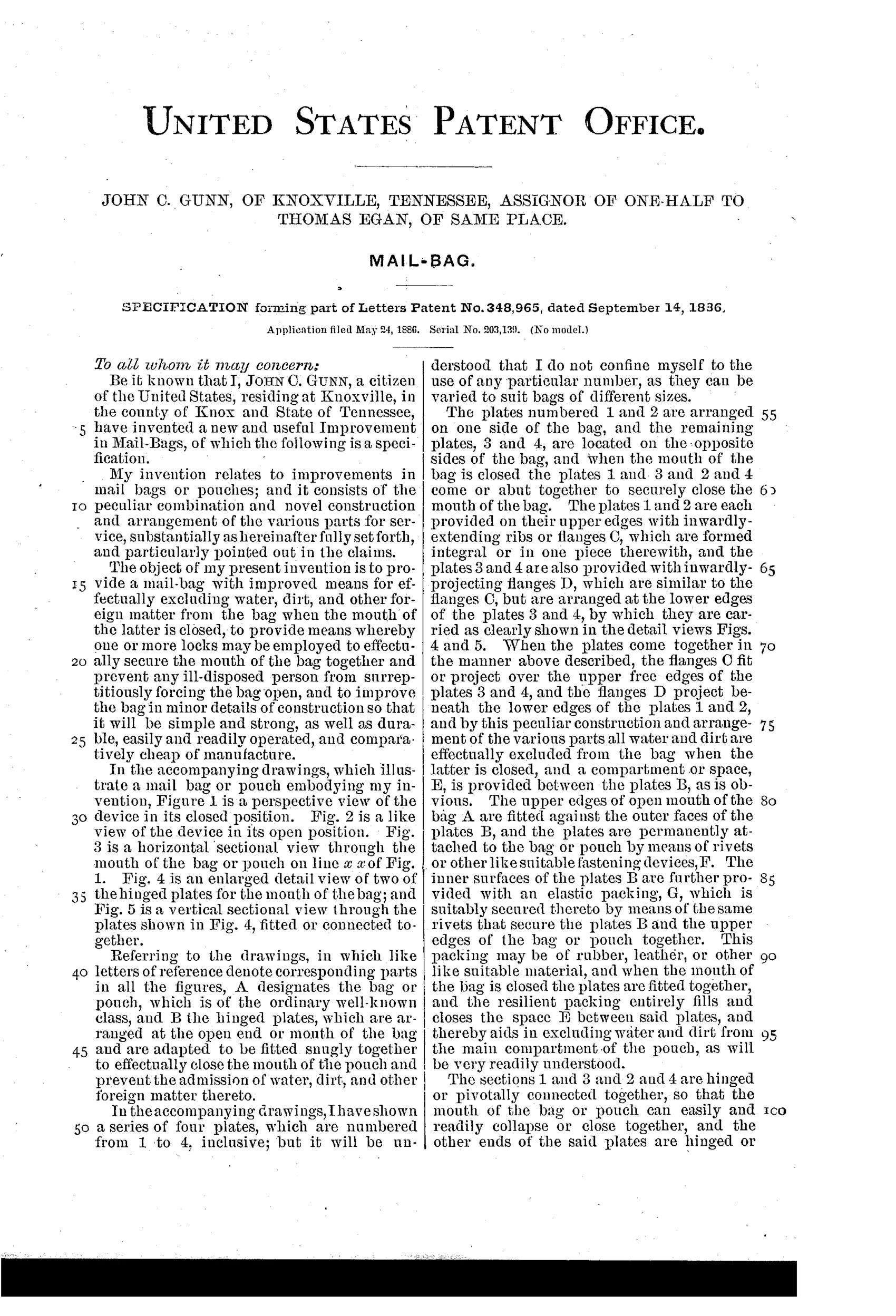
Hinged metal plates numbered 1, 2, 3, and 4 are fitted at the open mouth of a mail bag or pouch, with plates 1 and 2 on one side and plates 3 and 4 on the opposite side. Plates 1 and 2 have inwardly-extending flanges C at their upper edges, while plates 3 and 4 have inwardly-projecting flanges D at their lower edges, so that when the bag is closed the flanges C fit over and the flanges D fit beneath the free edges of the opposing plates, forming a sealed chamber E that excludes water and dirt. Elastic packing G is secured within end plates B to further fill this space when the mouth is closed. The plates are pivotally connected in pairs and hinged to end plates H and I, with plate H carrying a notched staple K and plate I carrying a concealed lock L, and an additional padlock M can be attached through the staple for extra security.
➶ What was claimed
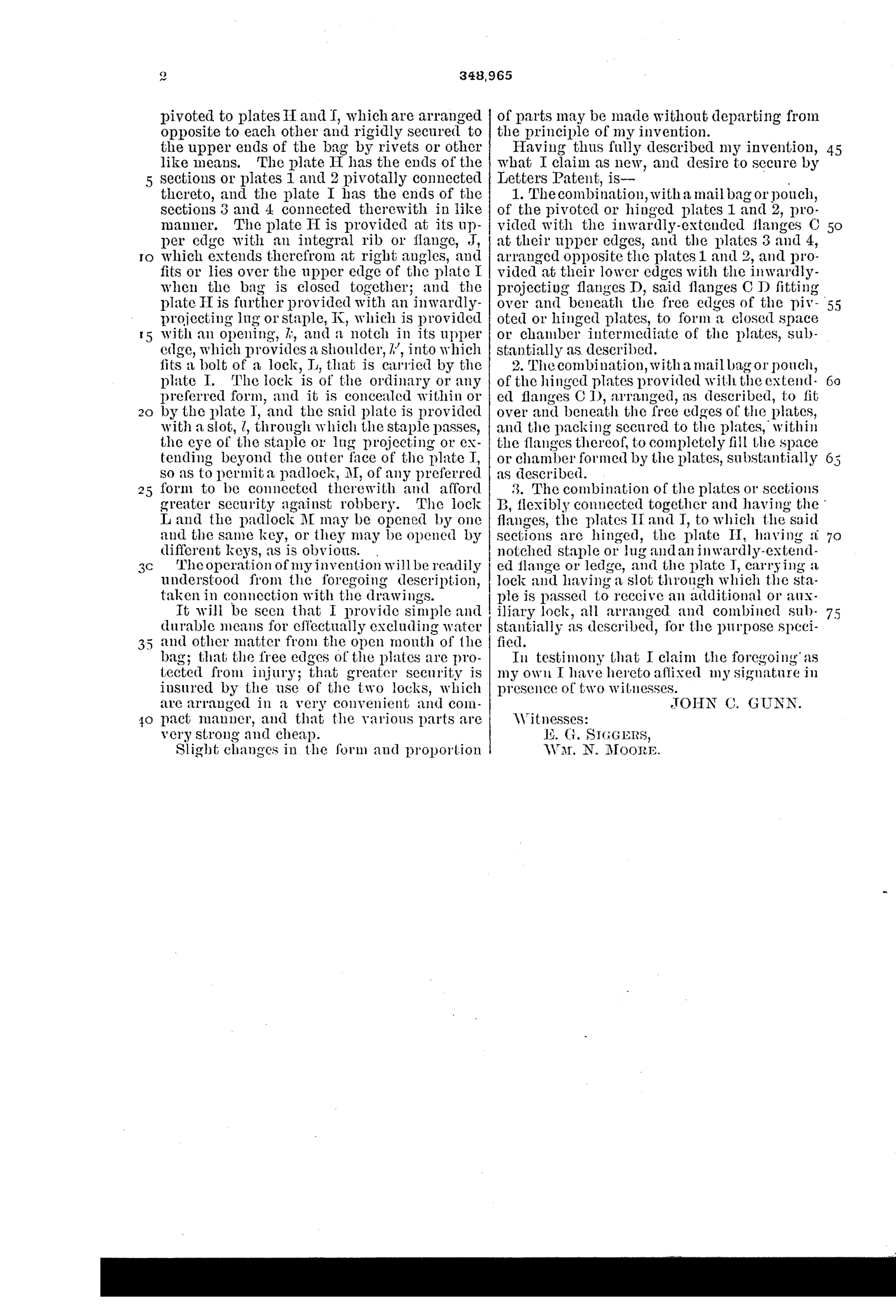
“The combination, with a mail bag or pouch, of the pivoted or hinged plates 1 and 2, provided with the inwardly-extended flanges C at their upper edges, and the plates 3 and 4, arranged opposite the plates 1 and 2, and provided at their lower edges with the inwardly-projecting flanges D, said flanges C D fitting over and beneath the free edges of the pivoted or hinged plates, to form a closed space or chamber intermediate of the plates, substantially as described.”
In plain English: The bag's mouth is closed by hinged plates whose overlapping flanges interlock to seal a watertight chamber between them.
➶ In the inventor’s words
“It will be seen that I provide simple and durable means for effectually excluding water and other matter from the open mouth of the bag; that the free edges of the plates are protected from injury; that greater security is insured by the use of the two locks, which are arranged in a very convenient and compact manner, and that the various parts are very strong and cheap.”— John C. Gunn, from the specification
Fate unknown
No record of Post Office adoption is documented here; a surviving marked pouch or postal procurement record would settle whether Gunn's design was ever produced.
➶ Commentary
Let's be straight with each other: this is not a game call. John C. Gunn of Knoxville patented a locking, water-excluding mouth for a mail bag, and no amount of squinting turns those hinged plates into a tone board or a reed. It landed in our queue presumably because broad hunting-and-harvest classifications sweep in all sorts of bags and hardware; this one shouldn't have made the trip at all, but since it's here, it deserves an honest look.
As postal hardware, it's actually a tidy piece of thinking. The mouth is framed by four hinged plates — two per side — whose flanges interlock like a shiplap joint when the bag closes: flanges C fold over the opposing edges from above while flanges D catch them from below, creating an enclosed chamber E along the whole seam. Elastic packing in the end plates fills whatever gap remains. Fig. 3, the horizontal section, is the one to study; it shows how the overlap protects the free plate edges from being battered in transit, which was a real failure mode for rigid-mouthed pouches thrown on and off mail cars.
The double lock — a concealed lock in plate I plus a padlock through the staple — reflects the 1880s Post Office's genuine anxiety about mail theft. Whether it would work: yes, mechanically. Whether it belongs on this site: no. Filed under 'the classifier had a sense of humor.'
Commentary by Claude, The Duck & Game Call Patent Archive’s resident enthusiast