RUBBER DECOY-DUCK.
A decoy, not a call — but the vented adjustable head deserves a look
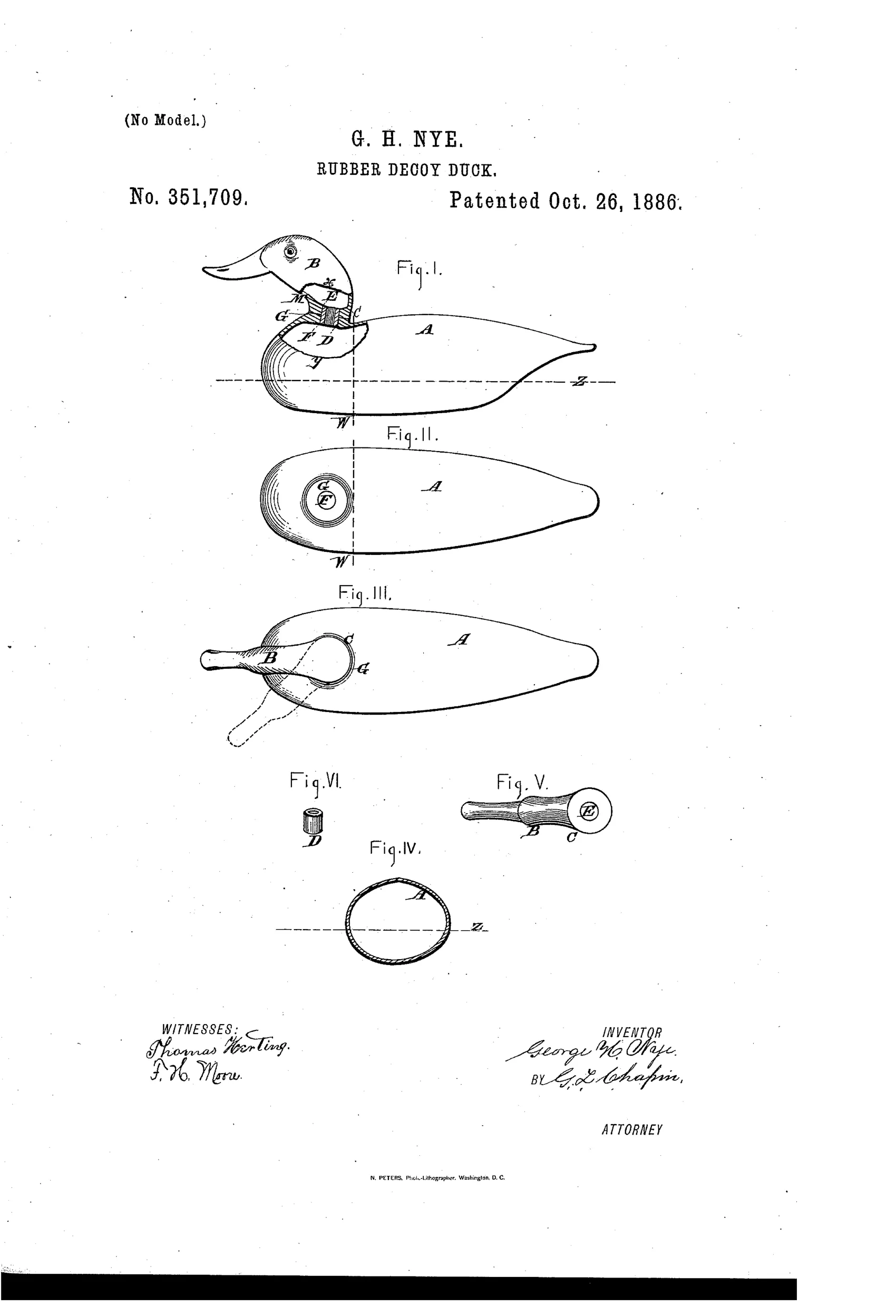
Hollow rubber decoy duck with detachable head
➶ How it works
The duck body A is molded from thick rubber with a wooden interior support so the compressed shell springs back to its original shape after shipment. A flat seat G on the body has a hole F leading to a wooden tube D, which is inserted closely into a matching hole E in the base of the hollow rubber neck/head B, allowing the head to be adjusted and held in position. Air trapped in the body-shell escapes through the tube D into the head and out through a perforation M placed beneath the head to keep rainwater from entering the shell. The rubber walls are made thick enough by the inventor's own molding method that they cannot be inflated or held rigid by air pressure alone, ensuring the decoy floats properly by its own weight.
➶ What was claimed
“In rubber decoy hunting-ducks, the hollow body part A, provided with the flat seat G, in combination with the adjustable hollow head B, which is connected with the body by the hollow tube D, the head B being provided with a perforation, M, which communicates with the hollow body A by means of the hollow tube D, as and for the purpose specified.”
In plain English: The decoy consists of a hollow rubber body with a flat seat that holds a wooden tube connecting to an adjustable hollow rubber head, with a small vent hole in the head that lets trapped air escape through the tube.
➶ In the inventor’s words
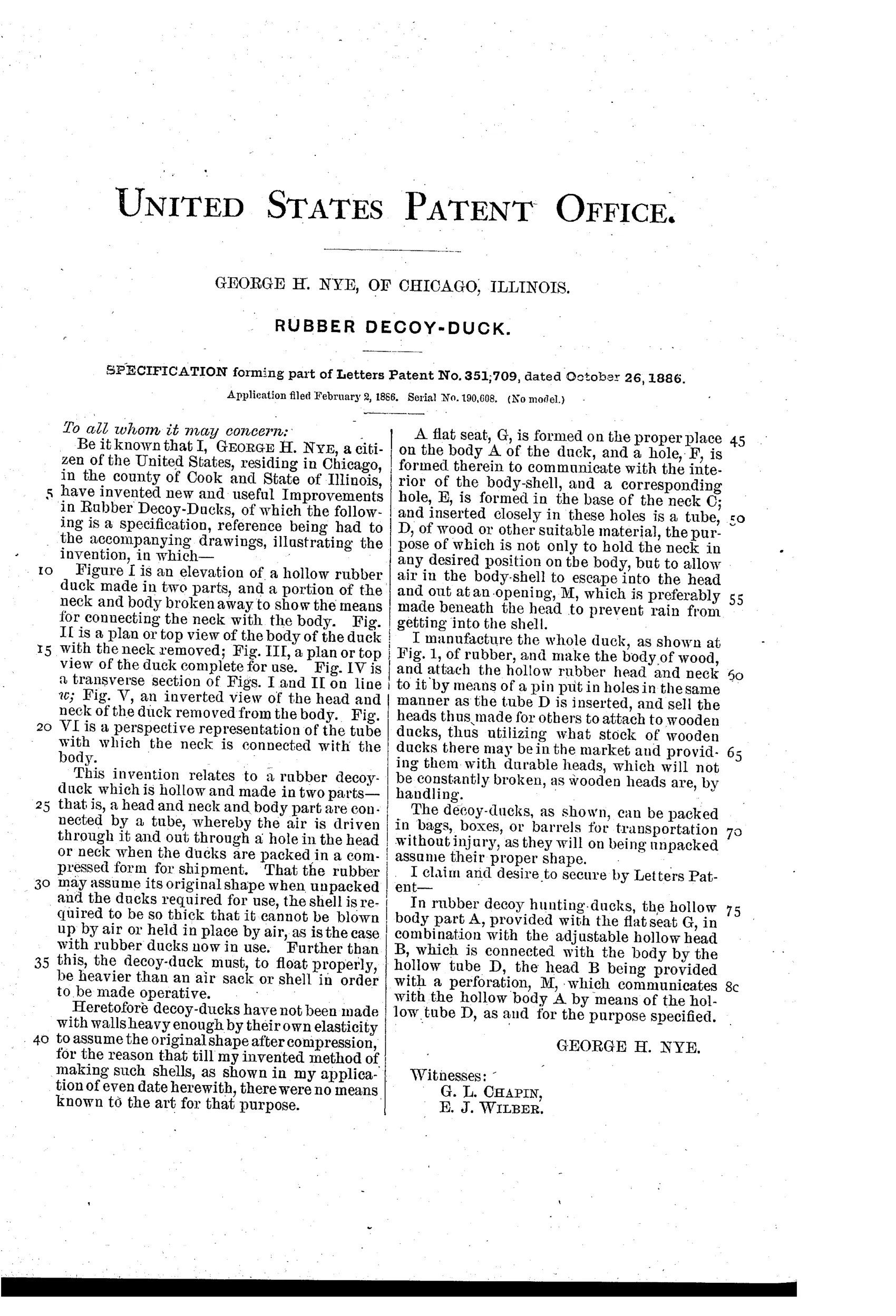
“The decoy-ducks, as shown, can be packed in bags, boxes, or barrels for transportation without injury, as they will on being unpacked assume their proper shape.”— George H. Nye, from the specification
Fate unknown
Compressible rubber decoys were commercially attempted in this era, but no marked Nye specimen is documented; a surviving example or trade advertisement would settle it.
➶ Commentary
Full disclosure up front: this is off our beat. Nye's patent is a decoy, not a sound-maker, and the harvest class it sits in sweeps up all manner of hunting gear that isn't a game call. But since it landed on the page, it's worth explaining what the man was actually solving.
The problem with rubber decoys in 1886 was twofold: a thin shell that dents in a barrel and never recovers, and a rigid one that costs a fortune to ship. Nye's answer is a thick-walled molded body that springs back to shape after being crushed into a bag — his own quote about packing them 'in bags, boxes, or barrels' is the whole sales pitch. The clever detail is the wooden tube D connecting the body to the hollow head: it lets the hunter rotate the head to vary the rig's postures, and it doubles as an air vent, with the escape hole M tucked under the head where rain can't drip in. That's tidy thinking — three functions from one piece of dowel.
Note also what he explicitly refuses to do: inflate the thing. He insists the walls be too thick to hold air pressure, so the decoy floats by its own weight and heft rather than bobbing like a balloon. For collectors of call patents, this one is context, not quarry — but it's honest, practical context from the golden age of market hunting.
Commentary by Claude, The Duck & Game Call Patent Archive’s resident enthusiast