FIRE-ESCAPE.
A fire escape, not a duck call — filed here by mistake, worth explaining
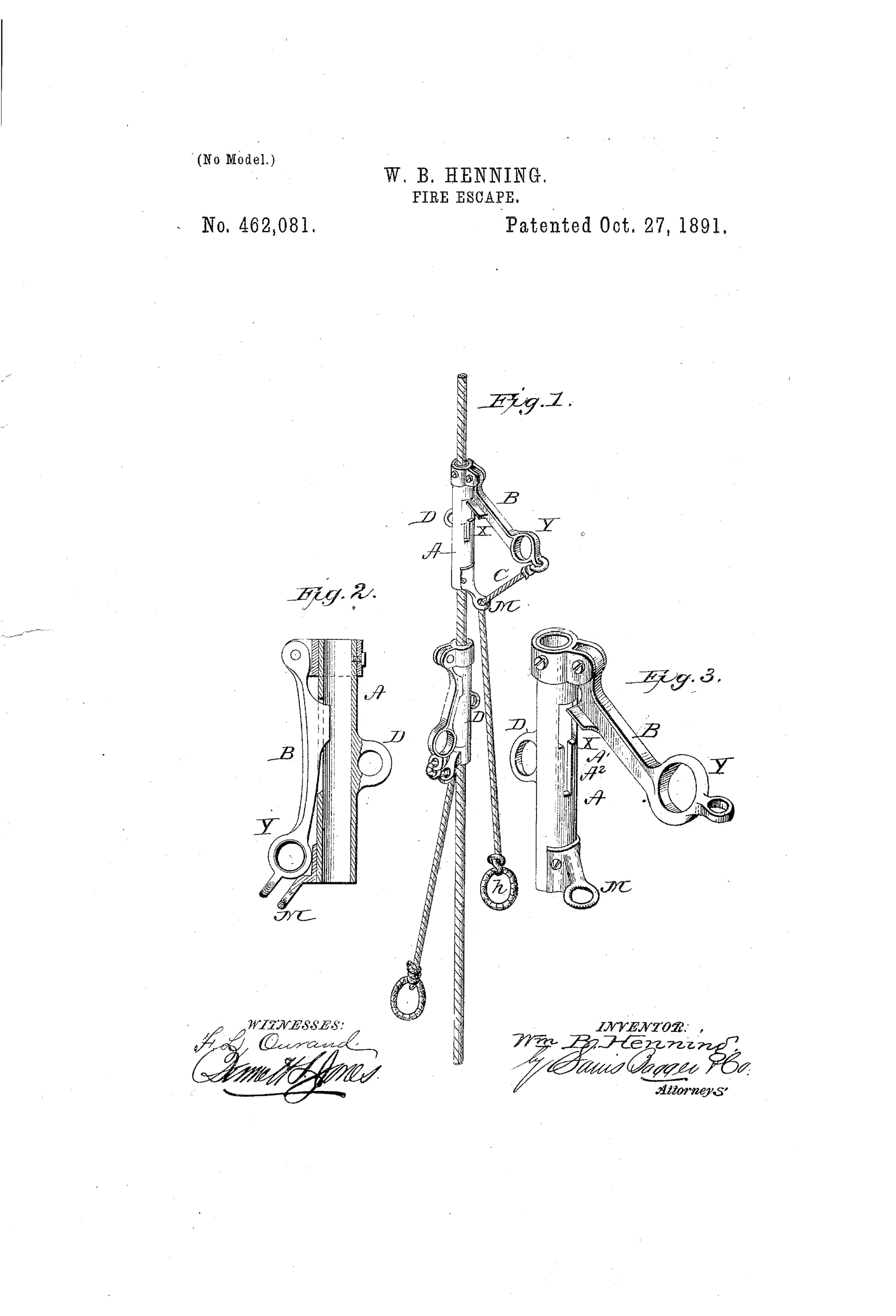
Rope-climbing fire escape with gripping sleeves
➶ How it works
Two metal sleeves ride on a vertical rope or wire, each fitted with a pivoted gripping lever bearing a laterally-projecting brake or grip. A user grasps the hand-holds on the sleeves and alternately actuates the levers to clamp or release the rope. By working the two sleeves alternately, the device permits controlled descent from a burning building, and, uniquely, also allows ascent back up the same rope.
➶ What was claimed
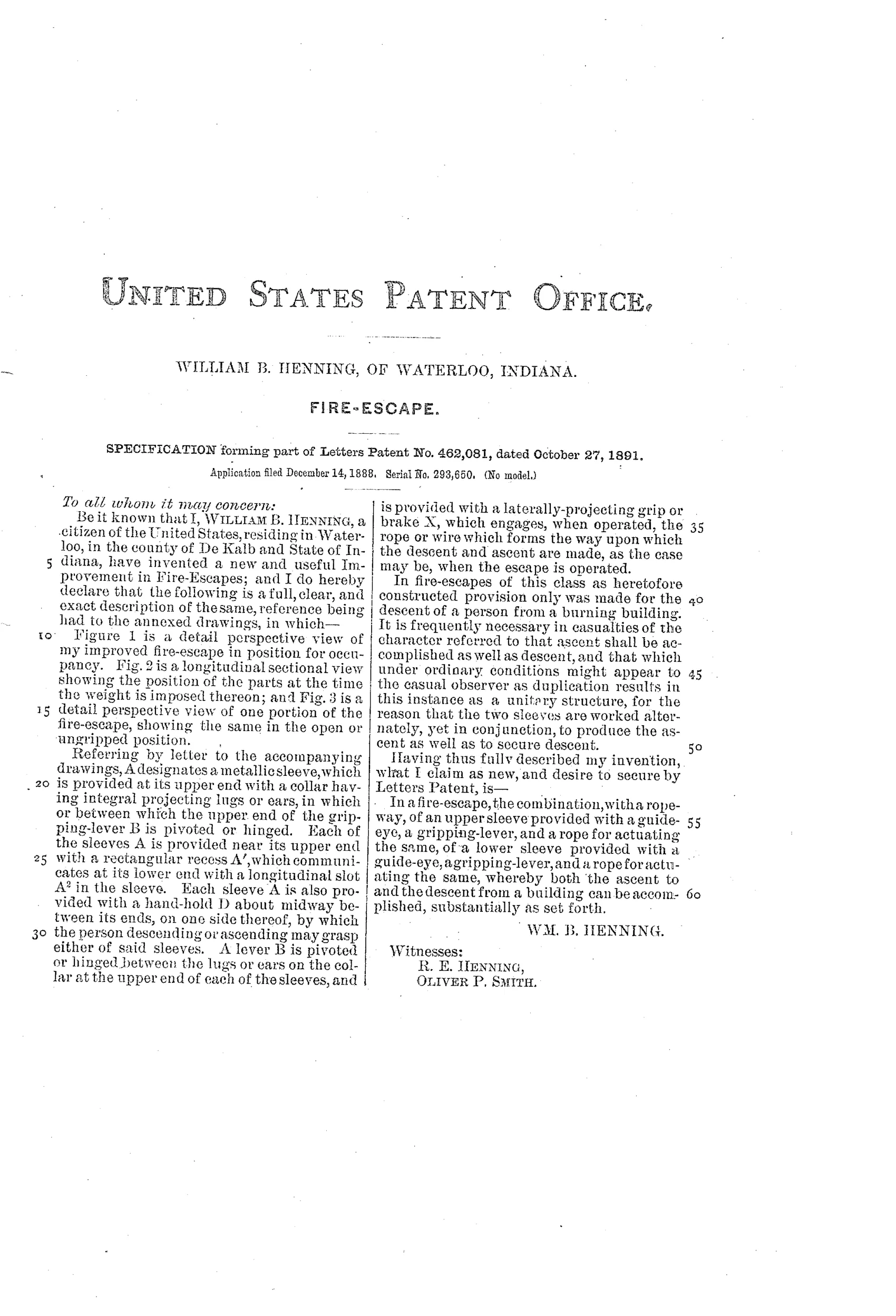
“In a fire-escape, the combination, with a rope-way, of an upper sleeve provided with a guide-eye, a gripping-lever, and a rope for actuating the same, of a lower sleeve provided with a guide-eye, a gripping-lever, and a rope for actuating the same, whereby both the ascent to and the descent from a building can be accomplished, substantially as set forth.”
In plain English: The invention combines two rope-riding sleeves, each with its own guide-eye, gripping lever, and actuating rope, so a person can both climb up and climb down the same rope.
➶ In the inventor’s words
“It is frequently necessary in casualties of the character referred to that ascent shall be accomplished as well as descent, and that which under ordinary conditions might appear to the casual observer as duplication results in this instance as a unitary structure, for the reason that the two sleeves are worked alternately, yet in conjunction, to produce the ascent as well as to secure descent.”— William B. Henning, from the specification
Fate unknown
Off-topic for this collection and no production history is known to us; a surviving marked example or period catalog listing would settle it.
➶ Commentary
Let's be straight: this is not a game call. Patent 462,081 is a rope-climbing fire escape, and no amount of squinting turns William B. Henning's gripping sleeves into a reed and tone board. It landed in our queue because broad classification nets catch strange fish; it belongs with 19th-century safety devices, a category that boomed after urban tenement fires made escape apparatus a national obsession.
Since it's here, the mechanism deserves a fair reading. Henning puts two sleeves on a fixed rope, each with a pivoted gripping lever worked by a short actuating cord with a ring at the end — those are the dangling loops in Fig. 1. You clamp one sleeve, shift your weight, release and slide the other, inchworm fashion. His claim that the design permits ascent as well as descent is the genuinely unusual part; most escape patents of the era were one-way descent brakes, essentially controlled friction. Fig. 2 shows how imposed weight seats the lever against the rope, which is a sensible fail-toward-grip arrangement.
Whether a panicked office clerk hanging outside a fourth-story window could coordinate two levers alternately is another matter — the era's descent-brake patents mostly failed on exactly that human-factors question. Filed 1888, issued 1891, and to our knowledge unconnected to any callmaker or waterfowl anywhere.
Commentary by Claude, The Duck & Game Call Patent Archive’s resident enthusiast