DECOY-DUCK
A silent decoy on a call site — flat-pack duck, no quack included
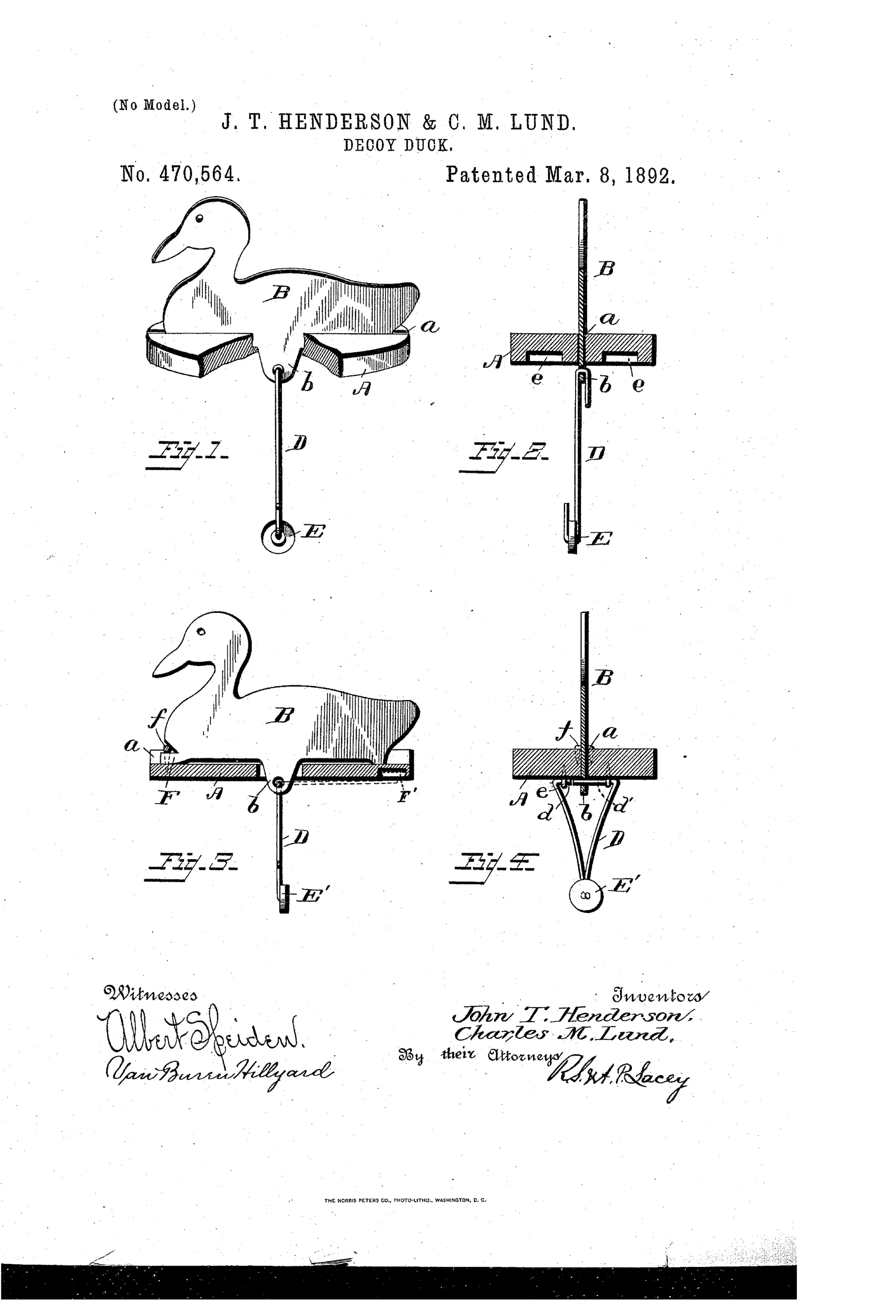
Collapsible floating decoy duck with weighted wire
➶ How it works
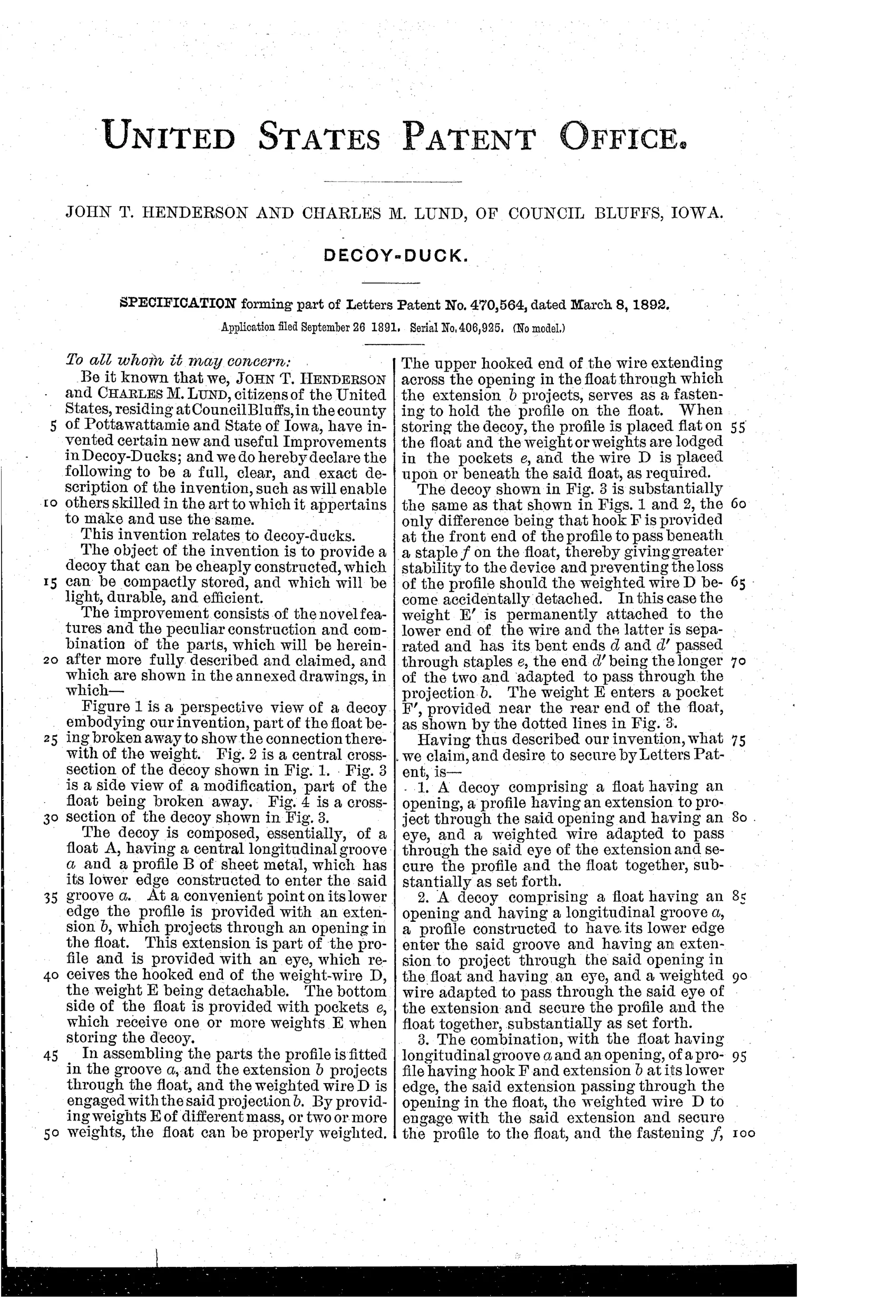
A sheet-metal profile duck body B fits into a longitudinal groove a in a wooden float A, with a lower extension b passing through an opening in the float. A weighted wire D with a hooked upper end engages the eye of extension b, securing the profile to the float and providing ballast underwater. Detachable weights E fit into pockets e on the underside of the float for storage when the decoy is disassembled. A modified version adds a hook F and staple f at the front of the profile for extra stability, using a permanently attached weight E' and bifurcated wire ends d and d'.
➶ What was claimed
“A decoy comprising a float having an opening, a profile having an extension to project through the said opening and having an eye, and a weighted wire adapted to pass through the said eye of the extension and secure the profile and the float together, substantially as set forth.”
In plain English: A duck decoy where a metal cutout duck shape is held onto a wooden float by a weighted wire that hooks through an eye on a tab projecting through a hole in the float.
➶ In the inventor’s words
“The object of the invention is to provide a decoy that can be cheaply constructed, which can be compactly stored, and which will be light, durable, and efficient.”— John T. Henderson and Charles M. Lund, from the specification
Fate unknown
Collapsible tin profile decoys were made by various firms in this era, but no example marked to this patent or these inventors is documented; a surviving specimen would settle it.
➶ Commentary
Fair warning up front: this is not a call. Henderson and Lund's patent makes no sound at all — it lives in the same broad hunting-gear class the Patent Office used for calls, which is how a decoy occasionally drifts onto these pages. It belongs to the other half of the duck hunter's kit, and it's worth a look mainly because of how frankly it addresses the market hunter's real problem: hauling a boatload of wooden decoy bodies is heavy, bulky work.
Their answer is a flat sheet-metal duck profile that drops into a groove in a wooden float, with a tab poking through a slot underneath. A single weighted wire hooks through an eye on that tab and does double duty — it locks profile to float and hangs as ballast to keep the silhouette upright. Fig. 2 shows the trick clearly. Knock it apart and the weights stow in pockets on the float's underside, so a dozen decoys stack like plates. The Fig. 3 variant adds a front hook and staple, an admission that a single central fastening probably let the profile wobble in a chop.
Profile decoys were a known idea; the collapsible weighted-wire fastening is the specific contribution here. It would work in calm water, though a flat silhouette only reads as a duck from certain angles — a limitation full-bodied decoys never had.
Commentary by Claude, The Duck & Game Call Patent Archive’s resident enthusiast