DECOY.
Two tin pans, one rubber band, and a duck that packs flat
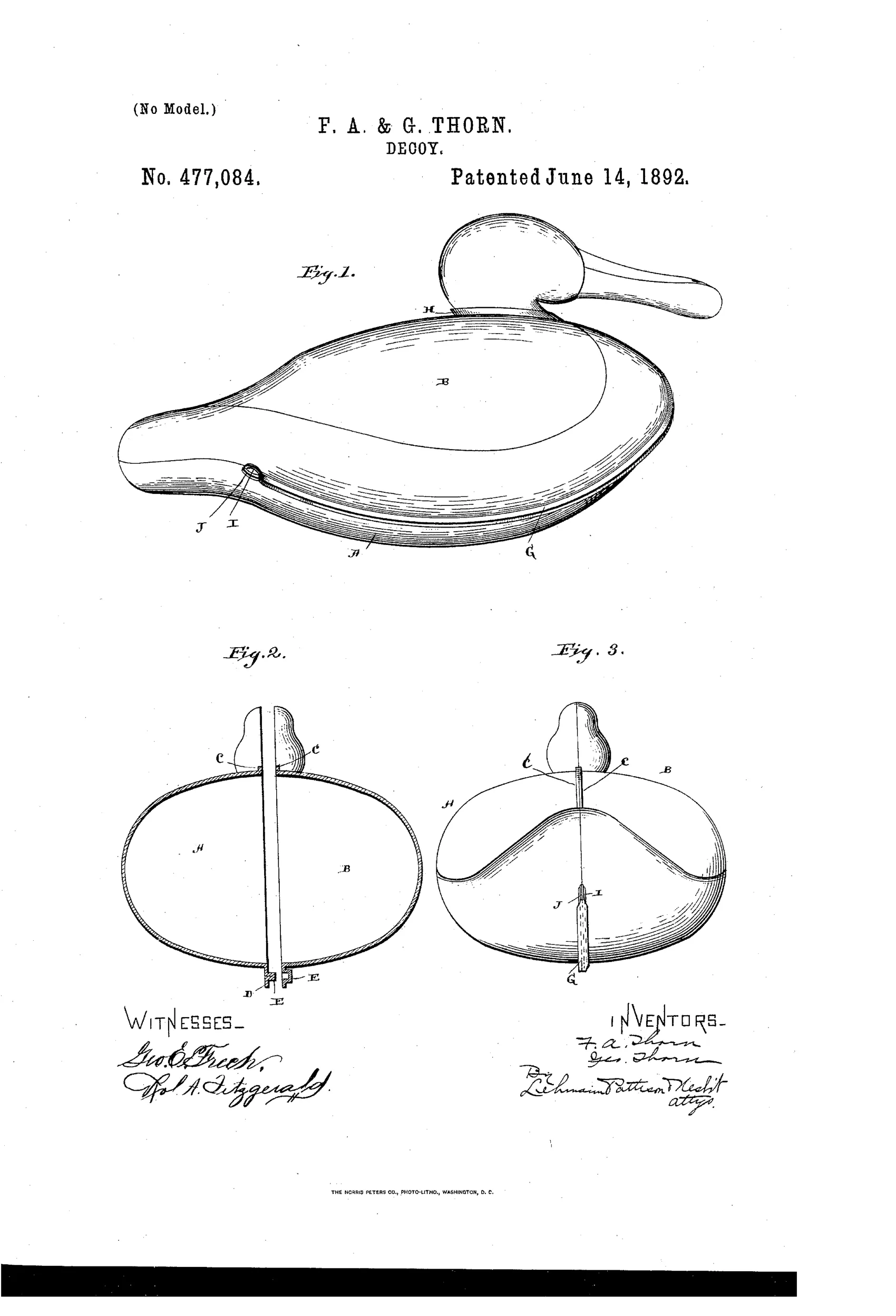
Sectional, collapsible sheet-metal duck decoy
➶ How it works
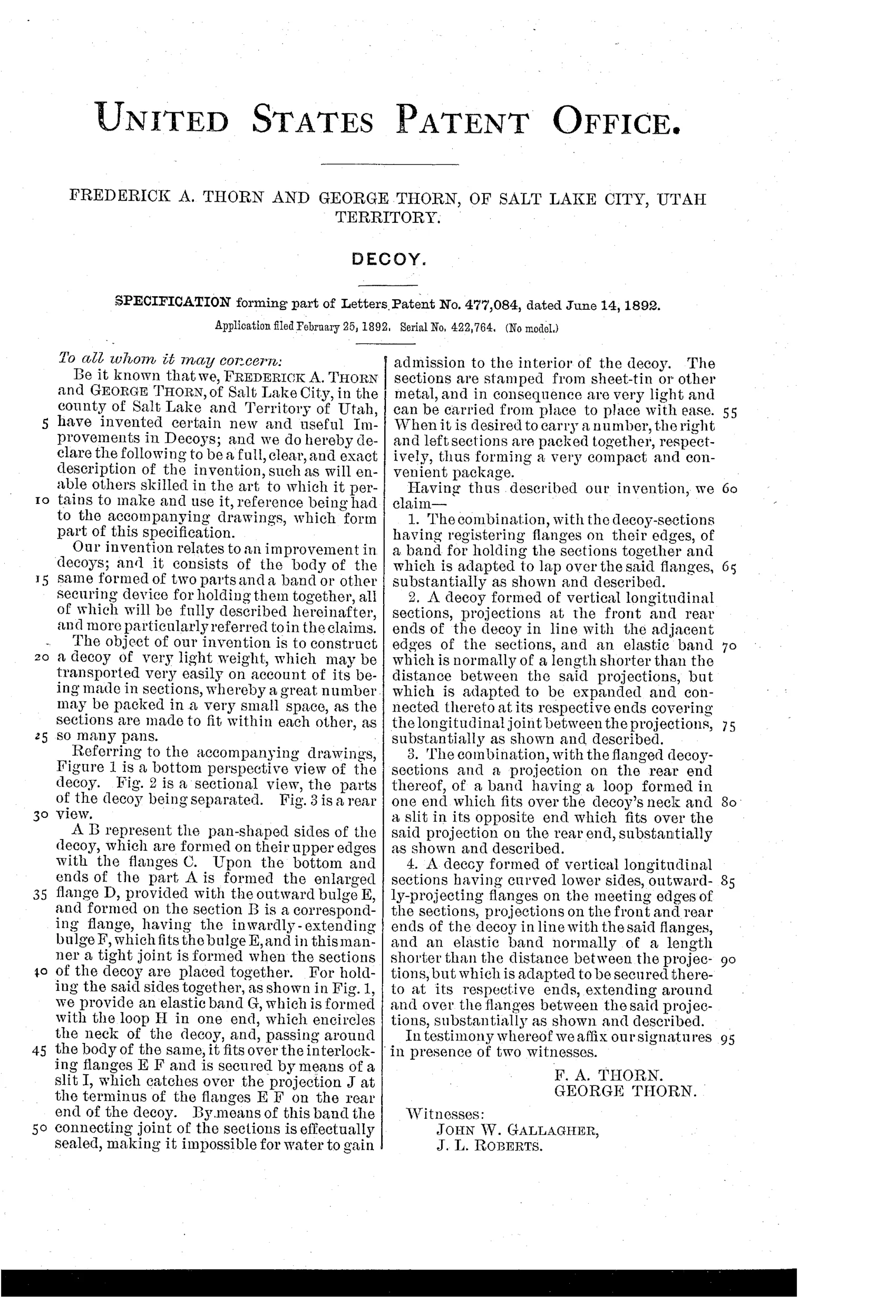
The decoy body is formed of two pan-shaped tin sections, A and B, that fit together like nested pans for compact storage. Flanges on the meeting edges interlock via a bulge-and-groove joint to form a watertight seal. An elastic band with a loop around the neck and a slit that catches a rear projection holds the two halves together and seals the longitudinal joint. Because the sections are stamped from thin sheet-tin, several decoys can be nested and carried easily in a small space.
➶ What was claimed
“A decoy formed of vertical longitudinal sections having curved lower sides, outwardly-projecting flanges on the meeting edges of the sections, projections on the front and rear ends of the decoy in line with the said flanges, and an elastic band normally of a length shorter than the distance between the projections, but which is adapted to be secured thereto at its respective ends, extending around and over the flanges between the said projections, substantially as shown and described.”
In plain English: The decoy is made of two curved sheet-metal sections with matching edge flanges and end tabs, held together by a stretchable band that wraps over the flanges to seal the seam.
➶ In the inventor’s words
“The sections are stamped from sheet-tin or other metal, and in consequence are very light and can be carried from place to place with ease.”— Frederick A. Thorn and George Thorn, from the specification
Fate unknown
No manufactured example of this Salt Lake City tin decoy is documented; a surviving marked stamping would settle it.
➶ Commentary
First, honesty about jurisdiction: this is a decoy, not a call. It makes no sound at all — it sits in the broader hunting-gear class that our category deliberately fences out. But it wandered into the collection, and it's a genuinely likable piece of frontier tinsmithing, so let's give it its due before sending it next door.
The idea is simple and the drawing shows it well. Fig. 2 is the key: the duck is split vertically down its length into two shallow pan-shaped stampings, one nesting inside the other like camp cookware. Flanged edges meet in a bulge-and-groove joint, and an elastic band — looped over the neck, slit to catch a tab at the tail — cinches over the flanges to seal the seam. A dozen of these would stack in the space one carved cedar block occupies, which mattered enormously to anyone hauling a rig by horse or handcart to the Great Salt Lake marshes in 1892.
The weak point is exactly where you'd guess: a rubber band as the sole watertight closure, in cold water, under wave action. Rubber of that era perished fast, and a seam that opens even slightly turns a floating decoy into a sinking one. Later collapsible decoys — and there were many patents chasing this same portability problem — mostly went to canvas, folding frames, or inflation instead. The Thorns' nesting-pan approach is clever, cheap to stamp, and probably one hard freeze away from failure.
Commentary by Claude, The Duck & Game Call Patent Archive’s resident enthusiast