COLLAPSIBLE DECOY.
An umbrella that quacks nothing: Roberts folds a goose into a pocket
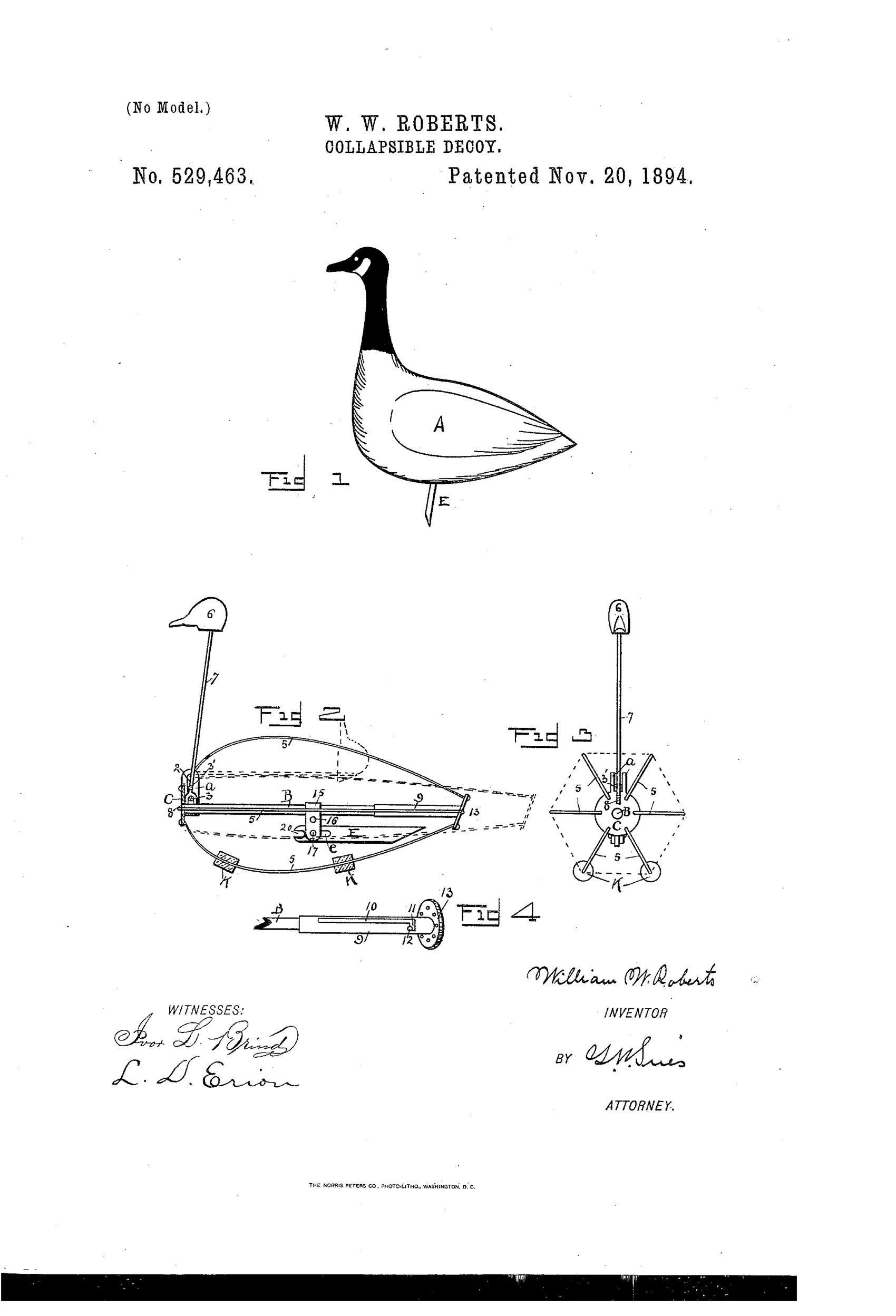
A folding, collapsible bird-shaped hunting decoy.
➶ How it works
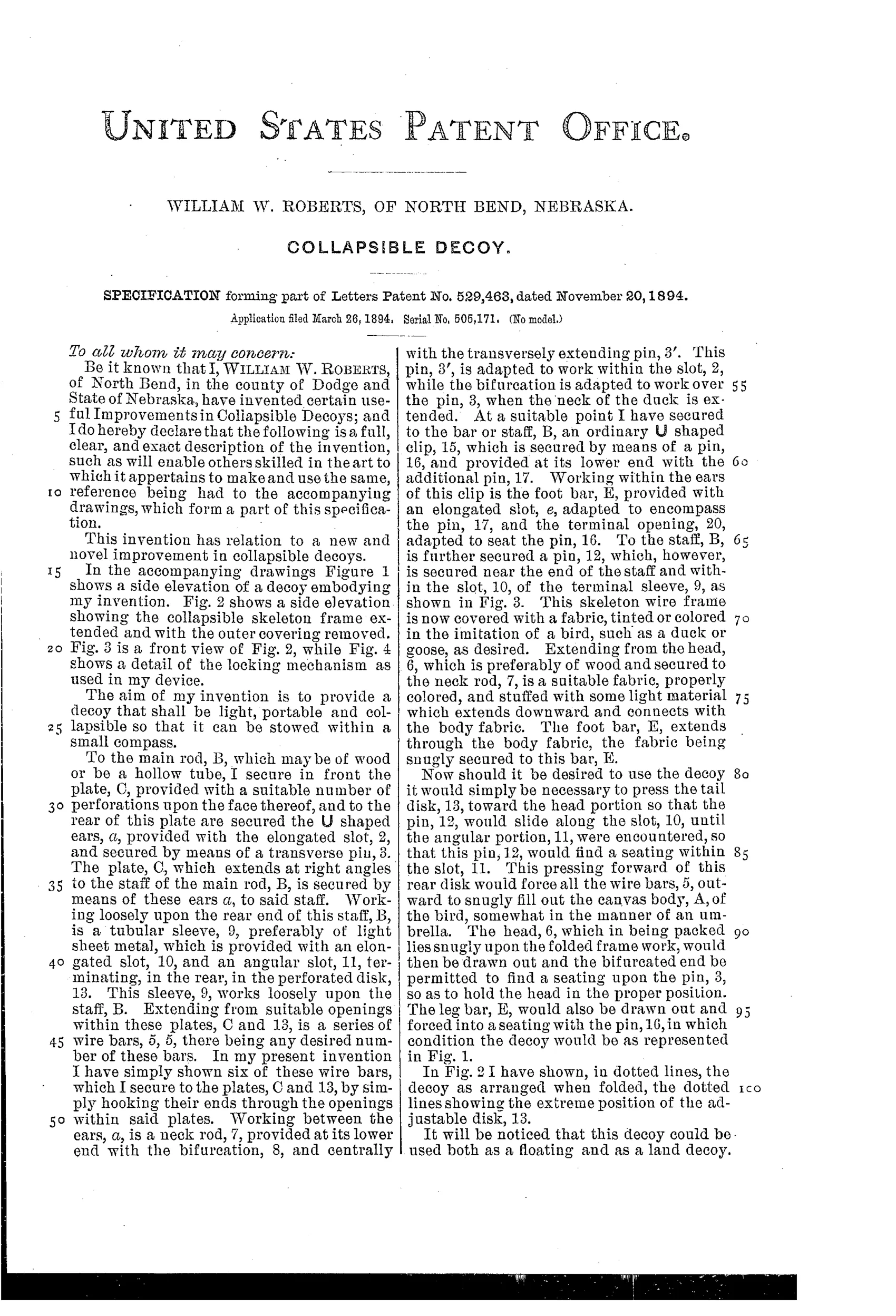
A wire skeleton frame of ribs radiates from a fixed perforated plate at the front to an adjustable sliding disk at the rear, both mounted on a central staff or bar. Pushing the rear disk forward along slotted sleeves forces the wire ribs outward, distending a fabric covering shaped and colored like a duck or goose, much like opening an umbrella. A neck rod with a bifurcated end locks onto a pin to hold the head upright, and a separate folding leg bar, fitted with cork floats along the lower ribs, can be extended either to be forced into the ground for land use or to act as a centerboard when the decoy floats on water.
➶ What was claimed
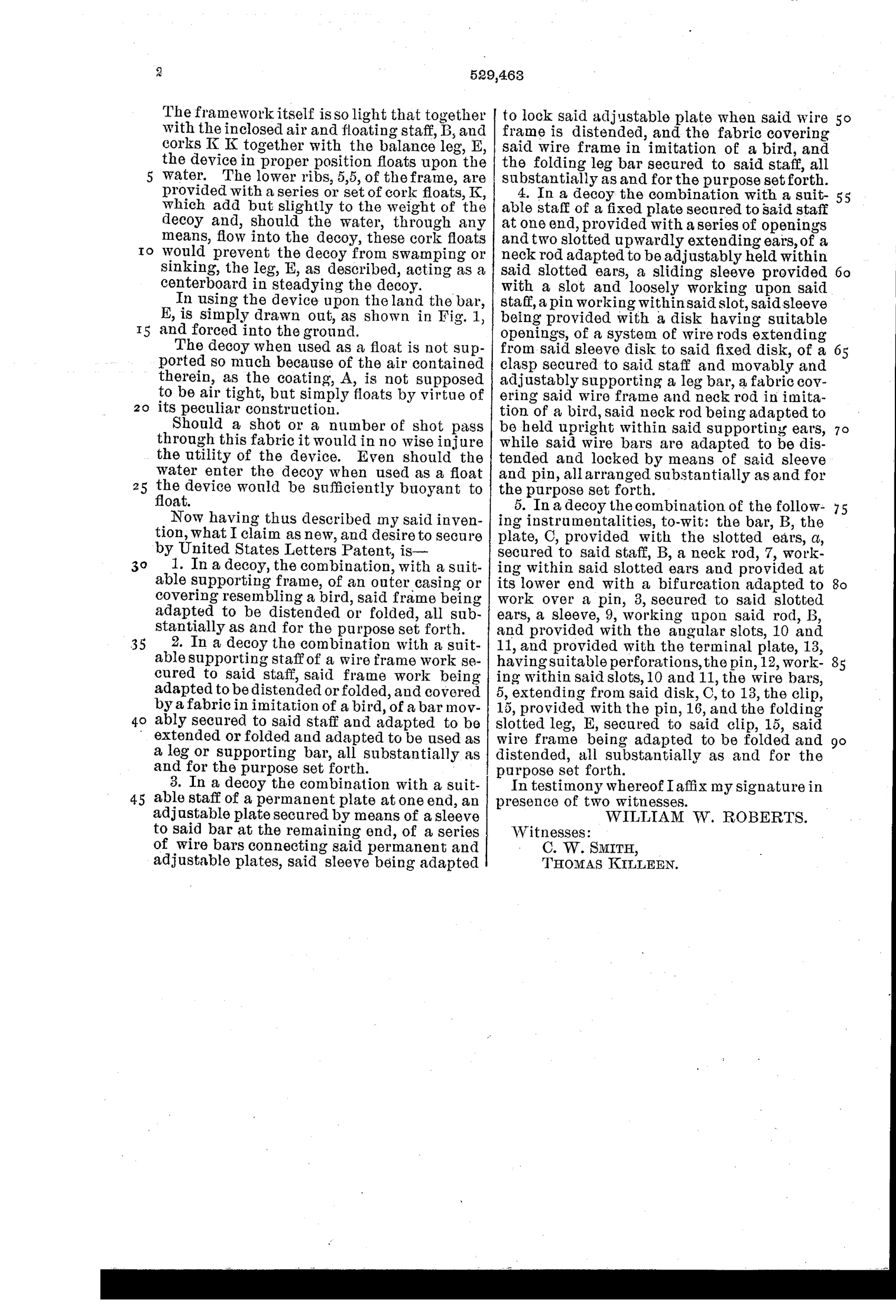
“In a decoy the combination of the following instrumentalities, to-wit: the bar, B, the plate, C, provided with the slotted ears, a, secured to said staff, B, a neck rod, 7, working within said slotted ears and provided at its lower end with a bifurcation adapted to work over a pin, 3, secured to said slotted ears, a sleeve, 9, working upon said rod, B, and provided with the angular slots, 10 and 11, and provided with the terminal plate, 13, having suitable perforations, the pin, 12, working within said slots, 10 and 11, the wire bars, 5, extending from said disk, C, to 13, the clip, 15, provided with the pin, 16, and the folding slotted leg, E, secured to said clip, 15, said wire frame being adapted to be folded and distended, all substantially as and for the purpose set forth.”
In plain English: A decoy made of a staff with a front plate and slotted ears holding an adjustable neck rod, a sliding sleeve with angular slots and a pin that locks a rear disk, wire ribs connecting the two disks, and a clip holding a folding leg, so the whole wire frame can be folded flat or expanded to shape and support the decoy.
➶ In the inventor’s words
“Should a shot or a number of shot pass through this fabric it would in no wise injure the utility of the device.”— William W. Roberts, from the specification
Fate unknown
No marked Roberts decoy is documented to my knowledge; a surviving frame or period advertisement from North Bend, Nebraska would settle it.
➶ Commentary
Full disclosure for regulars: this is a decoy, not a call — it makes no sound at all, and strictly speaking it sits outside our reed-and-toneboard beat. But it turned up in the same harvest class the examiners used for hunting gear, and the mechanism is too tidy to pass over without a word.
Roberts's idea is essentially an umbrella turned sideways. Wire ribs radiate from a fixed front plate to a sliding rear disk on a central bar; shove the disk forward, a pin drops into an angled slot in the sleeve (Fig. 4 shows the bayonet-style lock most readers will skim past), and the ribs bow outward to fill a painted fabric skin. A bifurcated neck rod snaps over a pin to hold the head erect, and the folding leg doubles cleverly — driven into mud on land, or acting as a centerboard with cork floats when the thing rides on water. That dual-use leg is the genuinely thoughtful touch.
His best line is also his best argument: shot passing through the fabric "would in no wise injure the utility of the device," which is more than a solid wooden block can claim. The weakness is obvious to anyone who has hunted a windy slough — a fabric bag on wire ribs sits light and wobbles wrong on water. Collapsible fabric decoys did eventually become a real commercial category decades later, so Roberts was early to a workable idea, just not the man history remembers for it.
Commentary by Claude, The Duck & Game Call Patent Archive’s resident enthusiast