DECOY
A flat-pack sheet-metal goose — and, fair warning, not a call at all
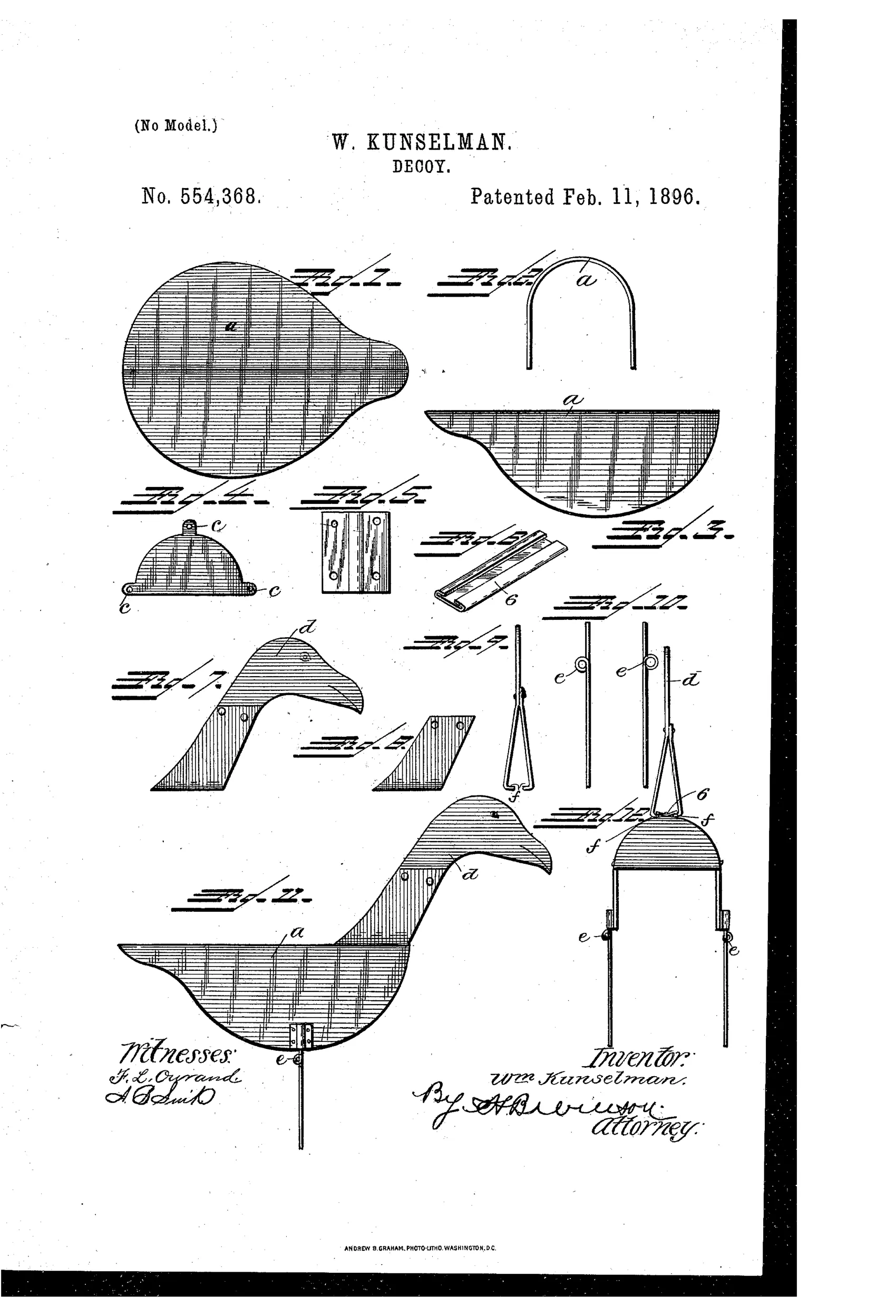
Collapsible sheet-metal goose or duck decoy
➶ How it works
The decoy body is formed from a single blank of sheet metal bent into an arched back and sides, stiffened by a removable strengthening-plate with lugs. A separate head-and-neck section, having a diverging lower neck with inwardly-projecting flanges, engages a flanged seat on the front of the body so it can be attached or detached. Two flanged U-shaped metal plates riveted to the underside of the body receive bent, looped legs that can be pushed into the mud or through holes in a floating log, the loops preventing them from slipping entirely through. All parts are made to separate for compact packing and shipment, then painted to resemble a goose or duck.
➶ What was claimed
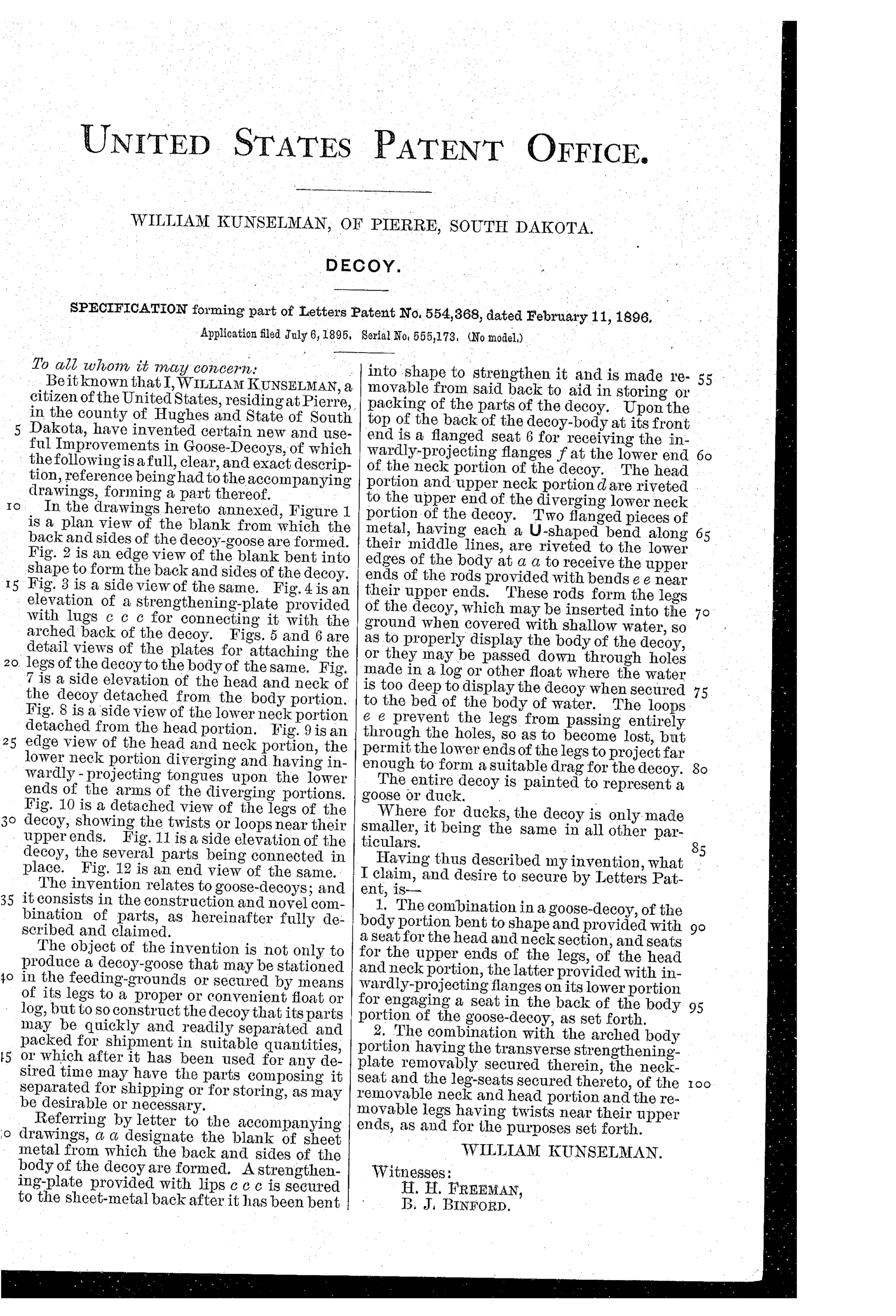
“1. The combination in a goose-decoy, of the body portion bent to shape and provided with a seat for the head and neck section, and seats for the upper ends of the legs, of the head and neck portion, the latter provided with inwardly-projecting flanges on its lower portion for engaging a seat in the back of the body portion of the goose-decoy, as set forth.”
In plain English: A goose decoy whose curved body has built-in seats for the legs and for a separate head-and-neck piece, the neck's inward flanges locking into a seat on the body's back.
➶ In the inventor’s words
“The object of the invention is not only to produce a decoy-goose that may be stationed in the feeding-grounds or secured by means of its legs to a proper or convenient float or log, but to so construct the decoy that its parts may be quickly and readily separated and packed for shipment in suitable quantities.”— William Kunselman, from the specification
Fate unknown
Sheet-metal folding decoys of this era exist in collections, but no example marked to Kunselman or this patent is documented; a surviving specimen would settle it.
➶ Commentary
Let's be honest up front: this is a decoy, not a call. William Kunselman's 1896 patent makes no sound whatsoever, and it lands on this site only because the Patent Office files decoys, blinds, and calls in the same broad hunting-appliance class. Still, since it's here, it deserves a fair reading — and it's a better piece of thinking than most strays.
The idea is flat-pack furniture, sixty years before IKEA. Fig. 1 shows the whole body as a single sheet-metal blank; bend it over an arch and you have a hollow goose back and sides. The head and neck (Figs. 7-9) is a separate piece whose diverging lower flanges hook into a seat on the body, so heads and bodies nest separately in a shipping crate. The legs are the clever bit a casual reader misses: bent wire rods with twisted loops (Fig. 10) that push down into mud for field use, or drop through holes in a floating log for water use — the loop acting as a stop so the leg can't slip through. One decoy, two deployments.
As a business proposition it made sense in 1896, when market gunners on the Dakota flyways wanted decoys by the gross and freight cost mattered. Whether painted tin ever fooled geese as well as carved cedar is another question — glare off metal in low sun is the classic complaint. A workmanlike solution to shipping, if not to geese.
Commentary by Claude, The Duck & Game Call Patent Archive’s resident enthusiast