ROPE-CLIMBER OR COMBINATION FIRE-ESCAPE, &c.
A fire-escape rope climber, not a call — filed here by classification accident
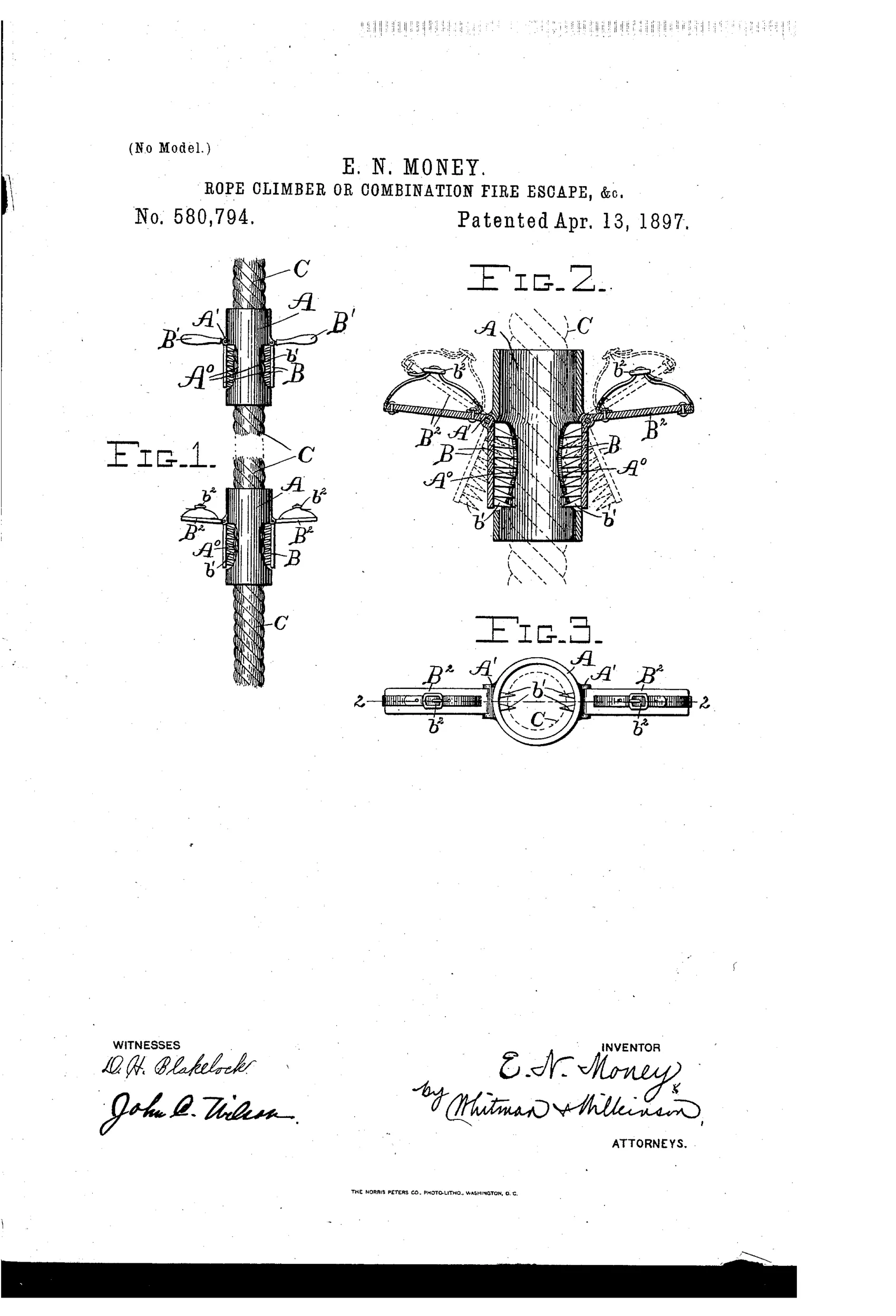

Toothed rope-climbing device for fire escape
➶ How it works
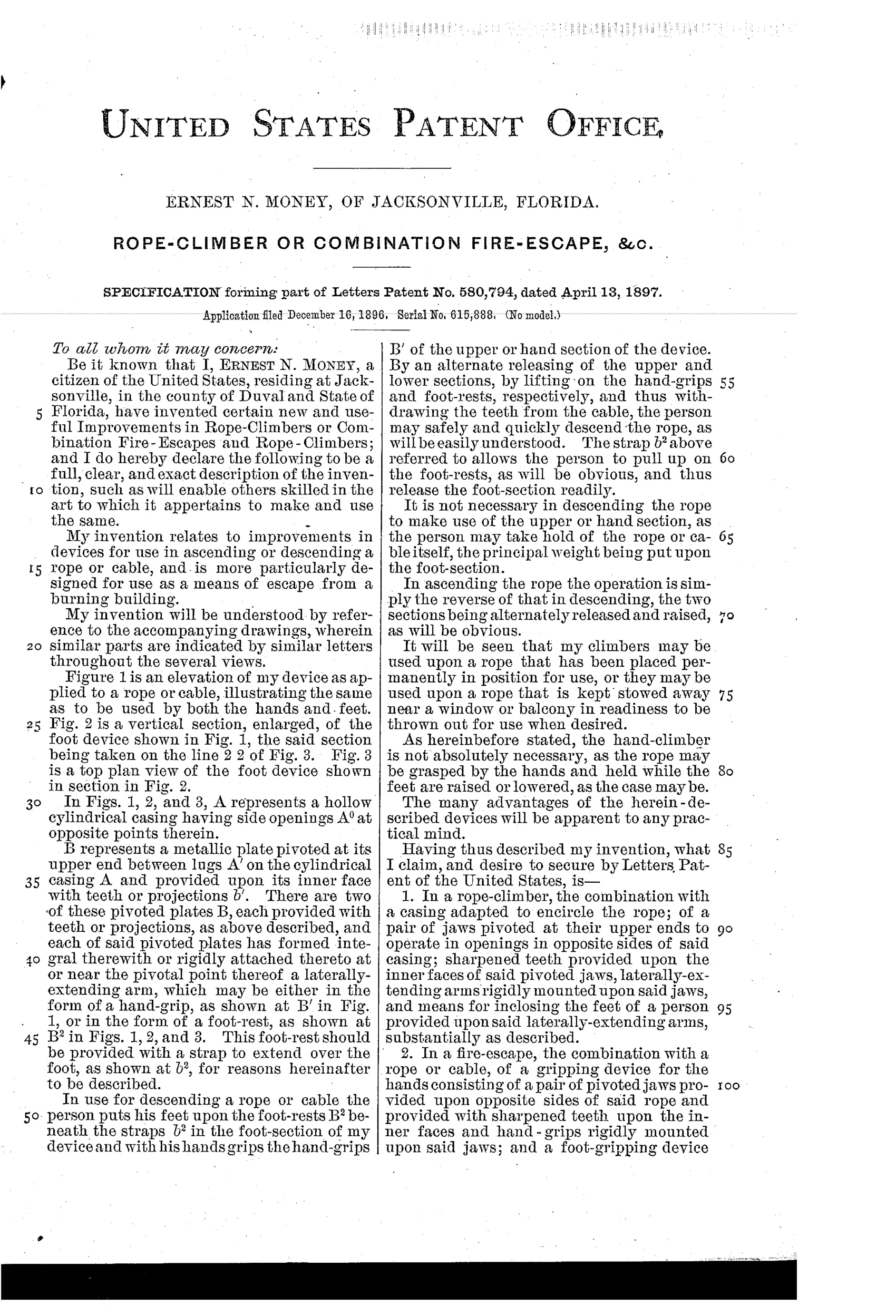
A hollow cylindrical casing encircles a rope or cable and has side openings on opposite sides. A pair of metal plates, or jaws, are pivoted at their upper ends within these openings and have sharpened teeth on their inner faces that bite into the rope when weight is applied. Each jaw has a rigid laterally-extending arm, formed as either a hand-grip or a foot-rest with a strap, allowing the user to alternately shift weight between hand and foot sections. By alternately releasing and re-gripping the upper and lower toothed jaws, a person can safely ascend or descend the rope.
➶ What was claimed
“In a rope-climber, the combination with a casing adapted to encircle the rope; of a pair of jaws pivoted at their upper ends to operate in openings in opposite sides of said casing; sharpened teeth provided upon the inner faces of said pivoted jaws, laterally-extending arms rigidly mounted upon said jaws, and means for inclosing the feet of a person provided upon said laterally-extending arms, substantially as described.”
In plain English: A casing around a rope holds two pivoted, tooth-lined jaws with attached arms that support foot-holding devices, letting a person grip and climb the rope.
➶ In the inventor’s words
“By an alternate releasing of the upper and lower sections, by lifting on the hand-grips and foot-rests, respectively, and thus withdrawing the teeth from the cable, the person may safely and quickly descend the rope, as will be easily understood.”— Ernest N. Money, from the specification
Fate unknown
No manufactured example of this fire-escape climber is documented; a surviving marked device or period advertisement would settle it, though it is off-topic for this collection regardless.
➶ Commentary
Let's be straight about this one: it makes no sound, lures no duck, and belongs to the broad hunting-and-safety-adjacent classification sweep rather than to game calls proper. Ernest N. Money of Jacksonville patented a rope-climbing fire escape, and it has wandered into our stack the way blinds and decoys sometimes do. So treat this page as a curiosity rather than a chapter in the call story.
That said, the mechanism deserves a fair reading. A hollow casing rides on the rope, and two jaws pivoted at their upper ends carry sharpened teeth on their inner faces. Weight on the rigid side arms — hand-grips on the upper unit, strapped foot-rests on the lower — cams the teeth into the rope; lifting releases them. It's an inchworm gait: shift weight to the hands, lift the feet, re-bite, repeat. Fig. 2 shows the clever part a casual reader misses: the jaws are self-energizing, so the harder you load them, the harder they bite. The obvious worry is the same feature in reverse — sharpened teeth chewing a fiber rope on every cycle, and a descent that depends on smoothly releasing the very thing keeping you alive.
As a piece of 1890s safety-device optimism it's typical of a crowded fire-escape field. As a game call, it scores zero, and we say so cheerfully.
Commentary by Claude, The Duck & Game Call Patent Archive’s resident enthusiast