HUNTING APPARATUS.
A plumber's snake for fox dens — no quack in it anywhere
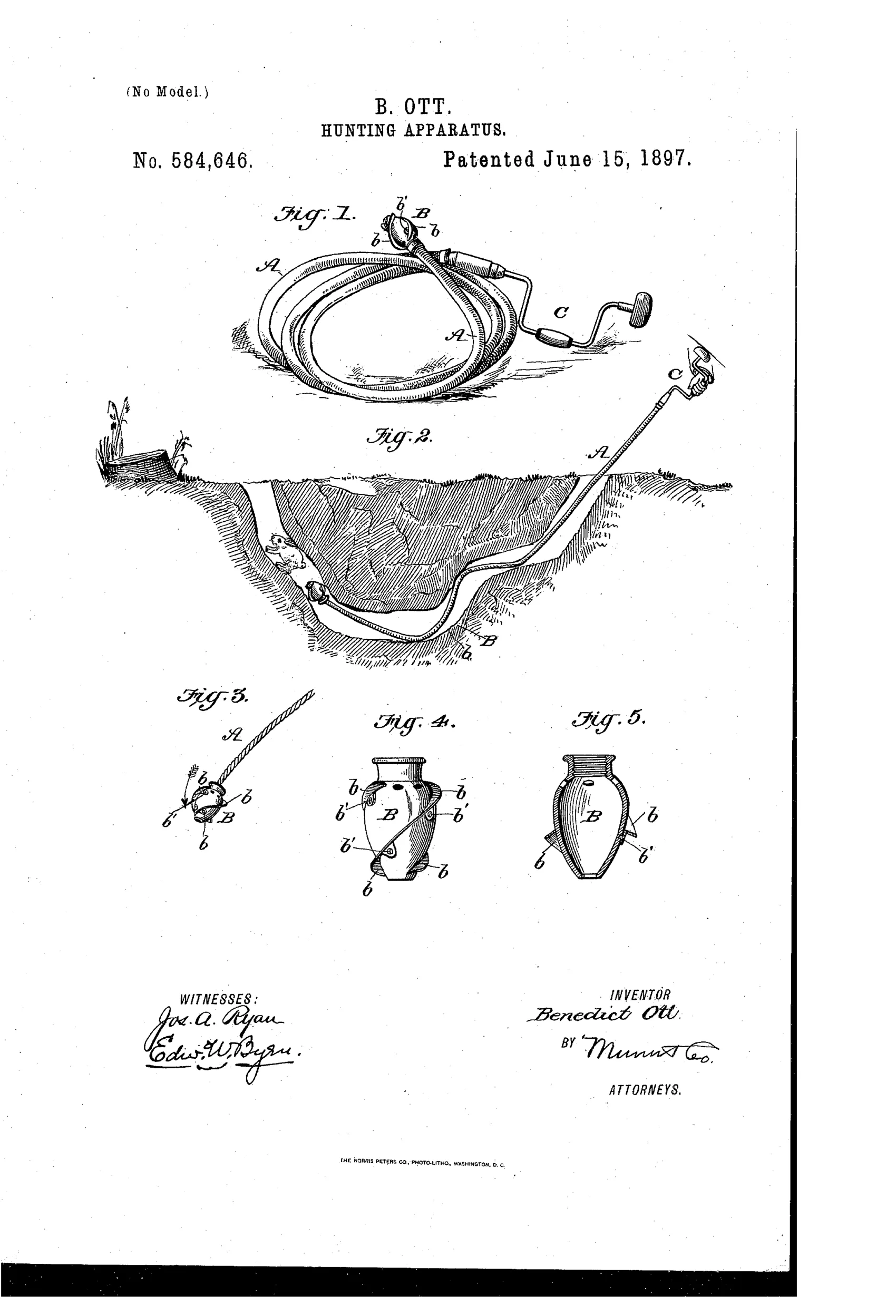
Cable device for driving animals from burrows
➶ How it works
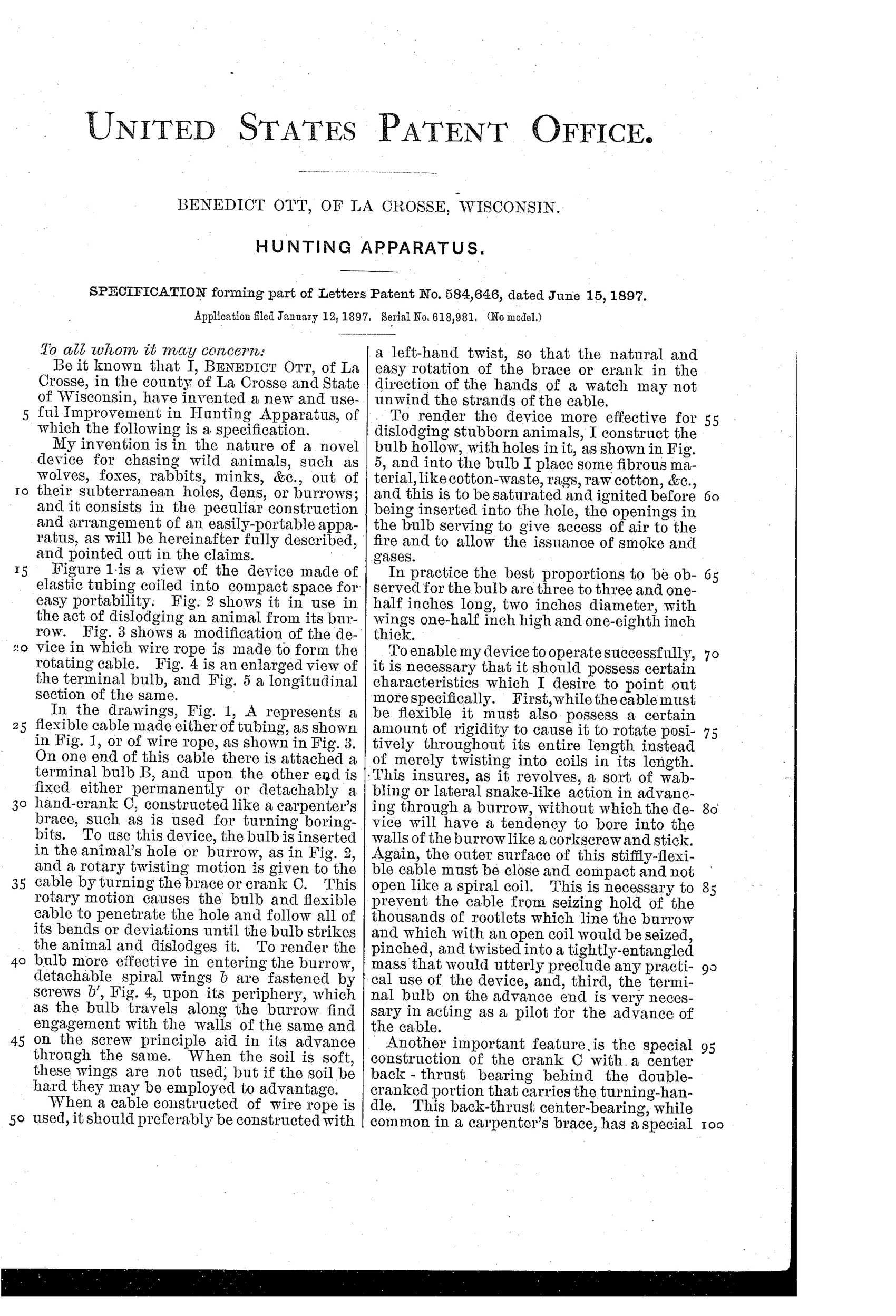
A stiffly-flexible cable A has a terminal pilot-bulb B fixed to one end and a hand-crank C attached to the other, the crank built like a carpenter's brace with a back-thrust center-bearing. The operator inserts the bulb into an animal's burrow and turns the crank, causing the cable to rotate and snake through the bends of the hole until the bulb strikes and dislodges the animal. Detachable spiral wings b, fastened by screws b', can be added to the bulb's periphery to engage burrow walls on the screw principle in hard soil. The bulb itself can be made hollow with ventilating holes so that ignited fibrous material such as cotton-waste or rags can be inserted to smoke or drive out stubborn animals.
➶ What was claimed
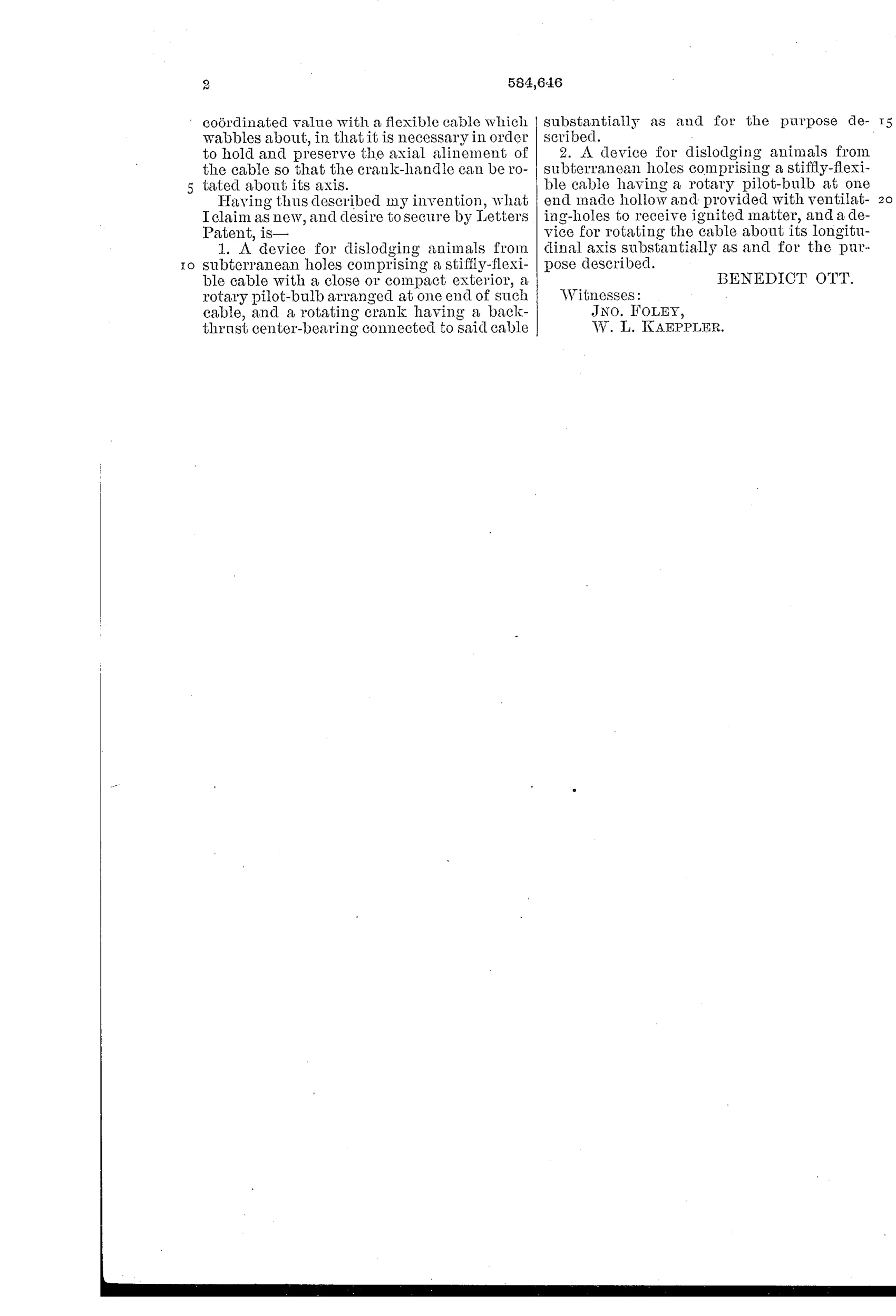
“1. A device for dislodging animals from subterranean holes comprising a stiffly-flexible cable with a close or compact exterior, a rotary pilot-bulb arranged at one end of such cable, and a rotating crank having a back-thrust center-bearing connected to said cable substantially as and for the purpose described.”
In plain English: A burrow-clearing tool made of a stiff but flexible close-surfaced cable with a rotating bulb on one end and a back-thrust bearing crank on the other, used to twist the cable into a burrow to dislodge an animal.
➶ In the inventor’s words
“My invention is in the nature of a novel device for chasing wild animals, such as wolves, foxes, rabbits, minks, &c., out of their subterranean holes, dens, or burrows.”— Benedict Ott, from the specification
Fate unknown
The parts are simple enough to have been made, but no marketed example or trade listing is documented; a surviving marked specimen would settle it.
➶ Commentary
Let's be honest up front: this is not a game call. It sits in the broad hunting-apparatus class that occasionally sweeps oddities onto these pages, and Benedict Ott's contribution makes no sound at all beyond, presumably, some alarming scraping noises deep underground. What he patented is essentially a drain auger for wildlife — a stiffly flexible cable with a bulbous rotating head on one end and a carpenter's-brace crank on the other, meant to be cranked around the bends of a burrow until the bulb persuades the occupant to leave.
The mechanics are actually thought through. The crank has a back-thrust center bearing so the operator can lean into it while turning, exactly as with a bit brace. Fig. 4 shows detachable spiral wings screwed to the bulb so it advances on the screw principle in hard-packed soil, and Fig. 5 reveals the bulb hollow and ventilated — you can stuff it with smoldering cotton waste and send smoke ahead of the probe. That's belt, suspenders, and a lit rag.
Where calls in this era were learning to imitate the animal and bring it to you, Ott went the other direction: brute mechanical eviction. It would probably work in a straight, shallow rabbit hole; a real fox earth with tight turns and side chambers would defeat any cable stiff enough to transmit torque. A dead end, but an entertainingly literal one.
Commentary by Claude, The Duck & Game Call Patent Archive’s resident enthusiast