CHAIR
Not a call at all: an 1899 tilting office chair filed under our roof
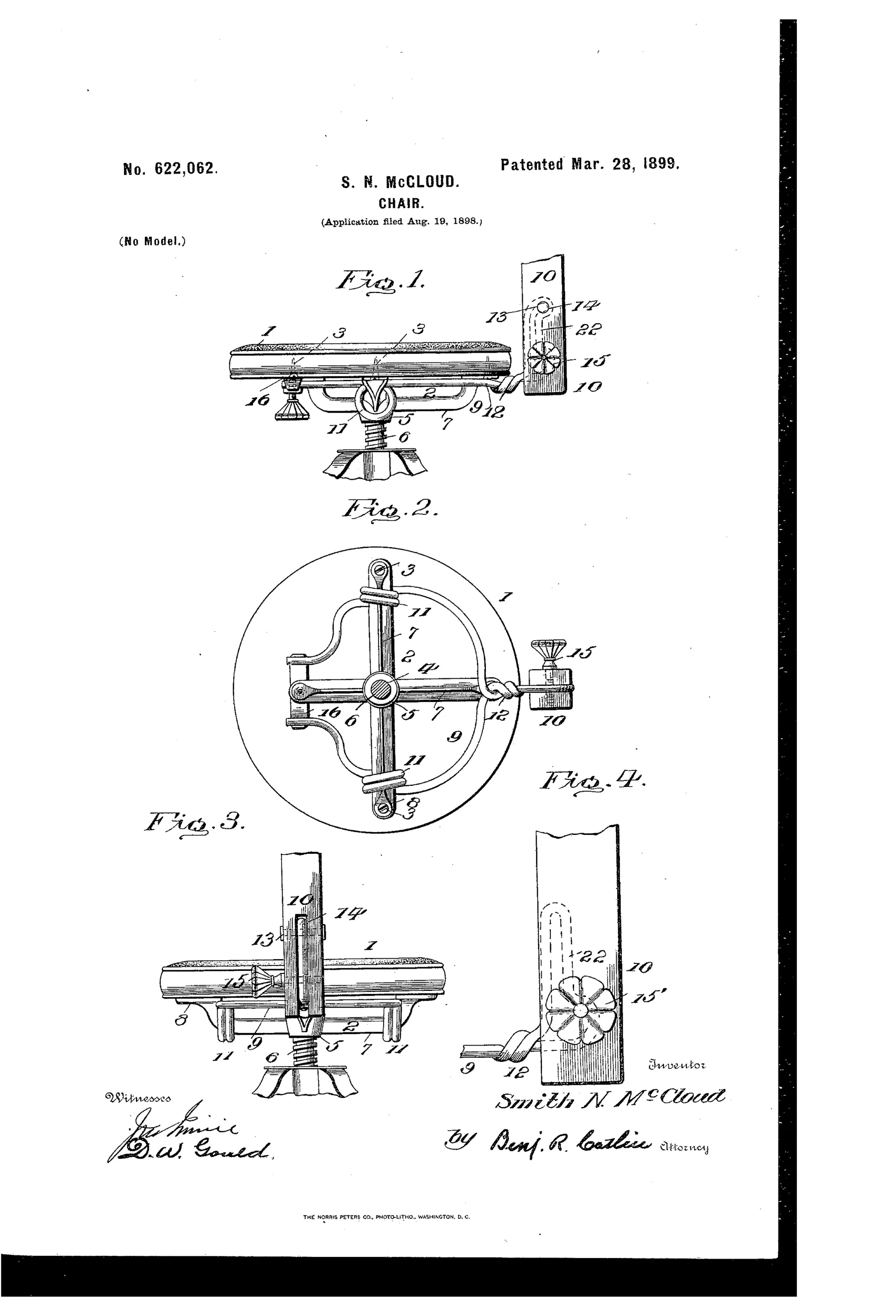
Tilting chair-back spring mounting mechanism
➶ How it works
A wire spring with two limbs coils around the arms of a spider-frame beneath the seat and extends backward, twisting together into a loop that engages a forked standard supporting the chair back. A pivot bolt passes through the forked standard and the spring loop, allowing the back to tilt independently of the seat, while a set-screw compresses the fork members onto the loop to fix the tilt angle. A separate adjusting bar and set-screw at the front ends of the spring vary the spring's tension, controlling the resistance of the tilting back.
➶ What was claimed
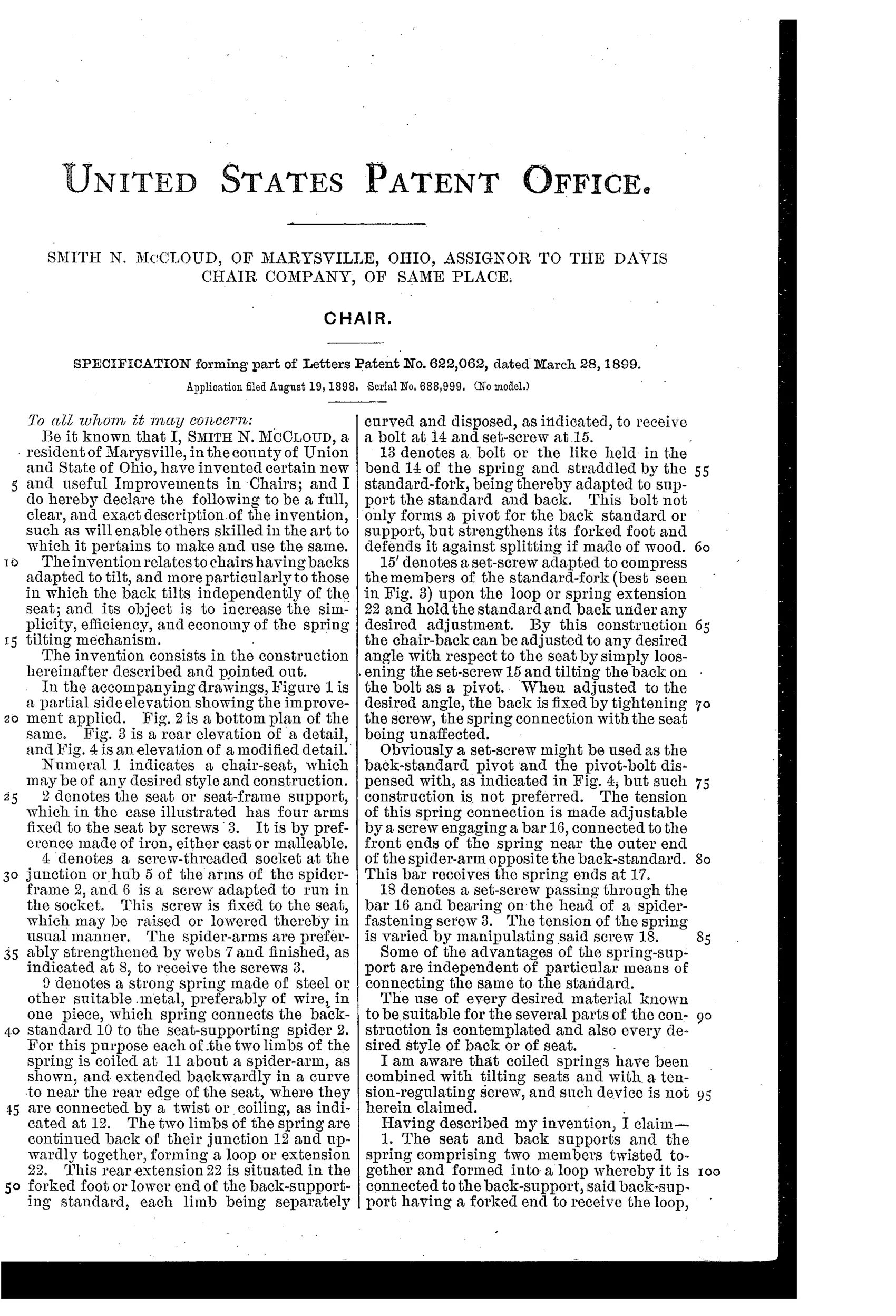
“The seat and back supports and the spring comprising two members twisted together and formed into a loop whereby it is connected to the back-support, said back-support having a forked end to receive the loop, and a set-screw to compress the fork members upon the loop, substantially as described.”
In plain English: A chair where the seat and back are joined by a two-part twisted wire spring forming a loop that fits into a forked back support, held in place by a set-screw that clamps the fork onto the loop.
➶ In the inventor’s words
“I am aware that coiled springs have been combined with tilting seats and with a tension-regulating screw, and such device is not herein claimed.”— Smith N. McCloud, from the specification
Fate unknown
Assignment to the Davis Chair Company suggests intent to manufacture, but I can't confirm production of this specific mechanism — and either way it's outside the game-call category.
➶ Commentary
Let's be straight about this one: it is a chair. Patent 622,062 covers a spring mounting for a tilting chair back, assigned to the Davis Chair Company of Marysville, Ohio, and it has nothing to do with ducks, geese, turkeys, or anything else you'd whisper at from a blind. It likely landed in our stack because broad hunting-and-furniture classification sweeps are messy things; our harvest class already drags in blinds and scent bottles, and occasionally something wanders in from further afield still.
That said, since it's here, McCloud's mechanism is a tidy bit of wire-forming. The spring isn't a separate coil bolted between seat and back — it's a single two-limb wire that coils around the arms of the spider-frame under the seat, then twists together into a loop that becomes the pivot for the forked back-standard. The spring is the hinge. A set-screw clamps the fork onto the loop to lock the tilt, and a front adjusting bar varies tension. His own disclaimer is telling: coiled springs with tension screws were old news by 1899, so his claim rests narrowly on the twisted-loop-in-fork detail.
For our purposes: off-topic, but a good reminder of how crowded and finely sliced the mechanical patent landscape was in the 1890s — chair-tilt hardware was as contested a field as duck-call reeds would become.
Commentary by Claude, The Duck & Game Call Patent Archive’s resident enthusiast