FOLDING DECOY-DUCK
A sheet-iron duck that folds flat, flips species, and isn't a call at all
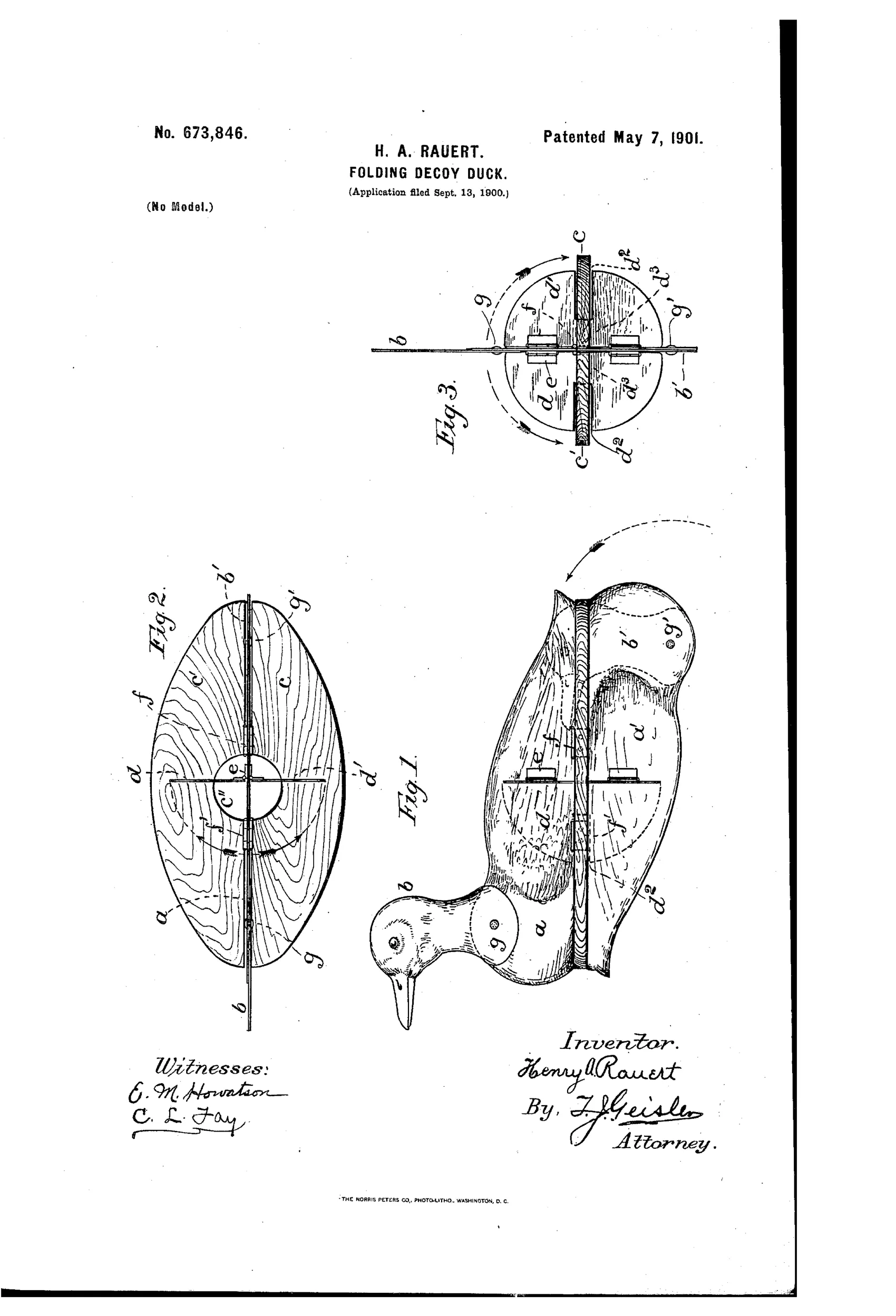
Collapsible sheet-iron decoy duck body
➶ How it works
The body is formed of sheet iron shaped to represent two opposed duck halves, with heads and necks pivoted by rivets so either head can fold under. Two floats are hinged to the sides of the body and fold flat against it for storage, then swing down to act as stabilizing wings when in use. Two semi-round wings are hinged vertically at the body's center and have slots that let them extend laterally over the floats, locking them in place against water pressure. Because the slot openings are offset from the hinge pivot points, extending the wings causes them to bind against the floats, securely holding the whole assembly rigid when set up.
➶ What was claimed
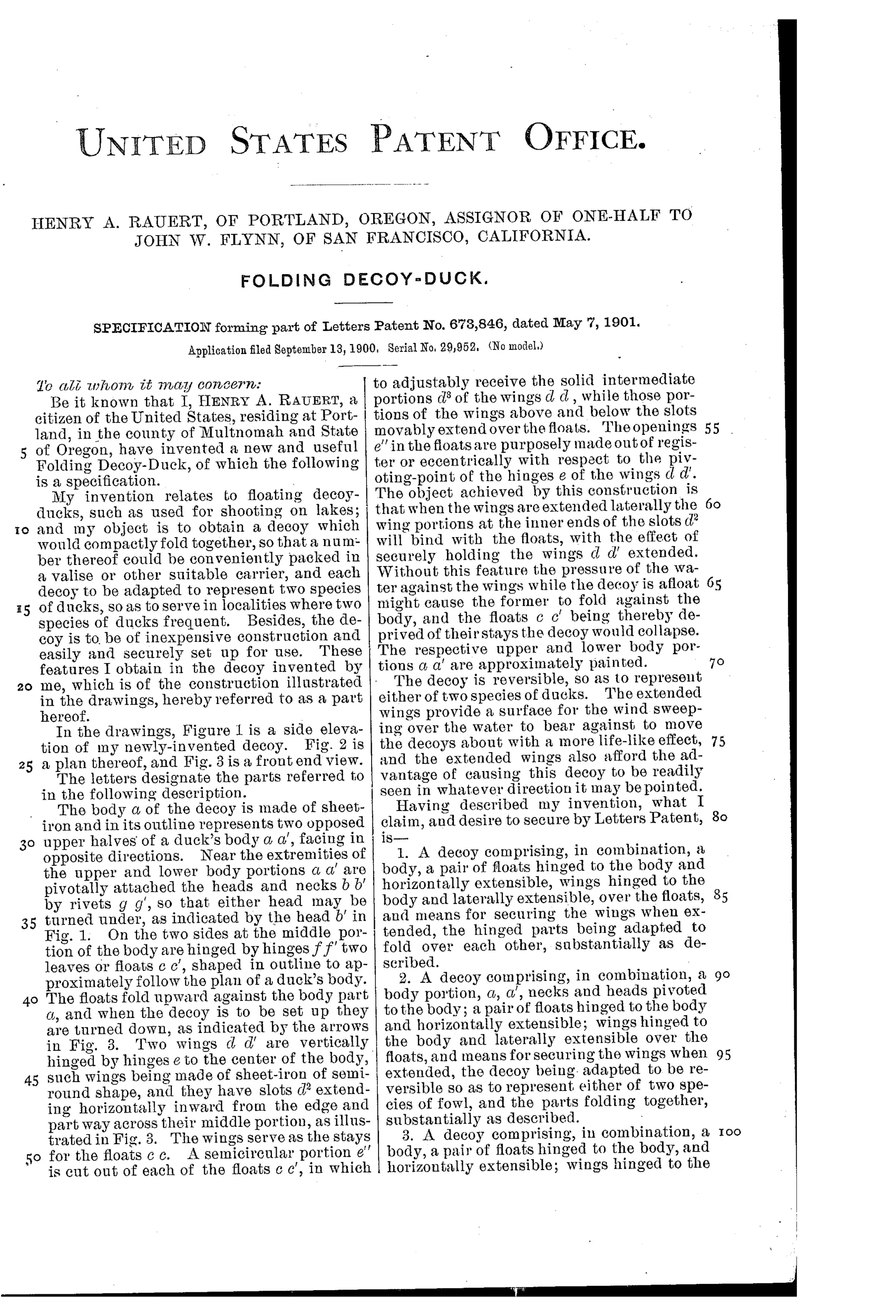
“A decoy comprising, in combination, a body, a pair of floats hinged to the body and horizontally extensible, wings hinged to the body and laterally extensible, over the floats, and means for securing the wings when extended, the hinged parts being adapted to fold over each other, substantially as described.”
In plain English: The decoy consists of a body with hinged floats that extend outward and hinged wings that extend over the floats and lock them in place, with all parts able to fold flat for storage.
➶ In the inventor’s words
“my object is to obtain a decoy which would compactly fold together, so that a number thereof could be conveniently packed in a valise or other suitable carrier, and each decoy to be adapted to represent two species of ducks, so as to serve in localities where two species of ducks frequent.”— Henry A. Rauert, from the specification
Fate unknown
No manufactured example of this folding sheet-iron decoy is documented; a surviving marked specimen or period advertisement would settle it.
➶ Commentary
Let's be upfront: this is a decoy, not a call. Rauert's patent makes no sound whatsoever — it sits in the broad hunting-gear class alongside blinds and scent pads, so strictly speaking it's a neighbor to our category, not a resident. But it's a delightful neighbor, so let's look at it anyway.
The mechanical idea is genuinely tidy. The body is two opposed sheet-iron duck profiles with pivoted heads, so either head can fold under — Rauert says outright the goal is one decoy that 'represents two species of ducks.' Paint a mallard on one side, a pintail or canvasback on the other, and flip. The floats hinge flat for packing, and the clever bit is in Fig. 3: the semi-round wings that swing out over the floats have slots offset from the hinge pivots, so extending them binds the assembly rigid against wave action. That's a real locking geometry, not just a latch.
The pitch — a valise full of flat decoys — was a live problem in 1900, and folding-decoy patents were a small cottage genre. The weak point is the material: sheet iron on saltwater or marsh acid rusts fast, and a flat silhouette from most angles is a worse decoy than a cheap solid-cedar block. Wooden decoys stayed dominant for good reason. This one reads as an earnest dead end, but the offset-slot lock deserves the second look.
Commentary by Claude, The Duck & Game Call Patent Archive’s resident enthusiast