DECOY-DUCK
A decoy, not a call — but the pendulum-necked head earns its detour
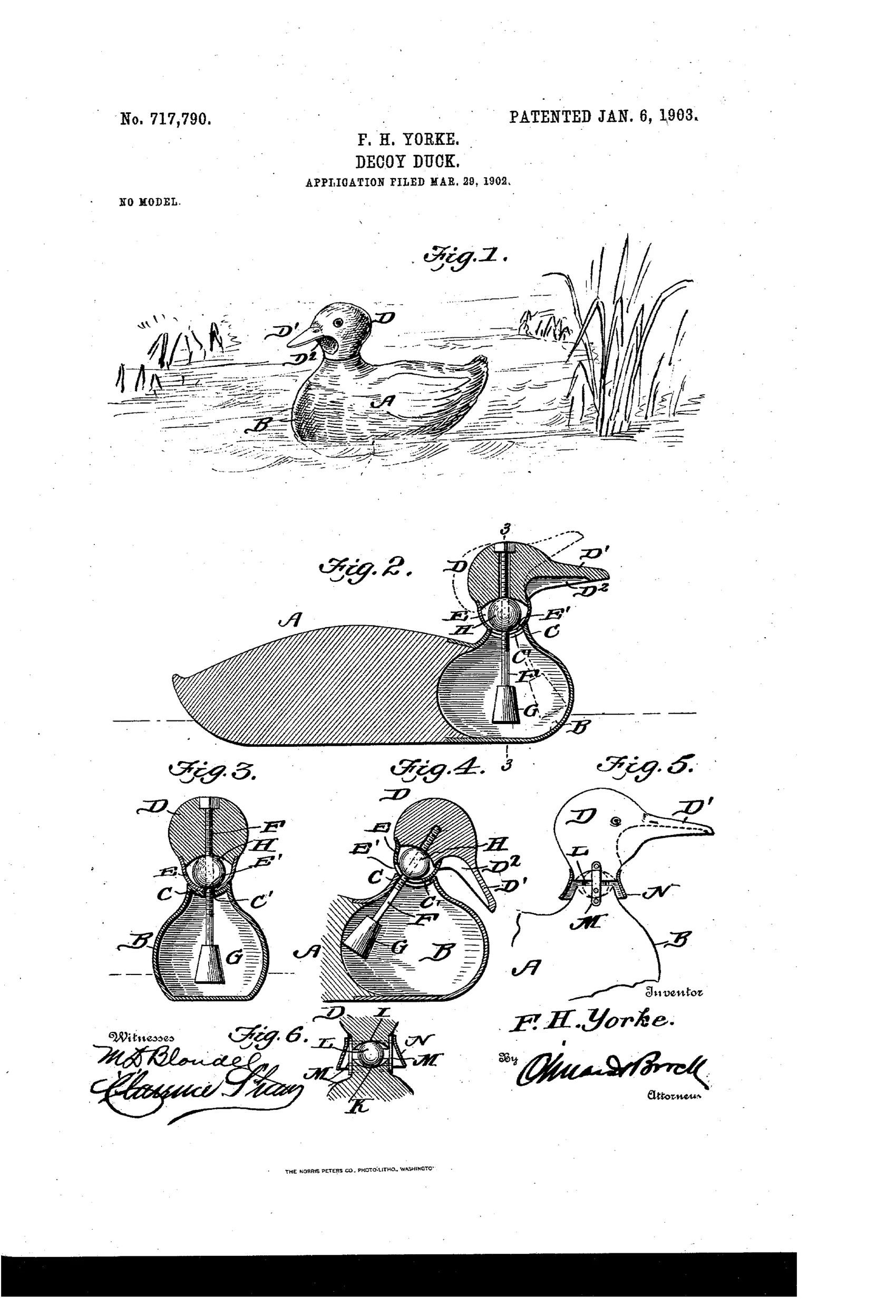
Decoy duck with rocking, nodding head
➶ How it works
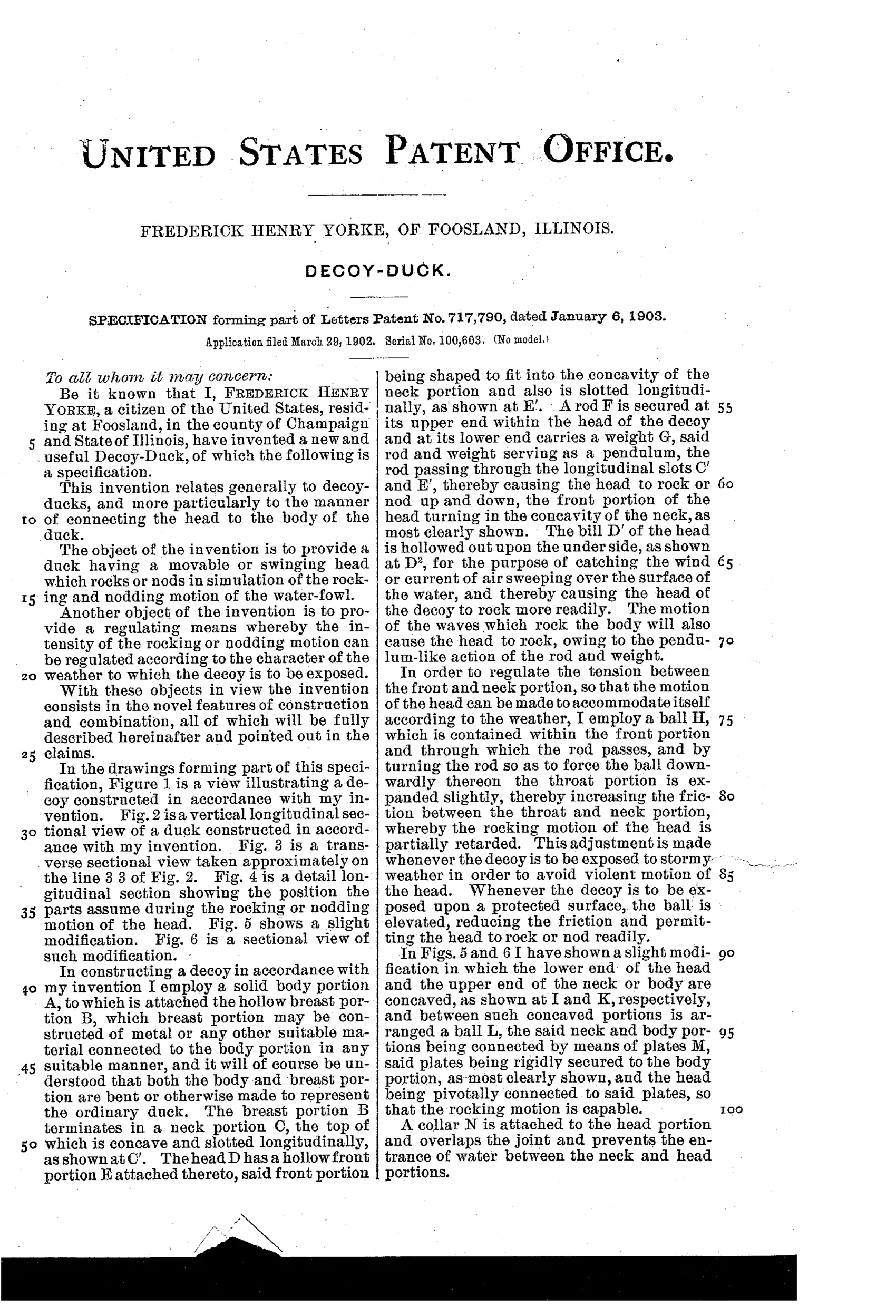
A solid body carries a hollow breast portion terminating in a slotted, concave neck. The head has a hollow front portion fitted into that concavity, with a weighted rod secured inside the head and passing down through the neck slots so the weight acts like a pendulum, causing the head to rock and nod as waves move the body. The bill's underside is hollowed to catch wind, further encouraging head motion. A ball placed in the throat portion, adjusted by turning the threaded rod, increases or decreases friction between the head and neck to regulate how violently the head rocks depending on weather conditions.
➶ What was claimed
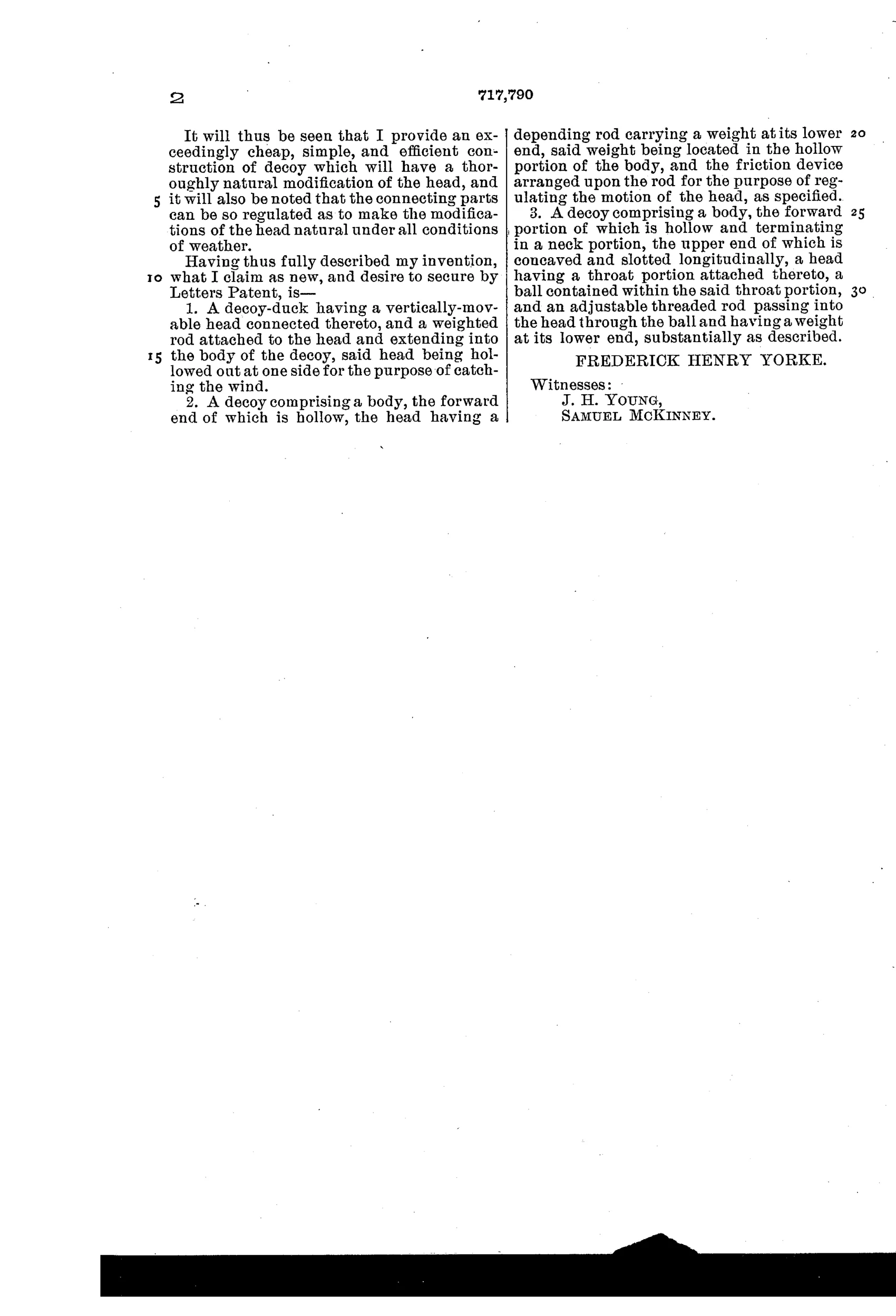
“A decoy comprising a body, the forward portion of which is hollow and terminating in a neck portion, the upper end of which is concaved and slotted longitudinally, a head having a throat portion attached thereto, a ball contained within the said throat portion, and an adjustable threaded rod passing into the head through the ball and having a weight at its lower end, substantially as described.”
In plain English: The decoy has a hollow-bodied neck with a slotted top, and a head with a threaded rod running through a ball and down to a weight, letting you adjust how loosely the head rocks.
➶ In the inventor’s words
“It will thus be seen that I provide an exceedingly cheap, simple, and efficient construction of decoy which will have a thoroughly natural modification of the head, and it will also be noted that the connecting parts can be so regulated as to make the modifications of the head natural under all conditions of weather.”— Frederick Henry Yorke, from the specification
Fate unknown
No documented examples of this pendulum-head decoy are known to me; a surviving specimen with the slotted neck and threaded rod would settle it.
➶ Commentary
Let's be upfront: this is a decoy, not a call, so it sits at the edge of our beat. The harvest class sweeps in all sorts of hunting gear, and most of it we pass over. But Yorke's rocking head is the kind of mechanism a call collector can appreciate, because it's chasing the same quarry by another route — a call fakes the sound of a live duck, and this fakes the motion.
The trick is all in Fig. 2. A threaded rod runs down from inside the head, through slots in the neck, to a pendulum weight hanging in the hollow breast. Every wave that tips the body swings the weight, and the weight nods the head. The bill's underside is hollowed to catch wind, so even a breeze on flat water stirs it. Best of all is the ball in the throat: turn the rod and you tighten or loosen the friction between head and neck, so on a rough day you can damp the motion down and on a calm day free it up. That's a genuinely thoughtful adjustment — most animated-decoy patents of the era just let the thing flail.
Whether hunters wanted a bobbing head badly enough to pay for slotted necks and threaded rods is another question. Bags of shot corn-anchored blocks were cheap, and a head that nods wrong reads as wrong to wary birds. Clever, honest work; probably a dead end commercially.
Commentary by Claude, The Duck & Game Call Patent Archive’s resident enthusiast