IMPROVEMENT IN DECOY-BIRDS.
A silent wing-flapper from 1868 — motion decoy, not a call at all
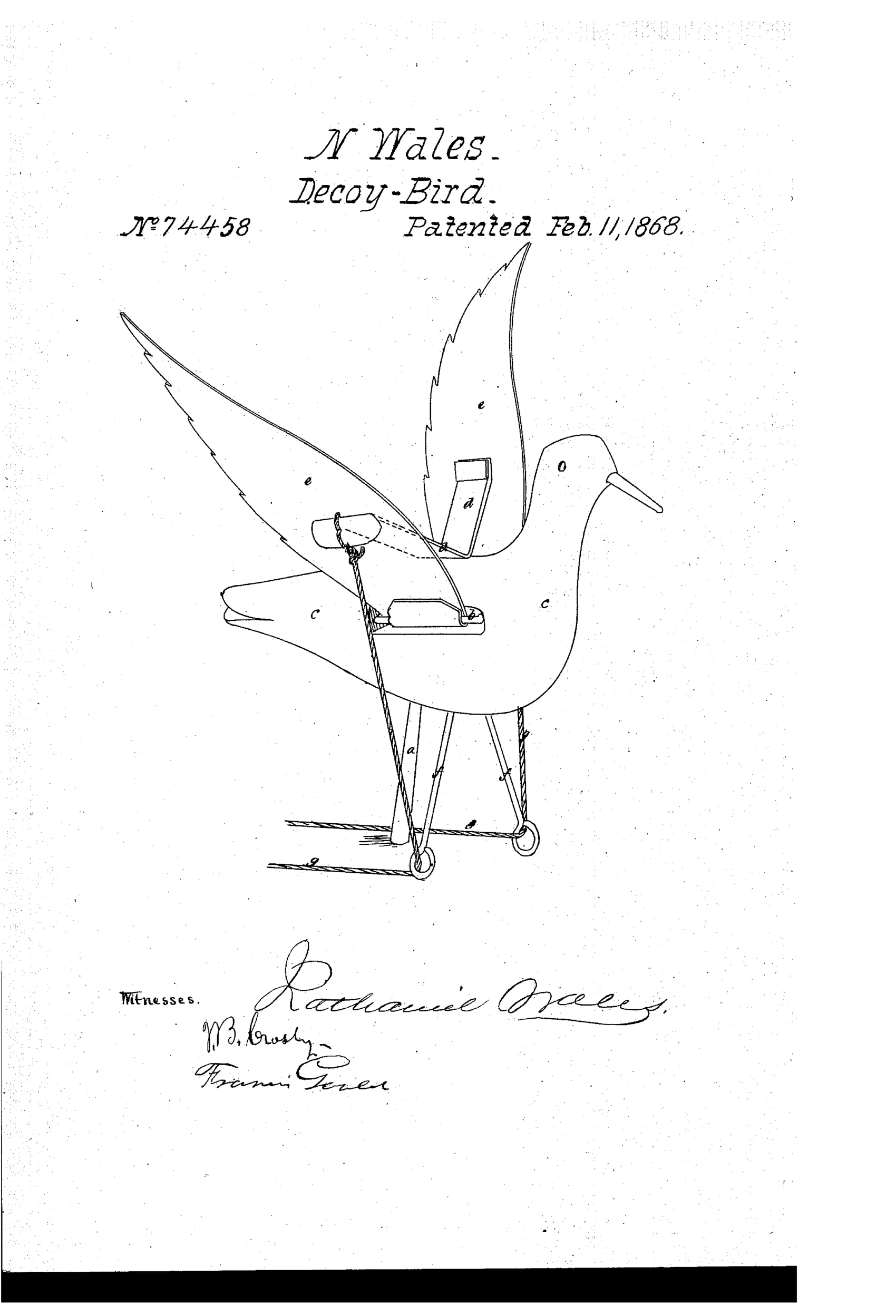
Decoy bird with gunner-operated moving wings
➶ How it works
The decoy body has wings pivoted to it, each fitted with a rubber spring that pulls the wing upward when slack. Strings run from each wing through leaders fixed in the body down to a peg or handle where the gunner stands. Pulling the strings draws the wings downward and stretches the springs; releasing the strings lets the springs contract and raise the wings again, mimicking a hovering or landing bird. Removable plugs or a twisting cylindrical plug allow the hinged wings to be detached or folded flat against the body for compact packing.
➶ What was claimed
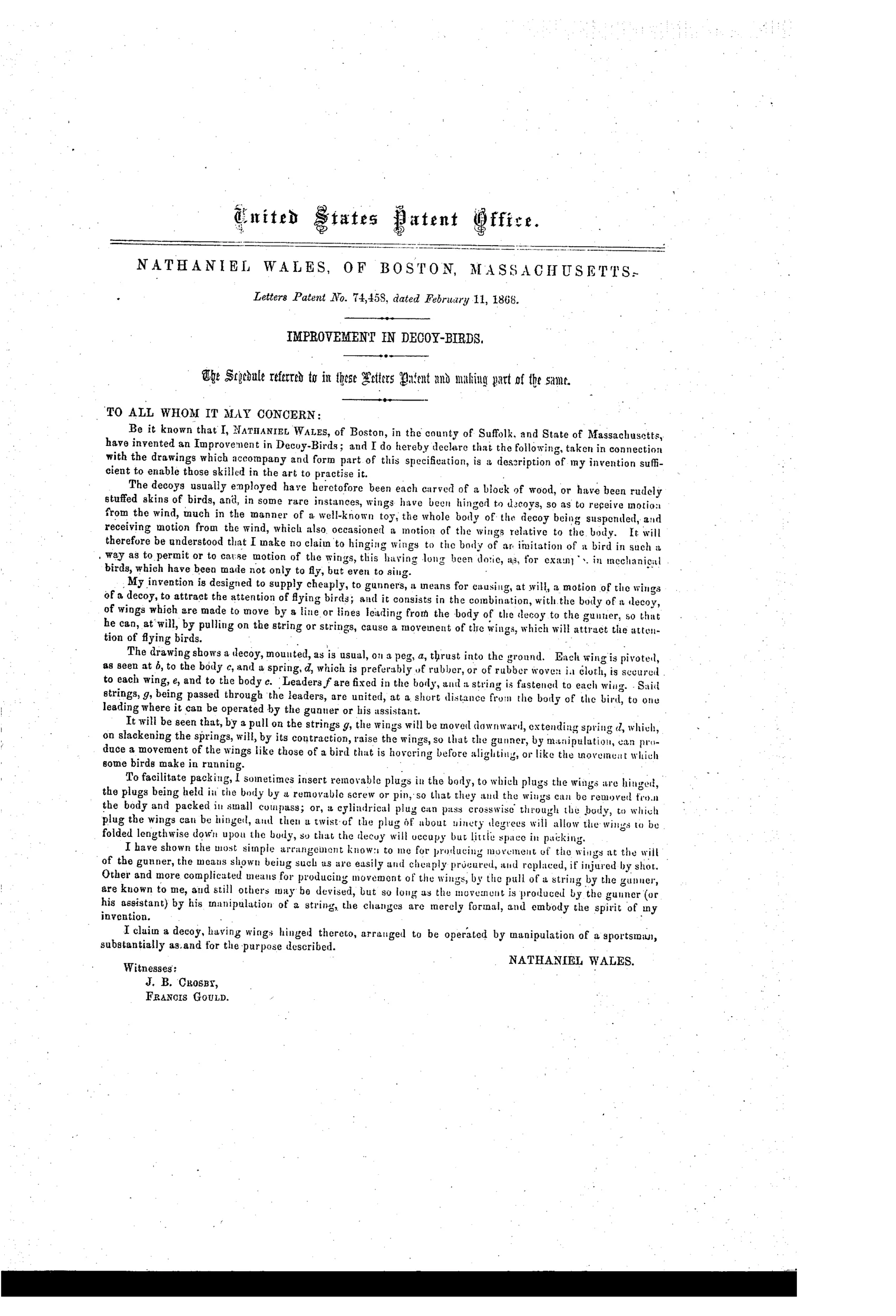
“I claim a decoy, having wings hinged thereto, arranged to be operated by manipulation of a sportsman, substantially as and for the purpose described.”
In plain English: The invention claims a decoy bird whose hinged wings can be moved by the hunter pulling a string, in the manner shown.
➶ In the inventor’s words
“My invention is designed to supply cheaply, to gunners, a means for causing, at will, a motion of the wings of a decoy, to attract the attention of flying birds.”— Nathaniel Wales, from the specification
Fate unknown
No manufactured example or advertisement is documented; a surviving specimen with the folding-wing plug would settle it.
➶ Commentary
Let's be upfront: this patent makes no sound. Nathaniel Wales of Boston built a shorebird decoy with wings hinged to the body, rubber springs pulling them up, and strings running down through the mounting peg to the hidden gunner. Pull the cord and the wings snap down; slack off and the rubber hauls them back up. It's a motion decoy — the great-great-grandfather of today's battery-powered spinning-wing rigs — and it sits in the broad hunting-gear class alongside our calls, which is how it wandered onto this shelf.
The drawing rewards a close look. The wings aren't crude paddles; they're feathered-edge silhouettes pivoted near the shoulder, and the little block labeled 'd' between them is the twisting plug that lets the whole wing assembly fold flat or come off for packing. Wales was clearly thinking about a market gunner's boat, where a decoy that won't stow is a decoy left home. The rubber-spring return is the clever economy: one string per wing does everything, since the spring handles the upstroke for free.
Does it work? Probably, in calm air and at shorebird ranges. Whether rubber of 1868 vintage survived salt water and cold is another matter. For our purposes it's context, not canon: two years before Elam Fisher's tongue-pincher opened the duck-call record, hunters were already patenting ways to lie to birds — just visually rather than audibly.
Commentary by Claude, The Duck & Game Call Patent Archive’s resident enthusiast