DECOY.
A duck decoy that folds flat like origami — off our beat, but irresistible
Foldable, collapsible duck decoy of stiff paper
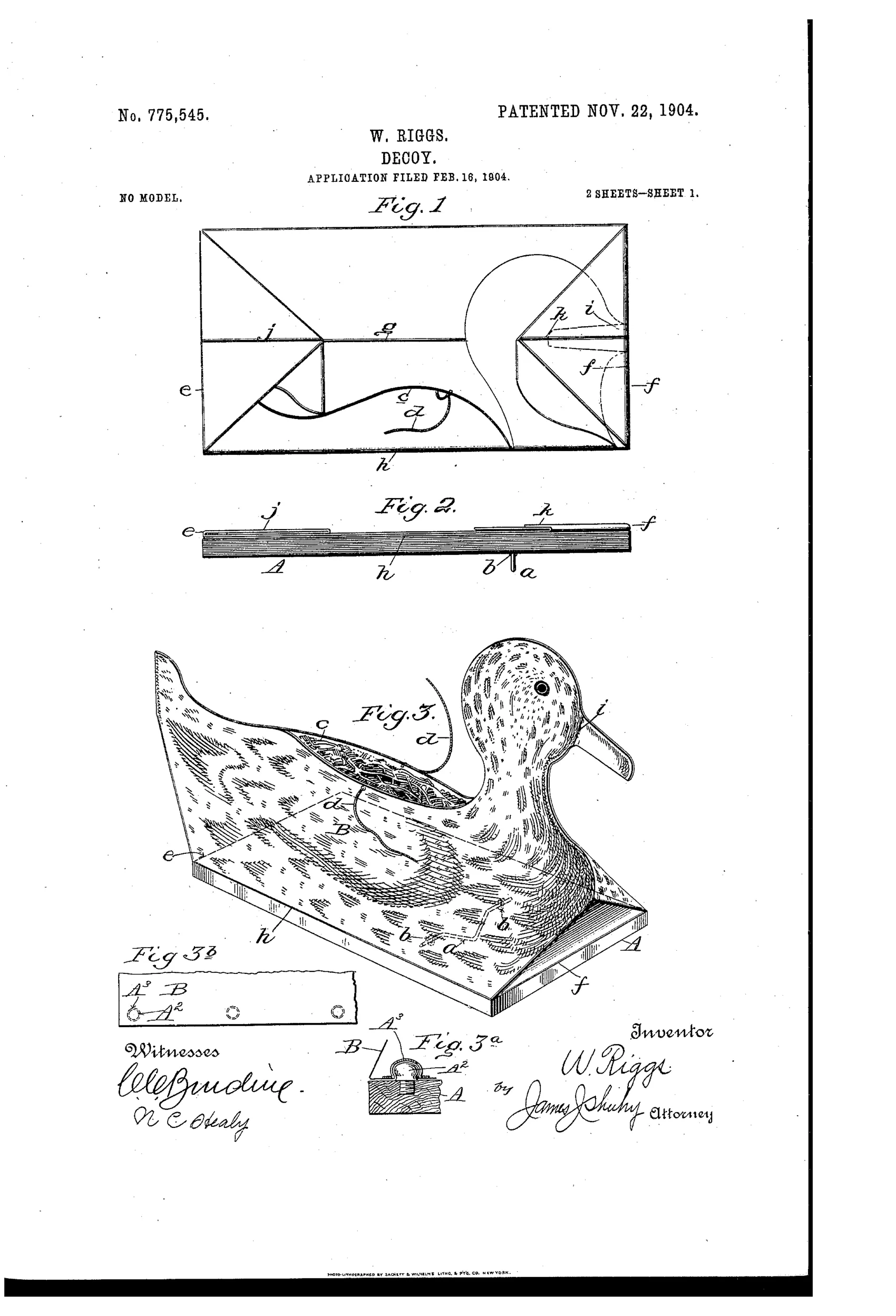
➶ How it works
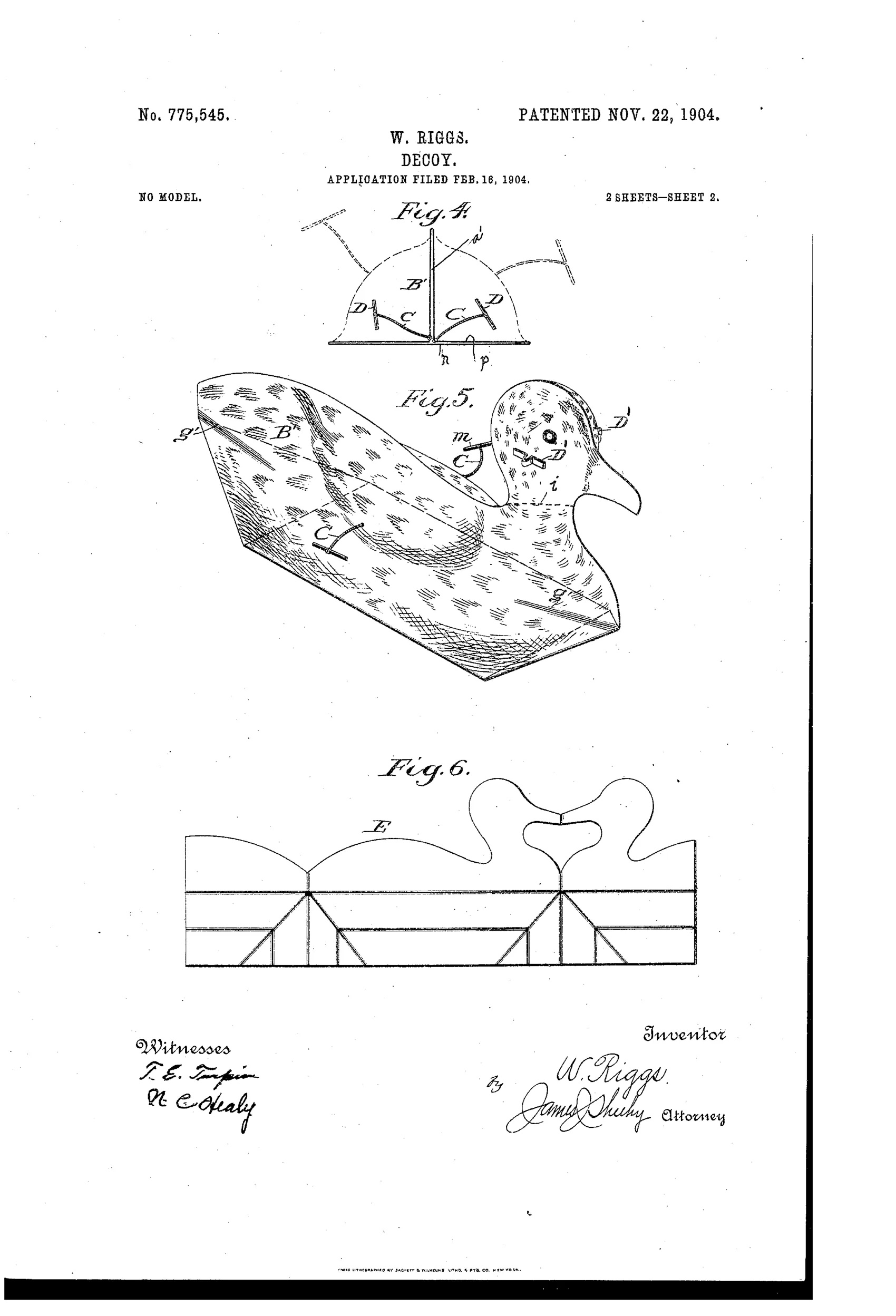
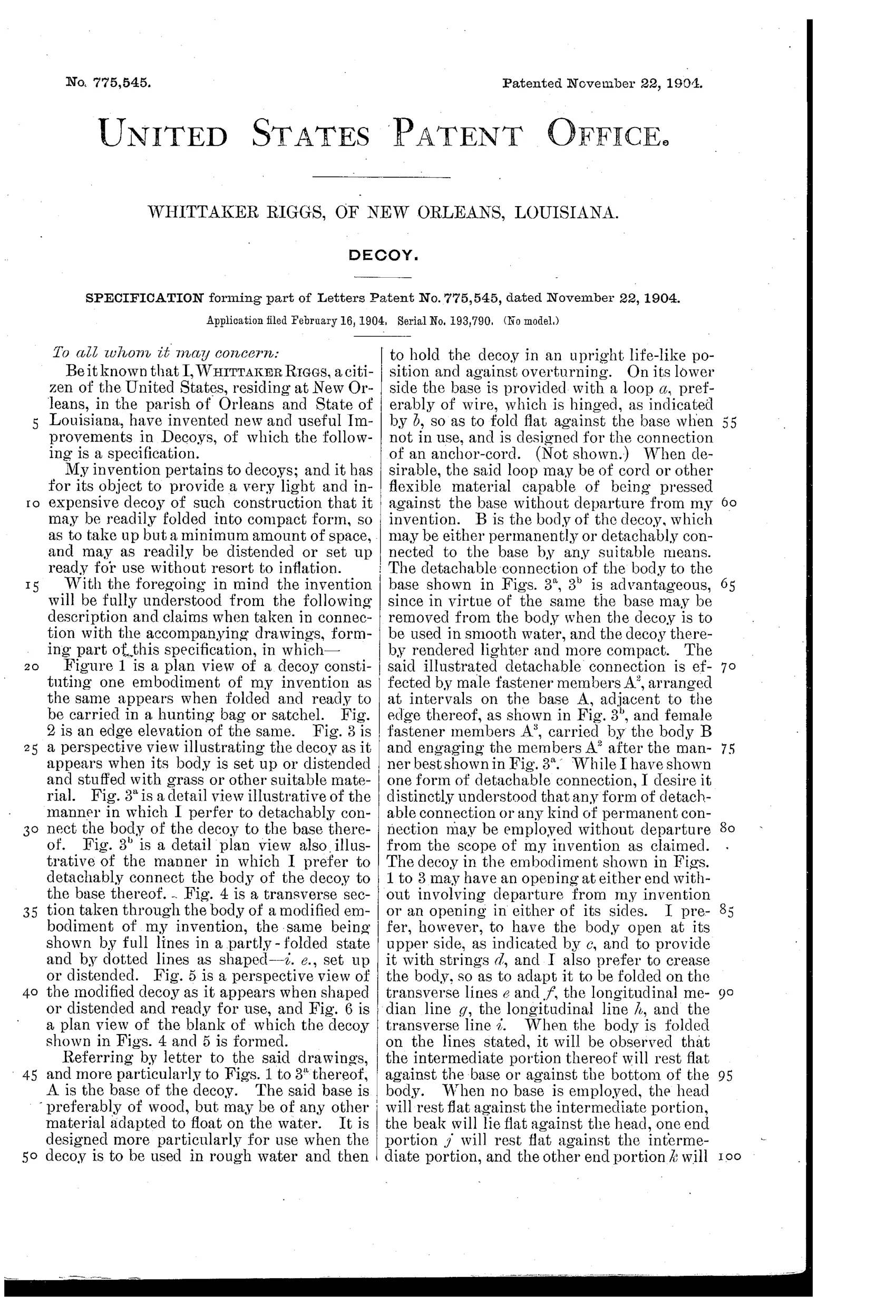
The decoy body is made of stiff paper or similar material creased along transverse and longitudinal lines so it can fold flat for storage yet spring back into a distended, duck-shaped form when unfolded. A base of wood carries a hinged wire loop for an anchor cord and fastener members that detachably connect the body to the base. In a modified form, a longitudinal central portion and finger-pieces or strings are pulled outward to distend the head and body into upright shape, eliminating the need for inflation or stuffing, though grass or leaves may optionally be added through a top opening closed by strings.
➶ What was claimed
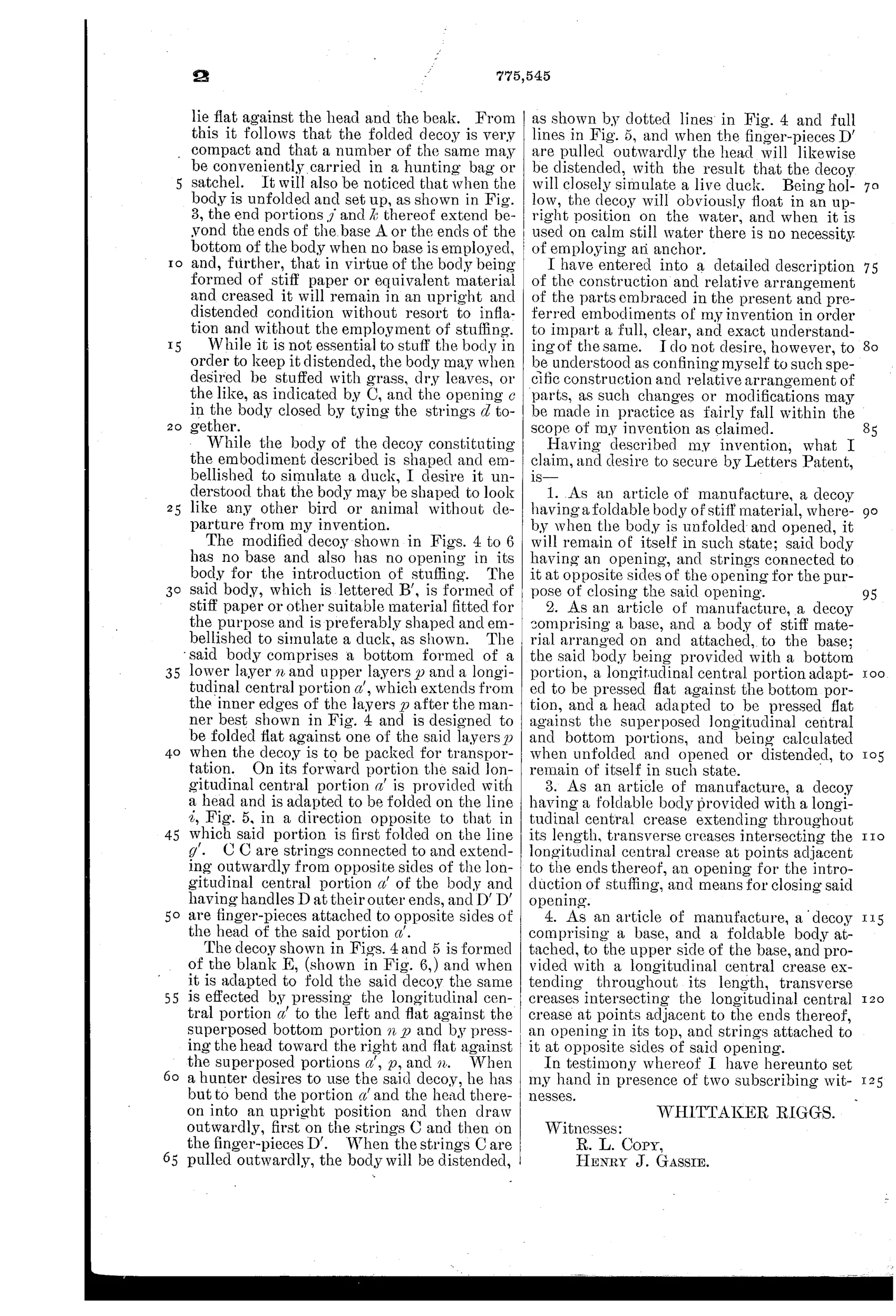
“As an article of manufacture, a decoy having a foldable body of stiff material, whereby when the body is unfolded and opened, it will remain of itself in such state; said body having an opening, and strings connected to it at opposite sides of the opening for the purpose of closing the said opening.”
In plain English: A decoy with a foldable stiff-material body that springs open and stays in shape by itself, with an opening on top that can be closed using strings.
➶ In the inventor’s words
“My invention pertains to decoys; and it has for its object to provide a very light and inexpensive decoy of such construction that it may be readily folded into compact form, so as to take up but a minimum amount of space, and may as readily be distended or set up ready for use without resort to inflation.”— Whittaker Riggs, from the specification
Fate unknown
No marked or documented example of a Riggs paper decoy is known to me; a surviving specimen or period advertisement would settle it.
➶ Commentary
Full disclosure: this is a decoy, not a call, so it sits outside our proper subject of sound-makers. But since the harvest class sweeps everything from blinds to scent bottles into one drawer, it turns up in the same searches, and Riggs's paper duck is too charming to pass over without comment.
The mechanism is essentially papercraft. Figures 1 and 2 show the body folded flat — a creased sheet of stiff paper that springs into three-dimensional duck shape when opened, held there by its own crease memory rather than inflation or a carved core. The wooden base carries a hinged wire loop for the anchor line and detachable fasteners for the body, so a hunter could carry a dozen 'ducks' in the space one cedar block would occupy. Fig. 3 shows the payoff: a surprisingly convincing bird, with an optional top opening (closed by strings) for stuffing grass or leaves to firm it up. The pull-string variant in Figs. 5 and 6 distends the head without any stuffing at all.
The weight problem Riggs solved — hauling rigs of solid wooden decoys through Louisiana marsh — was real, and folding and collapsible decoys became a genuine commercial genre decades later. Whether a paper bird survived rain, spray, and repeated folding is the honest doubt; the drawing is more optimistic than wet cellulose usually allows.
Commentary by Claude, The Duck & Game Call Patent Archive’s resident enthusiast