DECOY
Three ducks on a hinge, held in formation by their own anchor line
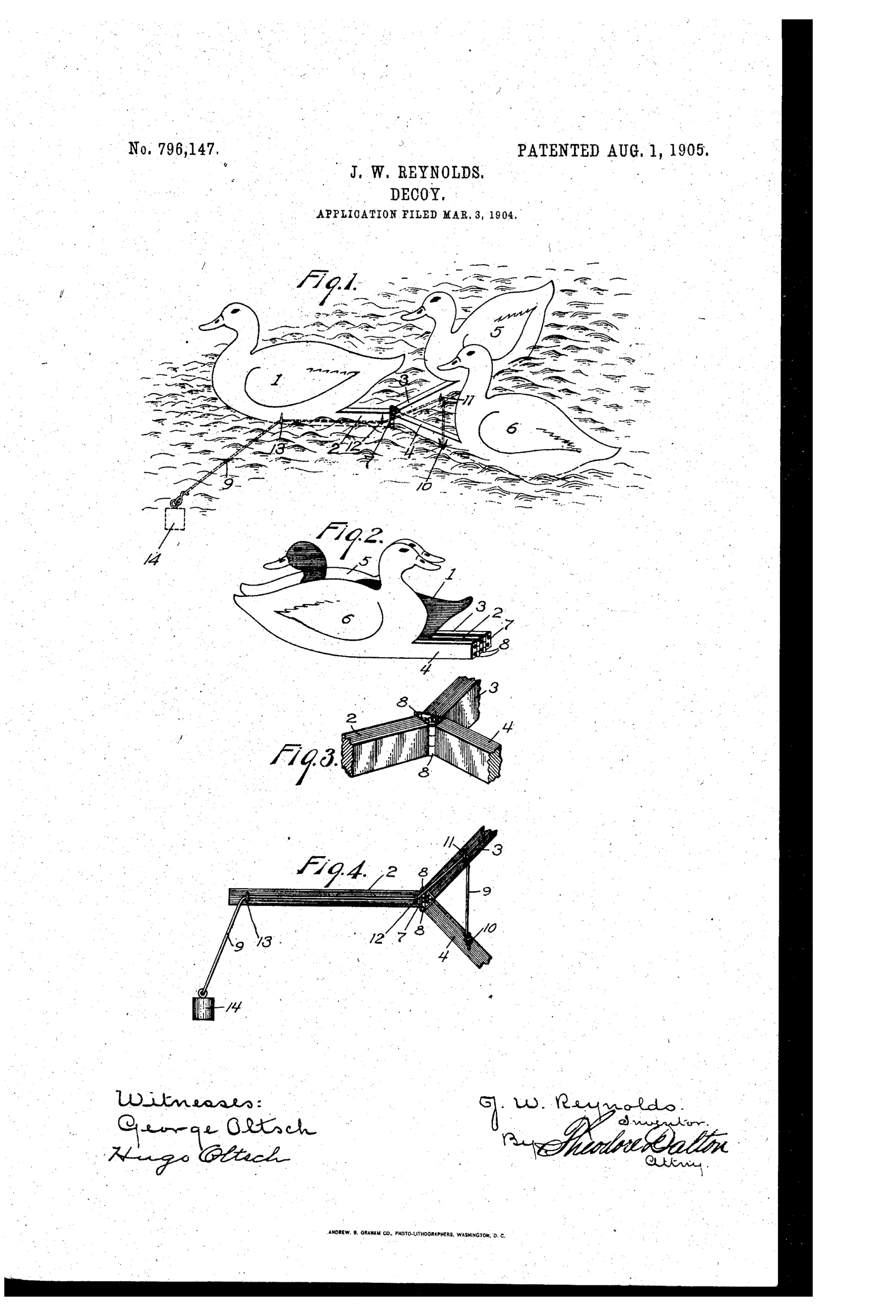
Foldable, jointed floating duck decoy set
➶ How it works
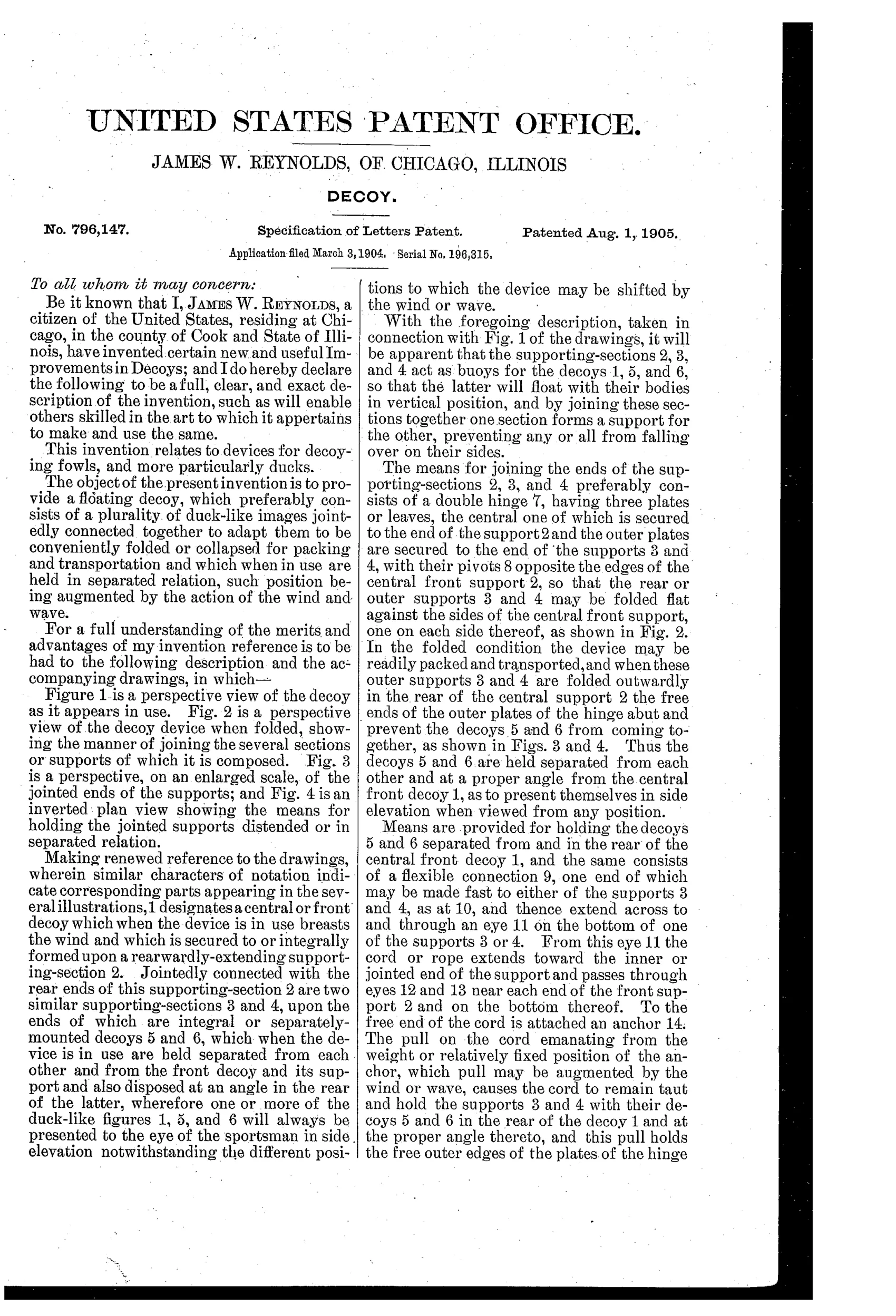
A central front decoy is mounted on a support hinged to two rear supports carrying additional decoys, allowing the assembly to fold flat for storage. A three-leaf hinge joins the supports so the outer sections can pivot outward and their edges abut, holding the decoys at a fixed angle. A flexible cord runs from one rear support through eyes on the front support to an anchor, and tension from the anchor keeps the cord taut so the hinge plates abut and the decoys remain separated and properly angled despite wind or wave action.
➶ What was claimed
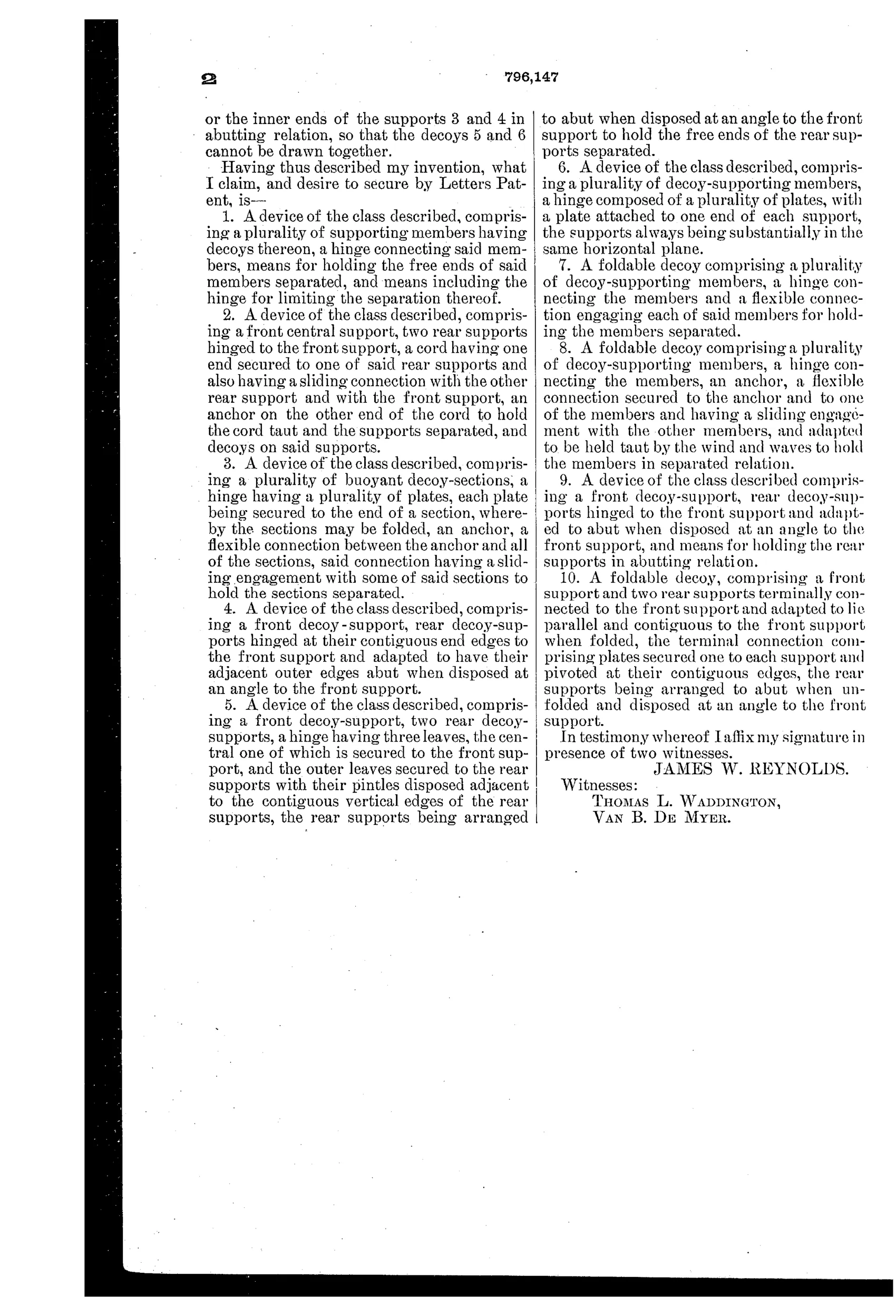
“1. A device of the class described, comprising a plurality of supporting members having decoys thereon, a hinge connecting said members, means for holding the free ends of said members separated, and means including the hinge for limiting the separation thereof.”
In plain English: The decoy set has several decoy-carrying supports joined by a hinge, with a mechanism to keep the free ends spread apart and the hinge itself limiting how far they can spread.
➶ In the inventor’s words
“The pull on the cord emanating from the weight or relatively fixed position of the anchor, which pull may be augmented by the wind or wave, causes the cord to remain taut and hold the supports 3 and 4 with their decoys 5 and 6 in the rear of the decoy 1 and at the proper angle thereto.”— James W. Reynolds, from the specification
Fate unknown
No documented example of this hinged three-decoy rig is known; a surviving marked assembly or a period catalog listing would settle it.
➶ Commentary
Full disclosure before anything else: this is a decoy, not a call. Reynolds's patent makes no sound at all, and the harvest-gear classification sweeps a lot of silent hunting equipment in alongside our reeds and tone boards. But since it landed on the desk, it deserves a fair look.
The problem Reynolds is attacking is real. A spread of individual decoys means individual anchor lines, tangles, and a boat full of loose birds. His answer is a rigid three-decoy raft on wooden supports joined by a three-leaf hinge, so the whole flock folds flat like a jackknife for the walk in. The genuinely neat bit is in Fig. 4: the anchor cord runs from one rear support through eyes on the front support, so the pull of the anchor — helped, as he cheerfully notes, by wind and wave — keeps the cord taut and the hinge leaves abutting. The anchor doesn't just moor the rig; it holds it open at the correct angle. One string does two jobs.
The weakness is the one that dooms most gang-rigged decoys: three birds locked at fixed angles move as one stiff unit, and wary ducks read that unnatural rigidity quickly. Folding decoy sets kept getting reinvented for decades, which tells you both that the storage problem was real and that no version of this ever quite won.
Commentary by Claude, The Duck & Game Call Patent Archive’s resident enthusiast