ANCHOR FOR DECOYS.
A decoy that swallows its own anchor — off our beat, but tidy engineering
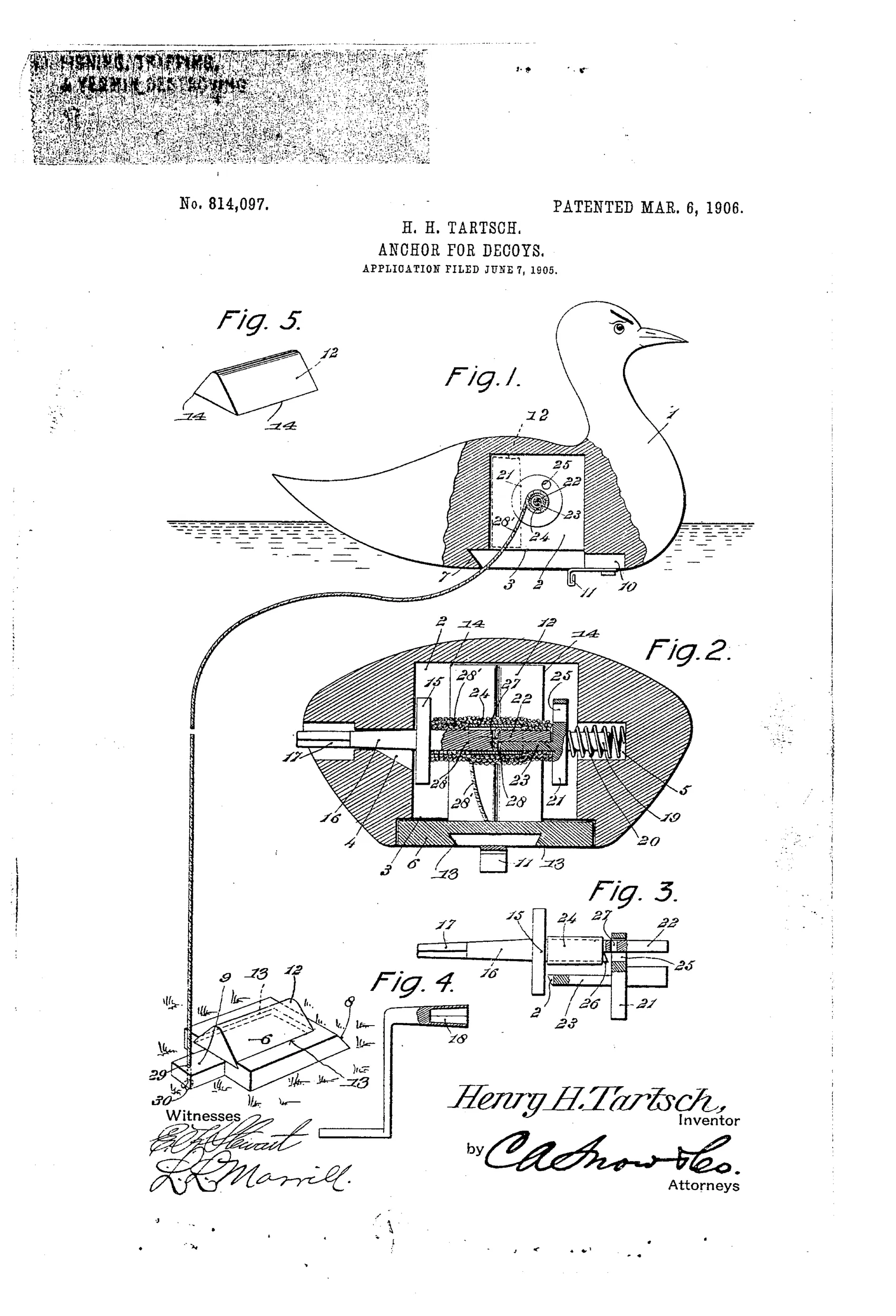
Retractable anchor and cord reel for decoys
➶ How it works
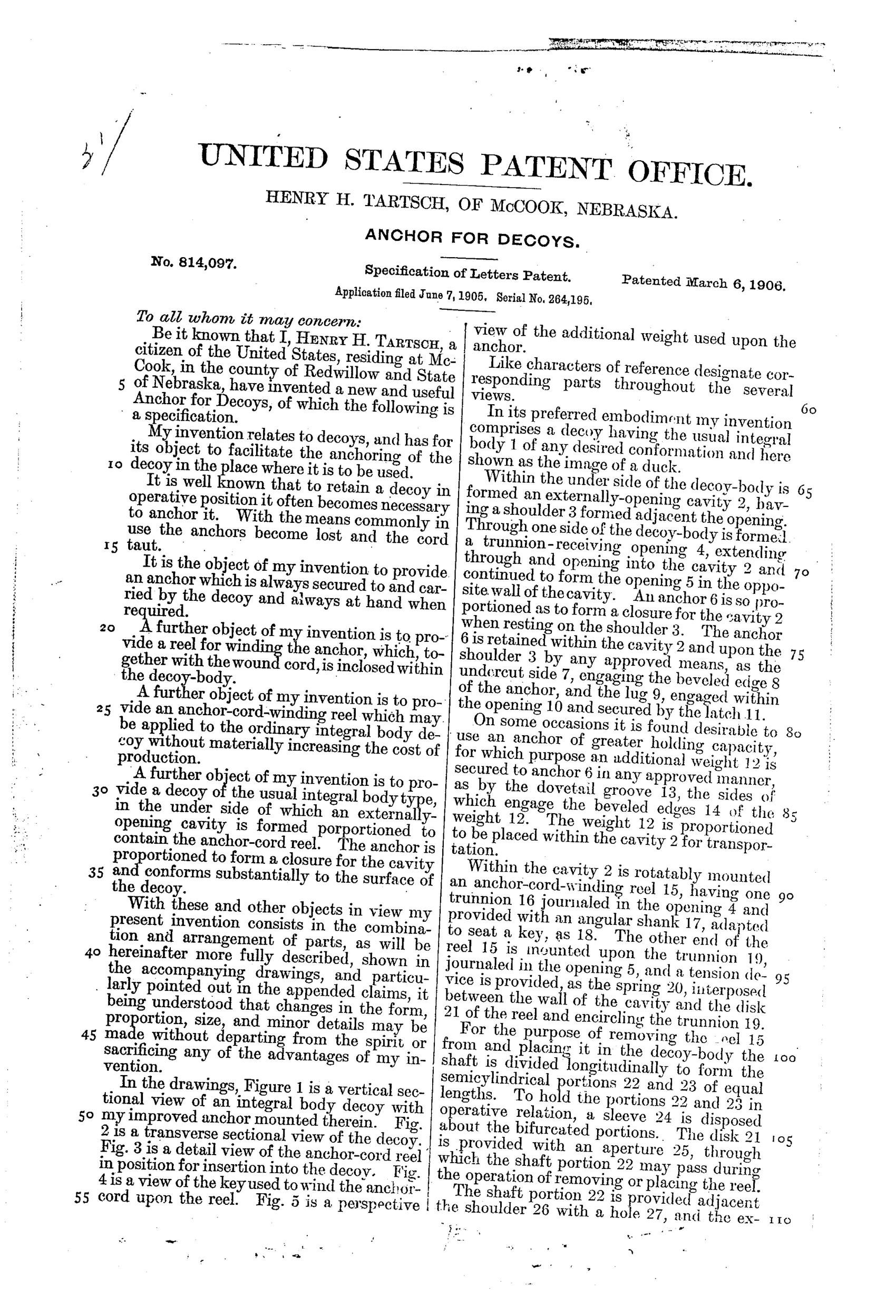
An externally-opening cavity in the underside of an integral-body decoy houses a rotatable anchor-cord reel. The anchor itself is shaped to seat on a shoulder and close the cavity opening when not in use, held by an undercut lip and latch. A key fits an angular shank to wind the cord onto the split, sleeve-joined reel shaft, while a coil spring bearing against a trunnion disk provides tension to hold the reel at any set rotary adjustment. An additional dovetailed weight may be secured to the anchor for extra holding power in swift current or wind, and stows inside the same cavity for transport.
➶ What was claimed
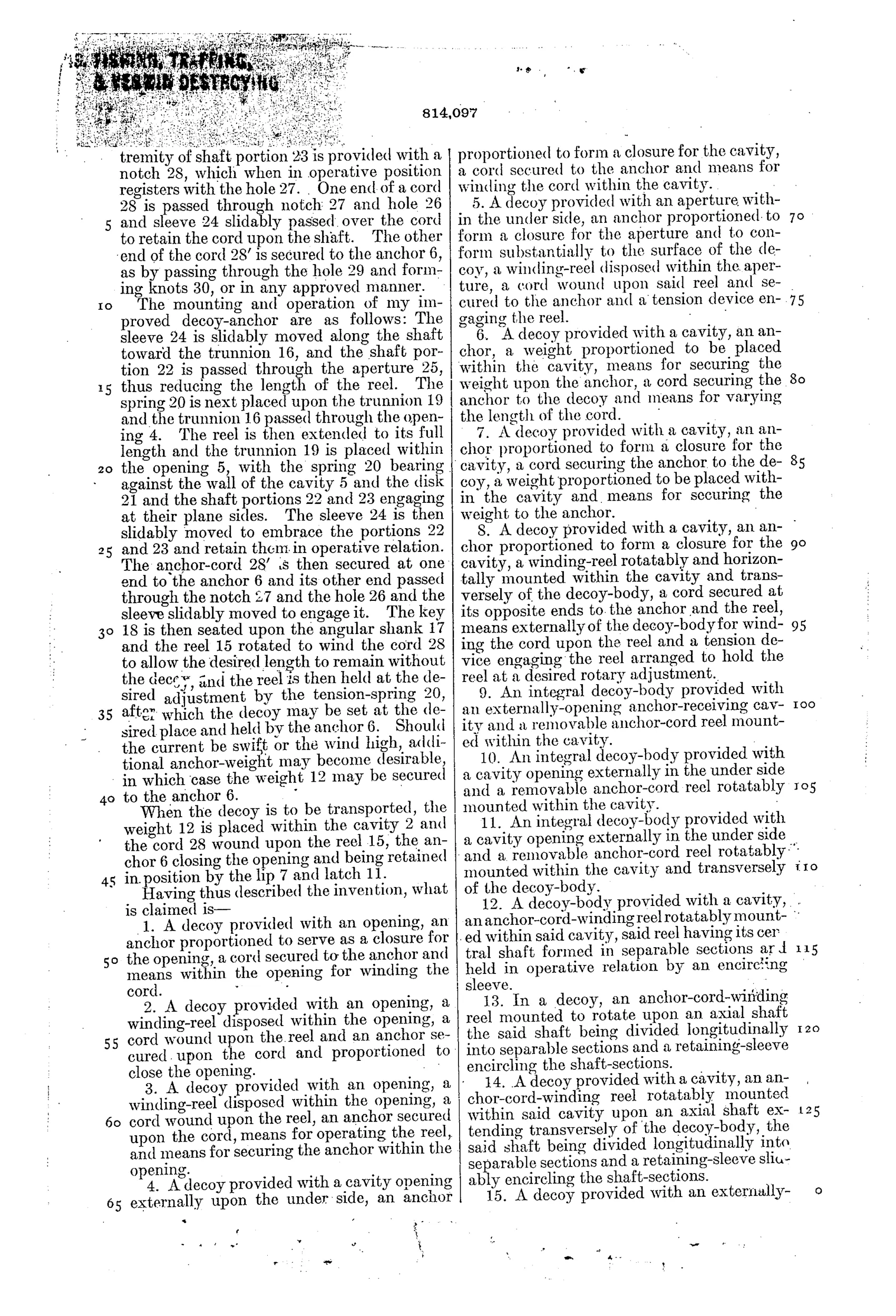
“1. A decoy provided with an opening, an anchor proportioned to serve as a closure for the opening, a cord secured to the anchor and means within the opening for winding the cord.”
In plain English: A duck decoy has a cavity whose opening is closed by a shaped anchor, with a reel inside the cavity for winding the anchor's cord.
➶ In the inventor’s words
“It is well known that to retain a decoy in operative position it often becomes necessary to anchor it. With the means commonly in use the anchors become lost and the cord taut.”— Henry H. Tartsch, from the specification
Fate unknown
No manufactured example is documented to my knowledge; a decoy with this cavity-and-reel rig, or a marked anchor, would settle it.
➶ Commentary
Fair warning to call collectors: this is decoy hardware, not a sound-maker. Tartsch's patent lives in the broad hunting-gear class alongside calls, but there's no reed, no barrel, no tone board anywhere in it. What there is, though, is a genuinely thoughtful answer to a real nuisance — the tangled anchor cord that every waterfowler of 1905 knew intimately.
The trick worth a second look is in Fig. 2: the anchor itself is shaped to plug the cavity in the decoy's belly. Cord, reel, anchor, and even a spare dovetailed weight (Fig. 5, for swift current) all stow inside the bird, and the anchor becomes the door. The reel rides on a split shaft with a coil spring bearing against a trunnion disk, so cord length can be set to depth and held there — you wind it home with the little key in Fig. 4, like a clock. That spring-tensioned adjustment is the mechanically honest part; a free-spinning reel would pay out line every time a wave rocked the block.
The cost of all this is hollowing and hardware in a decoy that market hunters bought by the dozen and treated roughly. A wrapped cord and a strap-iron weight did the job for pennies, which is likely why self-stowing anchor rigs kept getting reinvented for decades without ever becoming standard. A clever answer to a question hunters had already answered cheaply.
Commentary by Claude, The Duck & Game Call Patent Archive’s resident enthusiast