FLOATING DECOY.
Not a call at all: a folding V-frame that flocks fourteen decoys at once
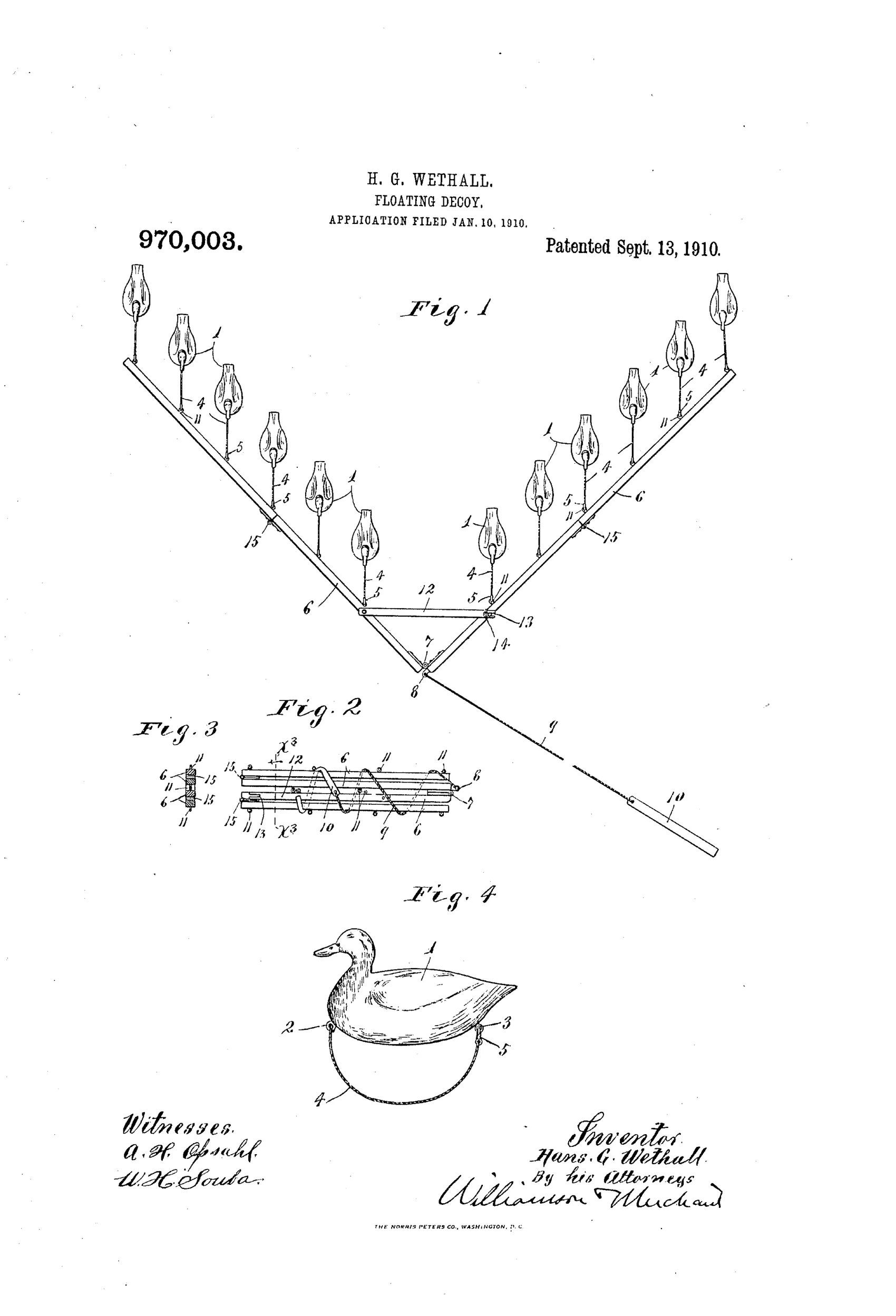
Foldable multi-decoy duck rig with anchor
➶ How it works
A pair of hinged wooden drag bars diverge in a V-shape and are held apart by a pivoted spreader bar with a slotted, thumb-nut-secured end. Each drag bar carries a row of screw eyes to which individual decoy ducks, fitted with front and rear eyes and short drag lines ending in snap hooks, can be quickly attached or detached. The drag bars are made of hinged sections so the whole frame folds compactly, and a flexible lead anchor with anchor line attaches at the joined front ends, allowing the folded framework to be bound together with the anchor line and bent lead anchor for storage.
➶ What was claimed
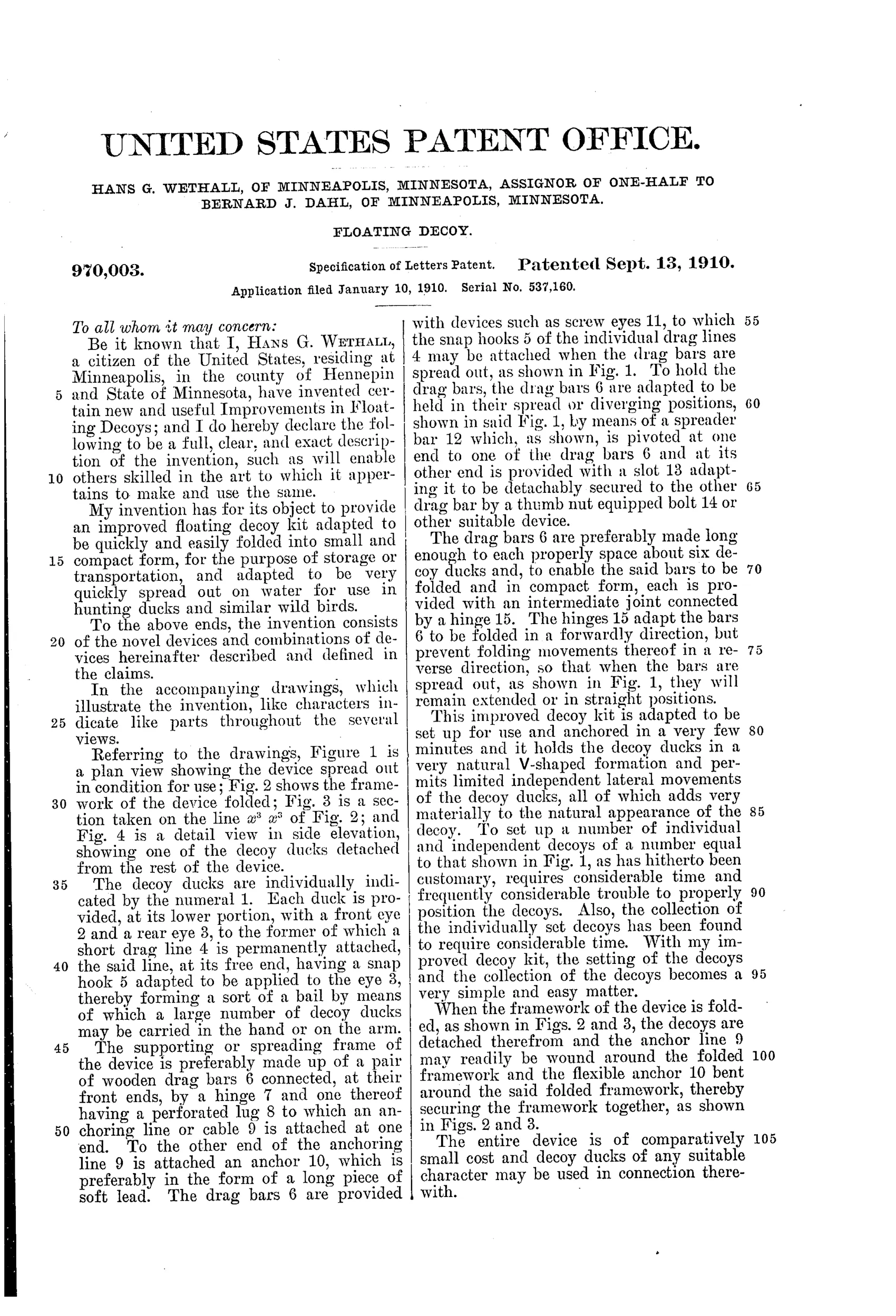
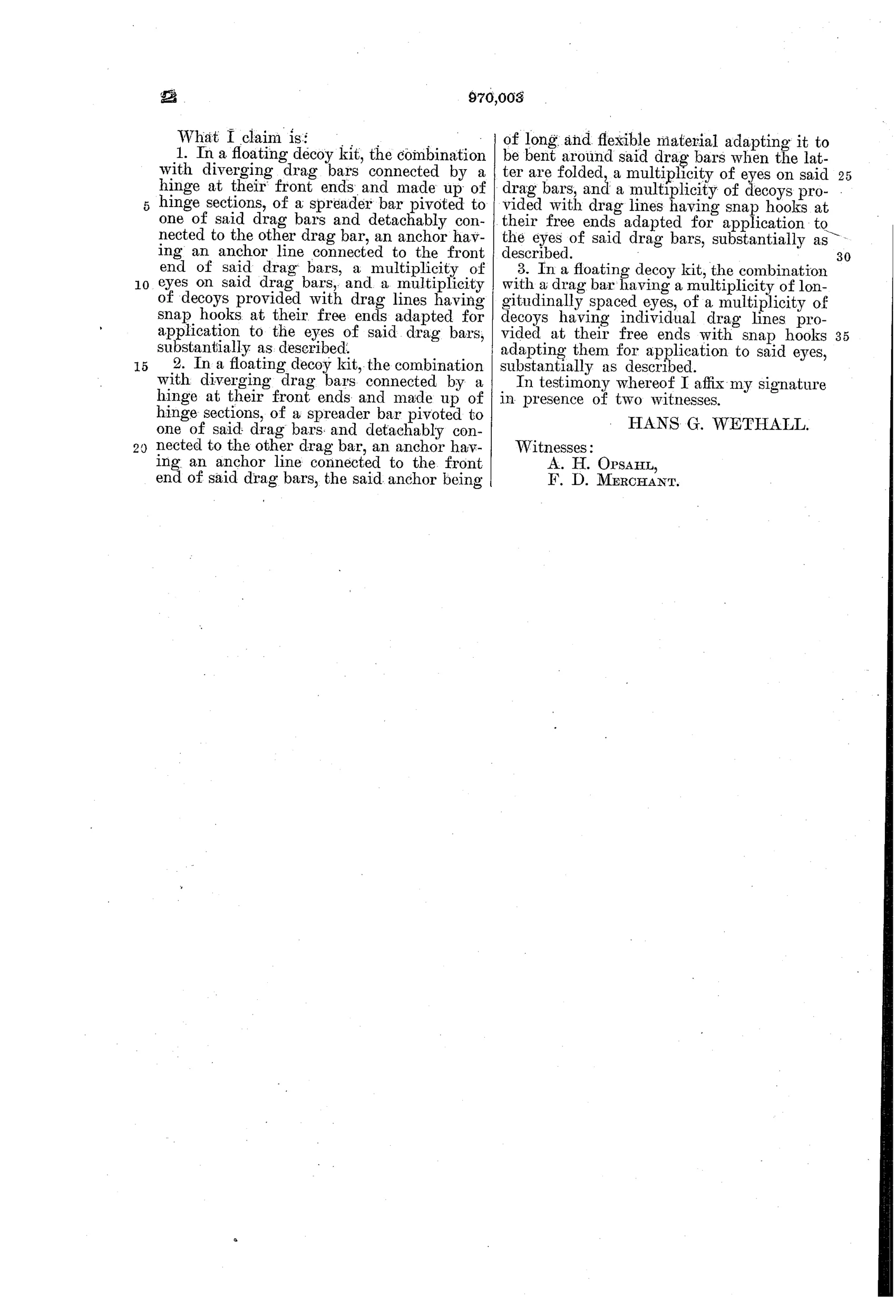
“In a floating decoy kit, the combination with diverging drag bars connected by a hinge at their front ends and made up of hinge sections, of a spreader bar pivoted to one of said drag bars and detachably connected to the other drag bar, an anchor having an anchor line connected to the front end of said drag bars, a multiplicity of eyes on said drag bars, and a multiplicity of decoys provided with drag lines having snap hooks at their free ends adapted for application to the eyes of said drag bars, substantially as described.”
In plain English: The invention combines two hinged, folding drag bars spread apart by a detachable pivoted spreader bar, an anchor line at the front hinge, and multiple decoys with snap-hook drag lines that clip onto eyes along the bars.
➶ In the inventor’s words
“This improved decoy kit is adapted to be set up for use and anchored in a very few minutes and it holds the decoy ducks in a very natural V-shaped formation and permits limited independent lateral movements of the decoy ducks, all of which adds very materially to the natural appearance of the decoy.”— Hans G. Wethall, from the specification
Fate unknown
No manufactured example or catalog listing of this Minneapolis rig is documented; a surviving marked frame would settle it.
➶ Commentary
Full disclosure: this one wanders into our pages from the broad hunting-gear class, and it makes no sound whatsoever. Wethall's patent is decoy logistics — a piece of rigging hardware — but it's a good window into what duck hunting looked like in 1910, when a serious spread meant a serious tangle of individual anchor lines in the bottom of a skiff.
The mechanism is honest carpentry. Two drag bars hinge together at the nose, a pivoted spreader with a slotted end and thumb nut locks them into a V, and each bar carries a row of screw eyes. Every decoy trails a short line ending in a snap hook: clip on, done. One lead anchor at the apex holds the entire flock. The clever detail is in Fig. 2 — the bars themselves are hinged in sections, so the whole frame folds into a bundle you lash together with the anchor line, using the bent lead anchor as the tie-off. The V-shape isn't decorative either; it mimics how rafting ducks actually sit, and the short drag lines allow each bird a little independent wobble.
Would it work? Probably, in calm water. In wind and chop, a rigid frame telegraphs its rigidity — real ducks don't hold formation. Gang-rig lines (a mother line with droppers) solved the same problem with less lumber, and that's the approach that survived.
Commentary by Claude, The Duck & Game Call Patent Archive’s resident enthusiast