FROG-TRAP
No call at all: a frog trap that wandered into the duck-call files
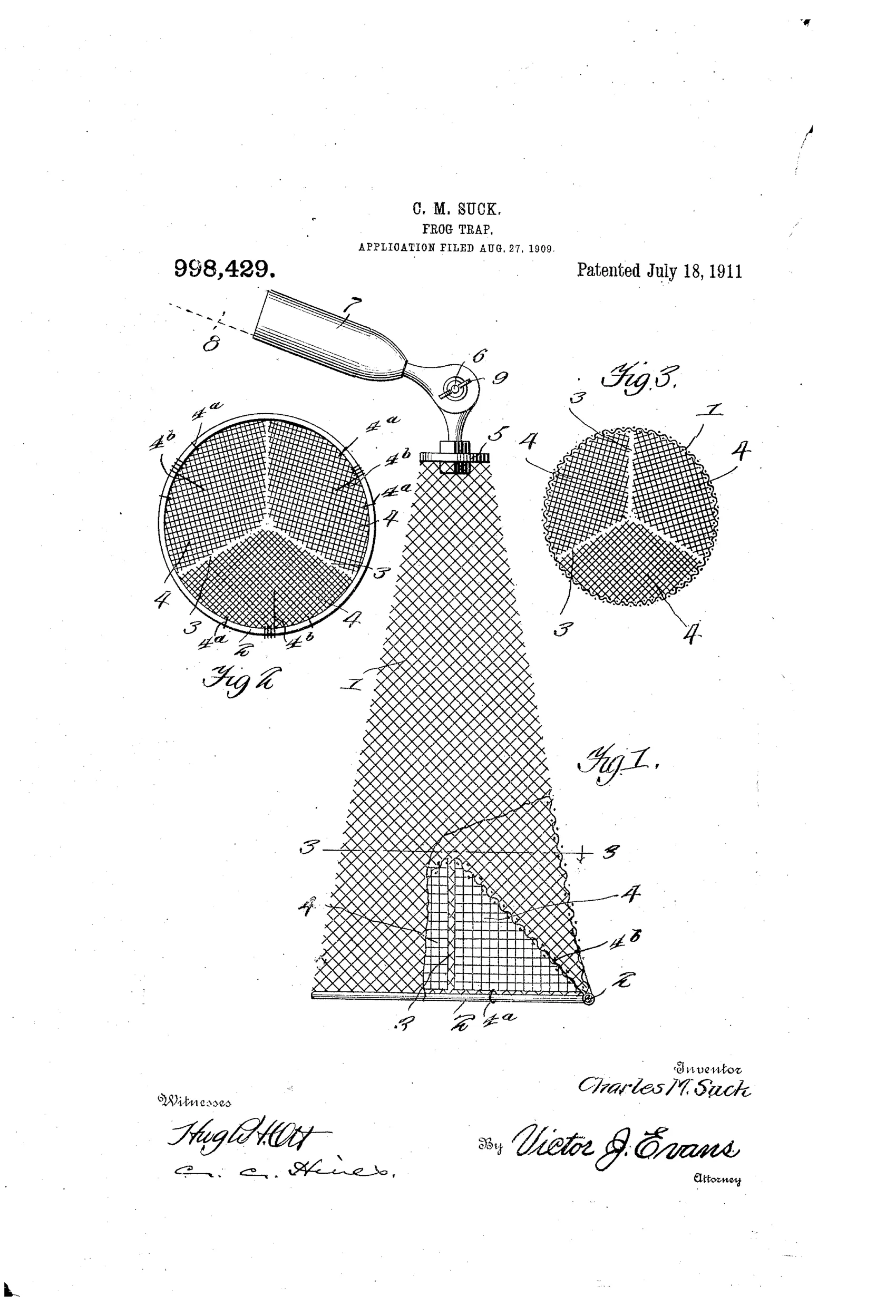
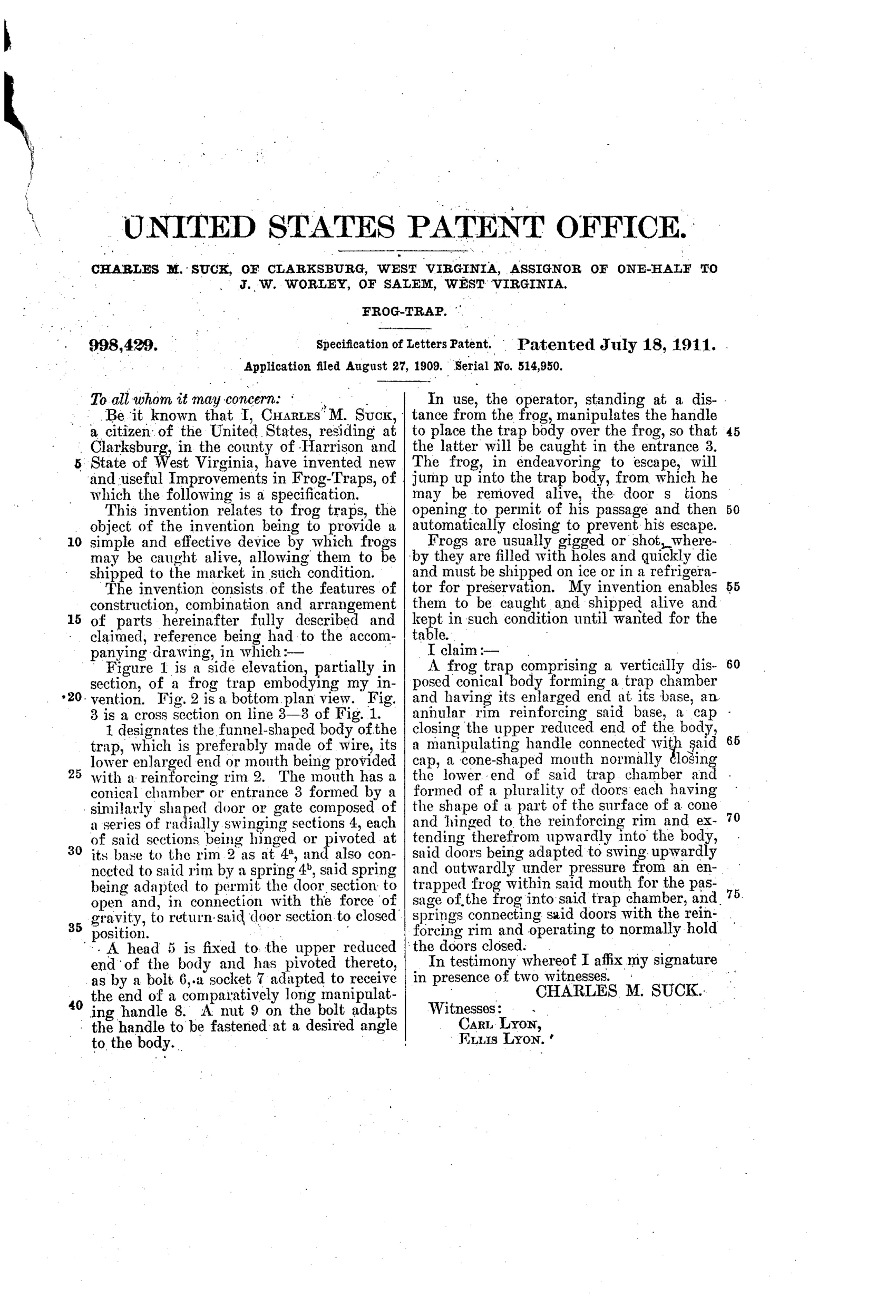
Wire funnel trap for catching frogs alive
➶ How it works
The trap consists of a vertically disposed conical wire body with an enlarged base and a reduced top closed by a cap. The base mouth has a spring-hinged, cone-shaped door made of radially swinging mesh sections that open inward and upward when a frog pushes through, then snap closed via springs and gravity to trap it. A pivoting handle attached to the cap lets the operator lower the trap over a frog from a distance. Once inside the funnel-shaped chamber, the frog cannot push back out because the door sections close automatically.
➶ What was claimed
“A frog trap comprising a vertically disposed conical body forming a trap chamber and having its enlarged end at its base, an annular rim reinforcing said base, a cap closing the upper reduced end of the body, a manipulating handle connected with said cap, a cone-shaped mouth normally closing the lower end of said trap chamber and formed of a plurality of doors each having the shape of a part of the surface of a cone and hinged to the reinforcing rim and extending therefrom upwardly into the body, said doors being adapted to swing upwardly and outwardly under pressure from an entrapped frog within said mouth for the passage of the frog into said trap chamber, and springs connecting said doors with the reinforcing rim and operating to normally hold the doors closed.”
In plain English: A cone-shaped wire trap with a hinged, spring-loaded multi-panel door at its base that lets a frog push its way in but snaps shut to keep it from escaping.
➶ In the inventor’s words
“Frogs are usually gigged or shot, whereby they are filled with holes and quickly die and must be shipped on ice or in a refrigerator for preservation.”— Charles M. Suck, from the specification
Fate unknown
The trap is simple enough to have been built, but no manufactured example or trade record is documented; a surviving marked trap would settle it.
➶ Commentary
Let's be honest up front: this is not a game call. Charles M. Suck's patent makes no sound, lures nothing, and belongs to the broad hunting-harvest class that occasionally deposits a stray like this among the reed-and-barrel patents we actually chase. But since it's here, it deserves a fair look, because it's a tidy little piece of thinking about live capture.
The pitch in the specification is the best part: frogs, Suck complains, are 'gigged or shot, whereby they are filled with holes and quickly die.' His answer is a conical wire chamber lowered over the frog by a long pivoting handle — clap the trap down, and the animal's own struggle does the rest. The clever bit is in the two circular insets: the mouth isn't a flat trapdoor but a cone of three mesh sections, hinged at the rim and sprung shut. A frog pushing upward wedges the panels apart; once through, springs and gravity close them, and the frog is now inside a funnel whose only exit points the wrong way. It's the classic minnow-trap geometry turned vertical and made active with a handle.
As mechanism it would probably work — funnel traps are ancient and reliable. As a commercial product for the frog-leg market of 1909, it's a niche within a niche, and it teaches us nothing about calls except how wide the hunting classes sprawl.
Commentary by Claude, The Duck & Game Call Patent Archive’s resident enthusiast