FOOTBOARD FOR WOOD-CHOPPERS.
A springboard for tree fallers — no reed, no quack, no call at all
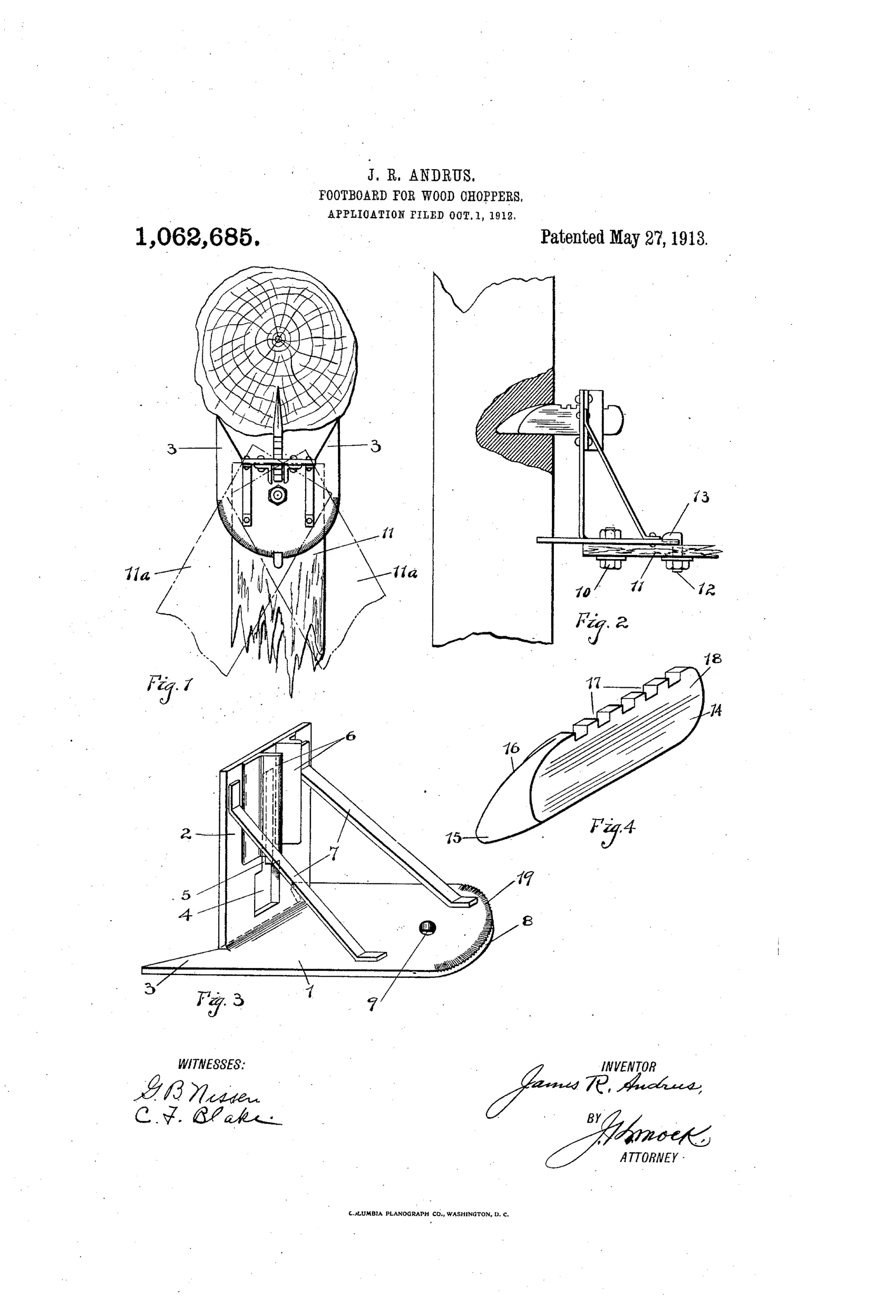
Tree-mounted swinging footboard for chopping wood
➶ How it works
An L-shaped steel frame has a base with forward-projecting barbs at each corner that dig into a tree's bark, and an upright portion with a vertical slot through which a notched wedge-shaped bar is driven horizontally into the trunk. Angle irons on the slot's sides keep the frame from moving laterally, while the upper edge of the slot engages one of the bar's notches to bear the frame's weight and hold it against the tree. A footboard is pivoted on a bolt near the base and can swing laterally to any angle; a second bolt with a flanged head rides in notches along the board's edge to lock it at the desired working angle, letting the operator stand securely while chopping.
➶ What was claimed
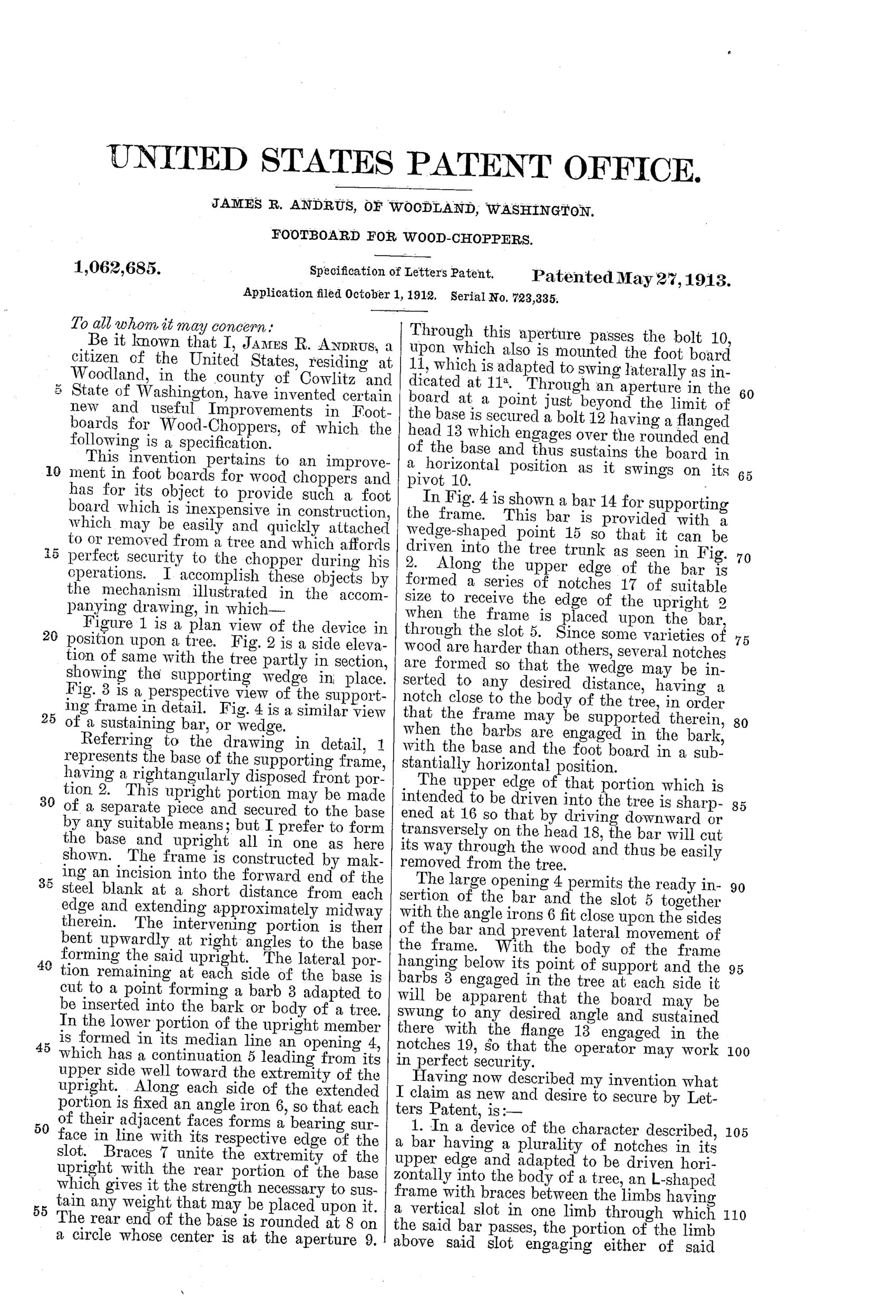
“In a device of the character described, a bar having a plurality of notches in its upper edge and adapted to be driven horizontally into the body of a tree, an L-shaped frame with braces between the limbs having a vertical slot in one limb through which the said bar passes, the portion of the limb above said slot engaging either of said notches to sustain said limb against the body of the tree and barbs projecting forwardly from the base of the frame to engage in the tree.”
In plain English: A notched wedge bar is driven into a tree trunk, and an L-shaped braced frame with a slotted upright slides onto the bar, resting in one of its notches while forward barbs on the frame's base bite into the tree to hold it steady.
➶ In the inventor’s words
“This invention pertains to an improvement in foot boards for wood choppers and has for its object to provide such a foot board which is inexpensive in construction, which may be easily and quickly attached to or removed from a tree and which affords perfect security to the chopper during his operations.”— James R. Andrus, from the specification
Fate unknown
Off-category logging hardware with no documented production; a surviving marked frame or trade-catalog listing would settle whether Andrus ever had it made.
➶ Patented the same day
- DECOY — William R. Johnson
➶ Commentary
Full disclosure: this one wandered into the game-call files by way of the broad hunting-and-outdoors classification, and it doesn't belong. There is no reed, no tone board, no sound-making function whatsoever. James Andrus of Woodland, Washington patented a steel replacement for the logger's springboard — the plank a faller stood on to get above a big tree's flared butt before cutting.
Taken on its own terms, it's a sensible piece of hardware. The traditional springboard was a wooden plank jammed into an axe-cut notch, and it could shift or pop out. Andrus drives a notched wedge bar horizontally into the trunk, then hangs an L-shaped frame on it: the slot in the upright catches a notch to carry the load, while barbs on the base bite the bark to stop rocking. The nicest touch is the pivoting footboard with edge notches and a flanged locking bolt — the faller could swing the board to any angle and lock it, useful when working around a trunk rather than facing it square.
Whether Pacific Northwest fallers, a famously conservative bunch about their gear, would trade a cheap plank for bolted steelwork is another question. As a call, it scores zero; as 1912 logging ingenuity from timber country, it's a tidy little design that solved a real stability problem.
Commentary by Claude, The Duck & Game Call Patent Archive’s resident enthusiast