DECOY
A pocket-flat cardboard duck — and a decoy, not a call at all
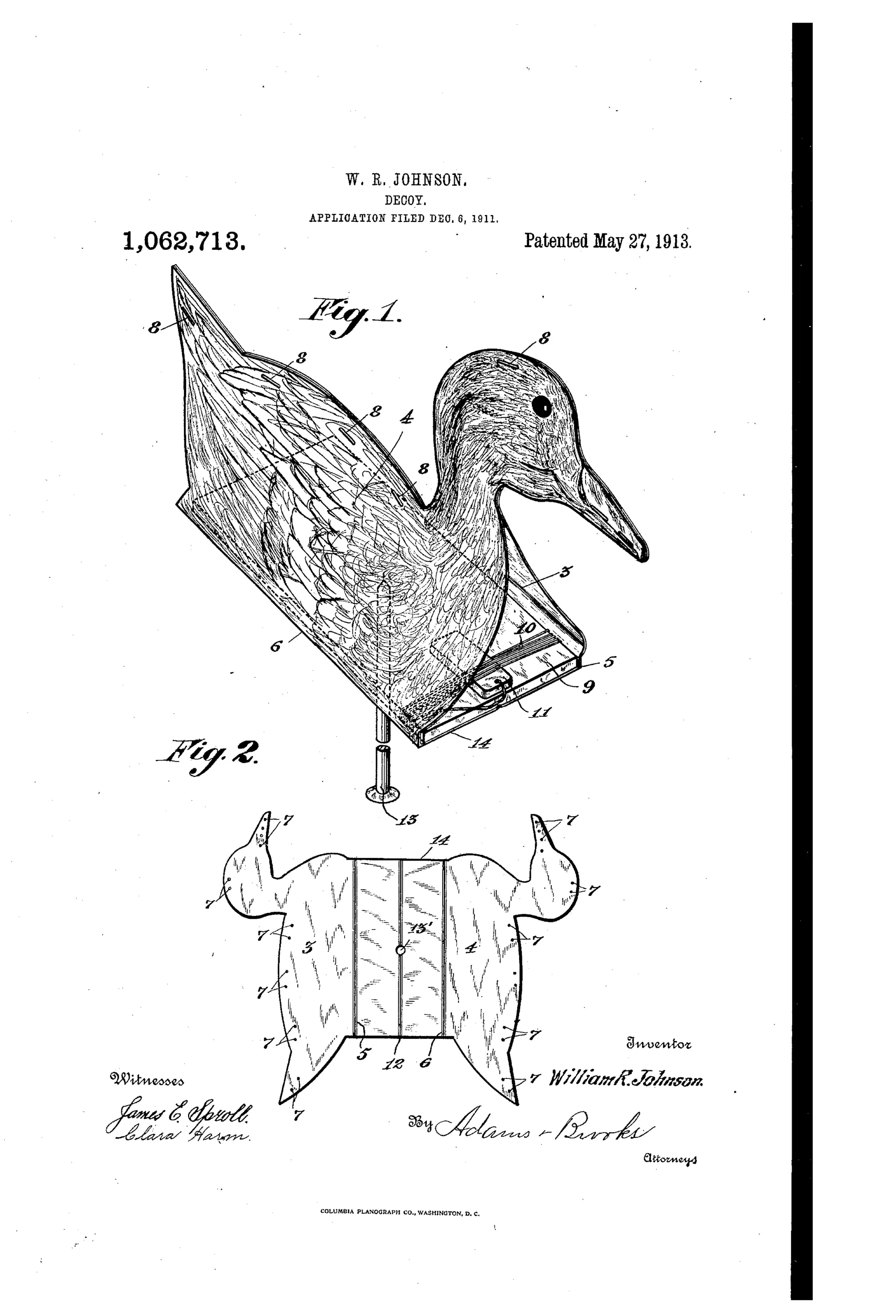
Foldable, water-proof cardboard duck decoy
➶ How it works
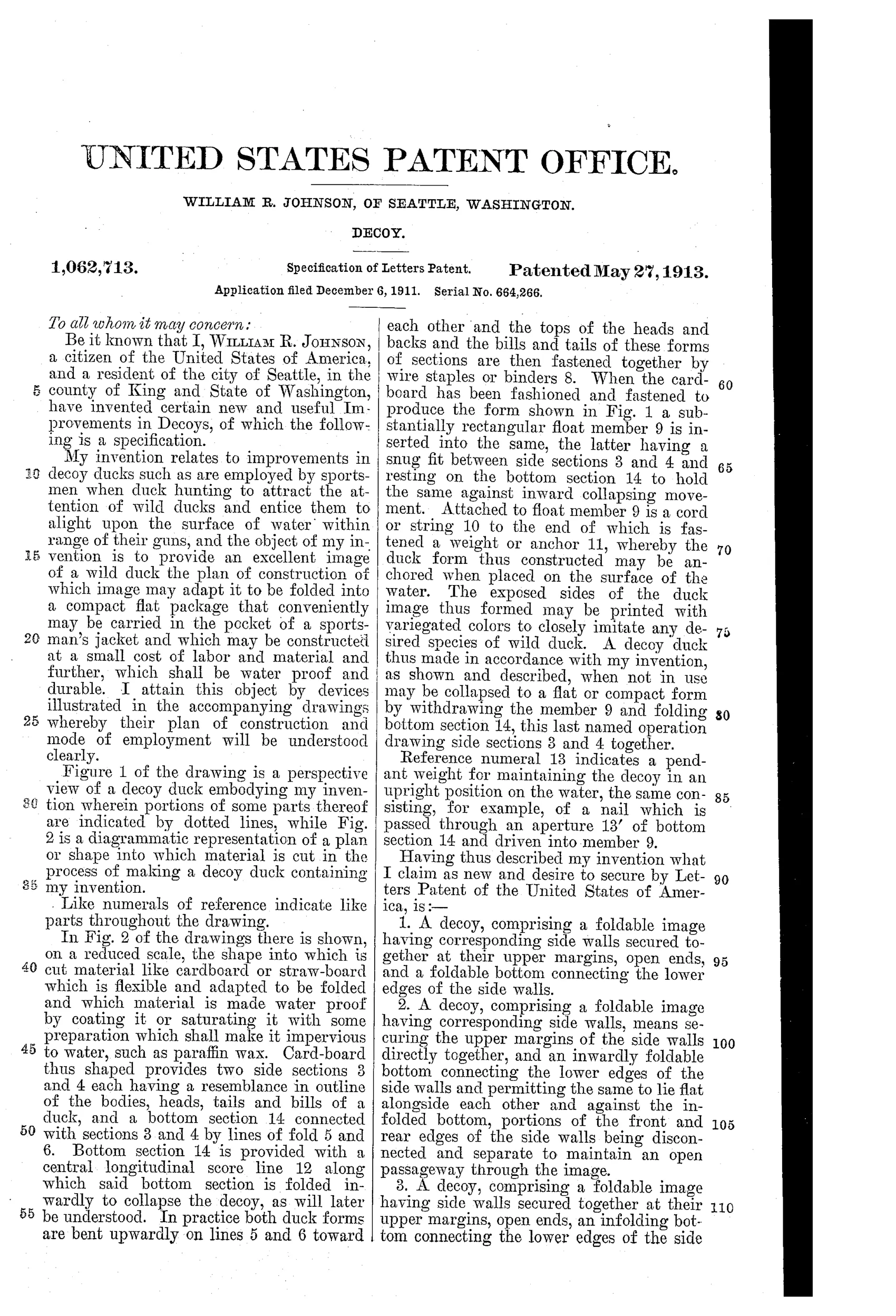
The decoy is formed from two flat cardboard side sections shaped like a duck's body, head, tail and bill, joined at the top by wire staples. A rectangular float member is inserted between the sides to hold them apart, resting on a foldable bottom section that otherwise collapses inward. A weighted anchor cord is tied to the float and a pendant nail-weight passes through the bottom to keep the decoy upright and moored on the water.
➶ What was claimed
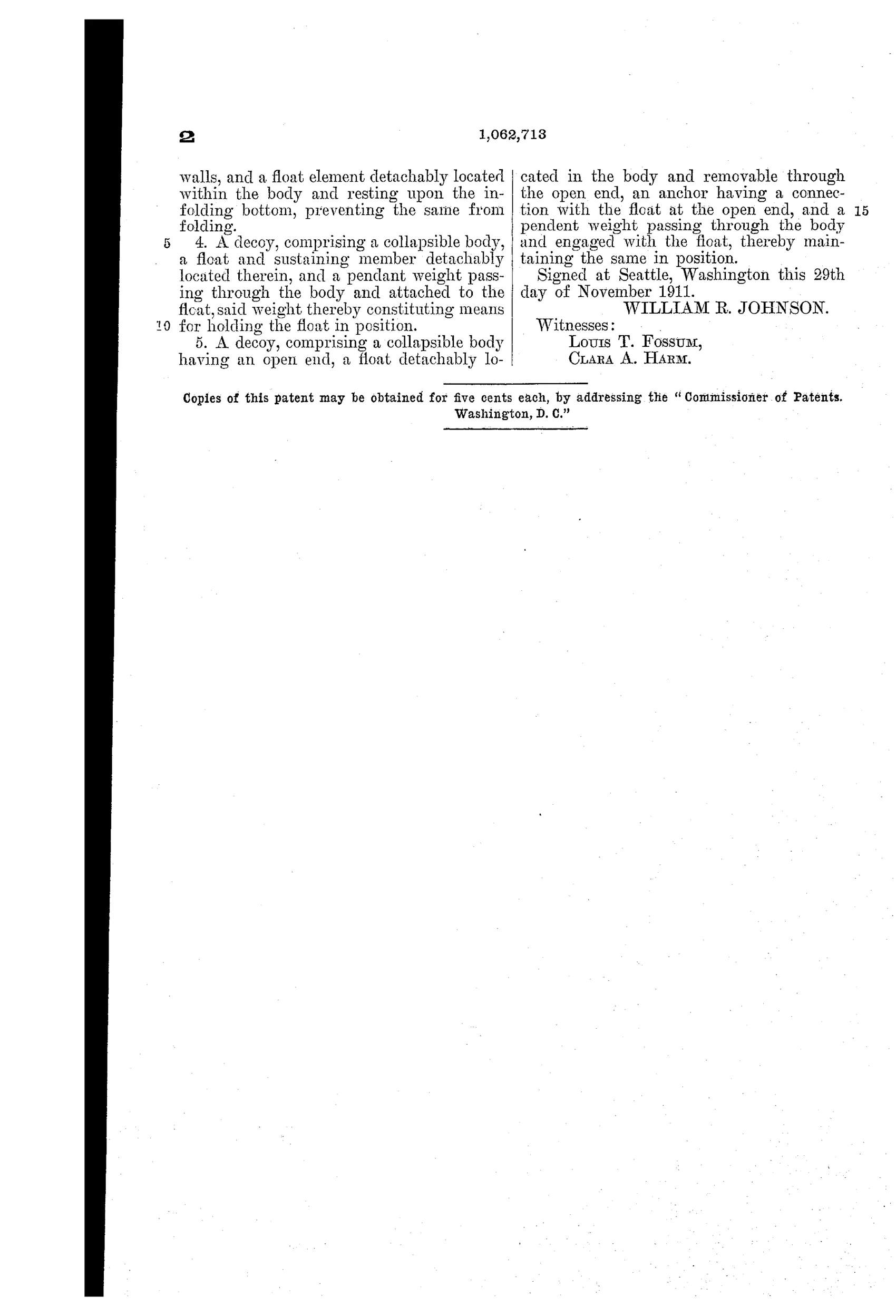
“1. A decoy, comprising a foldable image having corresponding side walls secured together at their upper margins, open ends, and a foldable bottom connecting the lower edges of the side walls.”
In plain English: A duck decoy made of two side pieces joined at the top with open ends and a bottom that can fold flat.
➶ In the inventor’s words
“the object of my invention is to provide an excellent image of a wild duck the plan of construction of which image may adapt it to be folded into a compact flat package that conveniently may be carried in the pocket of a sportsman's jacket”— William R. Johnson, from the specification
Fate unknown
Folding cardboard decoys were later made commercially by others, but no example tied to this specific Seattle patent is documented; a marked specimen would settle it.
➶ Patented the same day
- FOOTBOARD FOR WOOD-CHOPPERS. — James R. Andrus
➶ Commentary
Full disclosure: this one wanders into our pages by way of the broad hunting-gear class, but it's a decoy, not a sound-maker. No reed, no tone board, nothing to blow. Still, since it's here, it deserves an honest look, because Johnson's idea is a tidy piece of flat-pack thinking a good decade before that phrase existed.
The scheme is all in Fig. 2. The entire duck — both sides, head, bill, tail — is one die-cut cardboard blank, folded along the spine and stapled at the top margin. The bottom folds flat for transport; in use, a rectangular float slips between the sides and props them apart, giving the silhouette body and buoyancy at once. A nail-weight dangling through the bottom keeps it upright, and the anchor cord ties to the float rather than the shell, which is smart — the strain goes to the structural member, not the wet cardboard.
The stated goal, a decoy 'that conveniently may be carried in the pocket of a sportsman's jacket,' addresses the real curse of the decoy rig: weight. A dozen wooden blocks is a boat's worth of cargo; a dozen of these is a lunch sack. The obvious worry is waterproofing — 1911 coatings on paperboard would soften after a few outings. Folding silhouette and paperboard decoys did become a genuine commercial genre later, so Johnson was pointing the right direction, whether or not he got there himself.
Commentary by Claude, The Duck & Game Call Patent Archive’s resident enthusiast