COMBINED REEL, BALANCE WEIGHT, AND ANCHOR FOR DECOYS
A decoy anchor that reels itself in — hardware, not a call, but neighborly
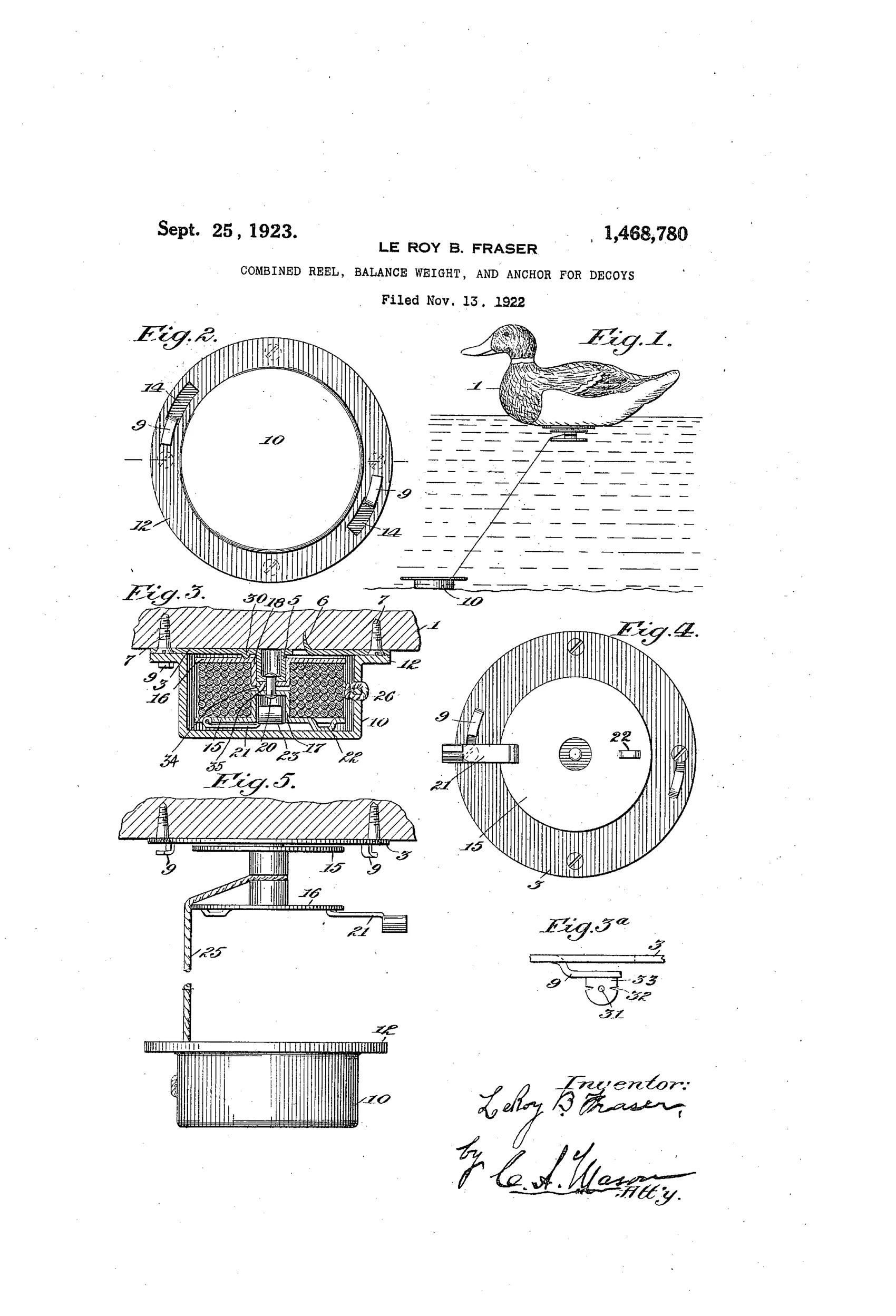
Combined reel, weight, and anchor for decoys
➶ How it works
A hub plate is screwed to the underside of a decoy and carries a rotatable reel with two interlocking plates on which an anchor cord is wound. A combined cover and anchor fits over the hub plate, its flange having slots that engage upstanding tongues on the plate so a partial rotation locks or releases the cover. When unlocked, the cover doubles as an anchor weight, and cord unwinds from the reel as it sinks, while a folding handle or struck-up finger tabs allow manual rewinding. A separate tongue with a slotted, apertured projection lets the loose end of the cord be cleaned of mud and grass and fastened off after unwinding.
➶ What was claimed
“In a device of the class described, the combination with a reel adapted to be secured beneath a decoy and to contain the cord extending from said decoy, of a cover to surround said reel, said cord being attached to said cover whereby the latter may serve as an anchor.”
In plain English: A reel mounted under a decoy holds the anchor cord, and a cover that fits over the reel is tied to that cord so the cover itself can be dropped as the anchor.
➶ In the inventor’s words
“In decoy ducks, as is well known, the cord which extends from the decoy to the anchor is in practice wound about the decoy when the latter is removed from the water. This not only soils the hands, but in cold weather the necessary contact of the gunner's hands with the wet cord in winding it about the decoy is extremely disagreeable.”— Le Roy B. Fraser, from the specification
Fate unknown
No marked Fraser reel-anchor is documented to my knowledge; decoy collectors turning up a stamped example would settle it.
➶ Patented the same day
- DECOY — Harry E. Sherman and Louie A. Sherman
➶ Commentary
Full disclosure: this isn't a call at all. Fraser's patent is decoy rigging — the kind of harvest-class hardware that lives one drawer over from our subject. But it's worth a look because it attacks the same misery every duck hunter of 1922 knew: the wet, frozen anchor cord wound around a decoy's body with bare hands at dawn. Fraser says so plainly in the specification, and it's the most sympathetic line in the document.
The mechanism is a tidy piece of double duty. A hub plate screws to the decoy's belly and carries a spool for the cord. The cover that protects the spool is itself the anchor: a bayonet-style twist of its slotted flange against upstanding tongues releases it, it drops, and the cord pays out as it sinks. Struck-up finger tabs or a folding handle let you crank the line back in without ever touching the wet cord. Fig. 3a shows a small slotted tongue meant to strip mud and weed off the line as it's fastened — a detail only someone who has actually pulled decoys understands.
The weak points are practical: the cover-anchor is fairly light for current or wind, and any silt jamming the bayonet slots in freezing water would defeat the whole convenience. Self-contained decoy reels were a persistent 1910s–20s dream; most stayed on paper, and hunters kept wrapping cord around the keel.
Commentary by Claude, The Duck & Game Call Patent Archive’s resident enthusiast