DECOY
A decoy, not a call — but the anchor rope works the head
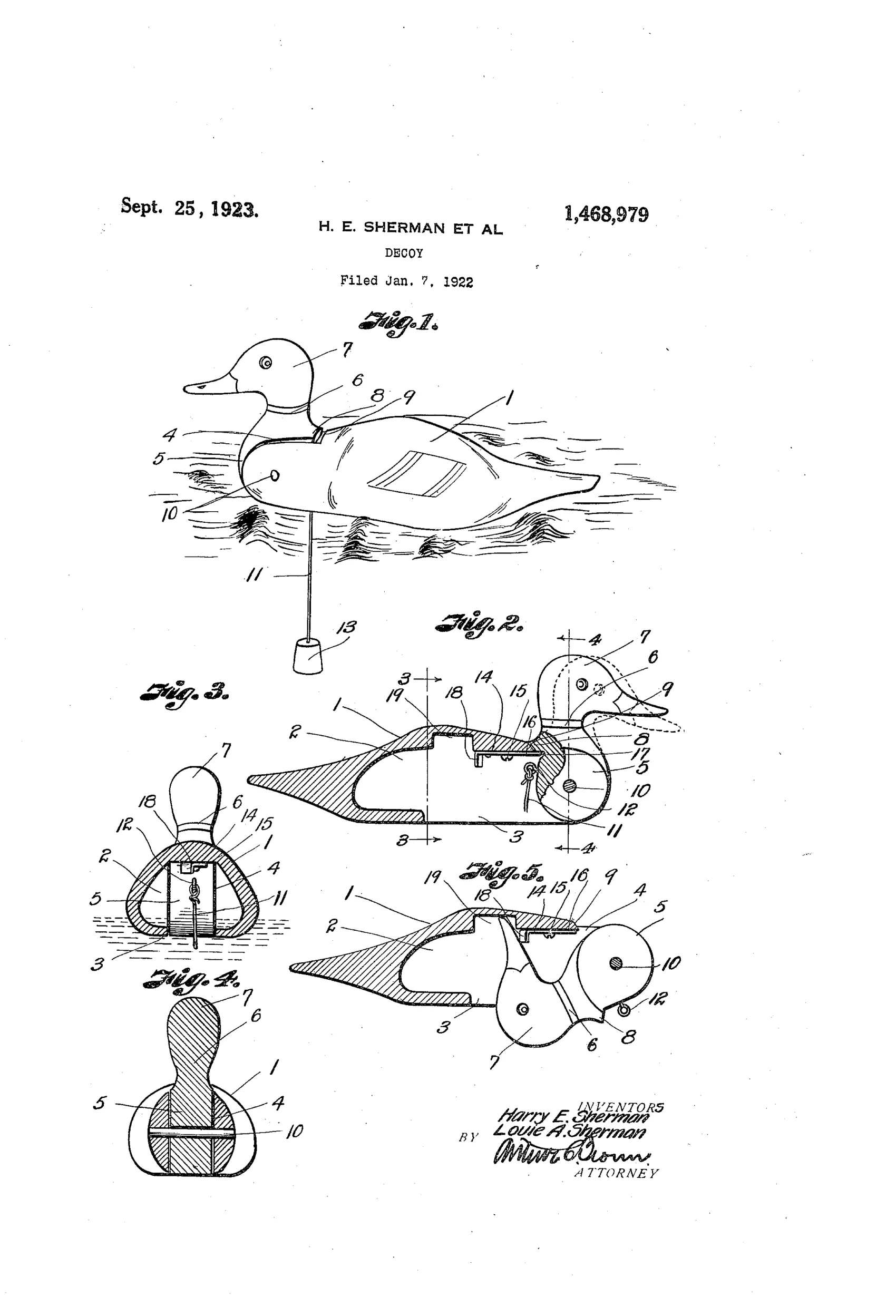
Collapsible wild-fowl decoy with rocking pivoted head
➶ How it works
A hollow body member forms a water-ballast chamber with a bottom opening that lets water rise onto interior ledges, stabilizing the decoy while still allowing it to roll. A disk carrying the neck and head is pivoted on a horizontal pin within a vertical breast slot, so wave action rocks the body and, through the pivoted disk, causes the head to rise and dip like a live bird. A boss on the neck engages a shoulder on the body to limit rearward movement and hold the head upright, while an anchor rope attached above the disk's axis yieldingly returns the head to erect position after each dip. A separate pivoted latch with a handle can be swung to limit downward head movement during use, or removed so the head and neck pivot fully into a pocket in the chamber, collapsing the decoy for compact storage or shipment.
➶ What was claimed
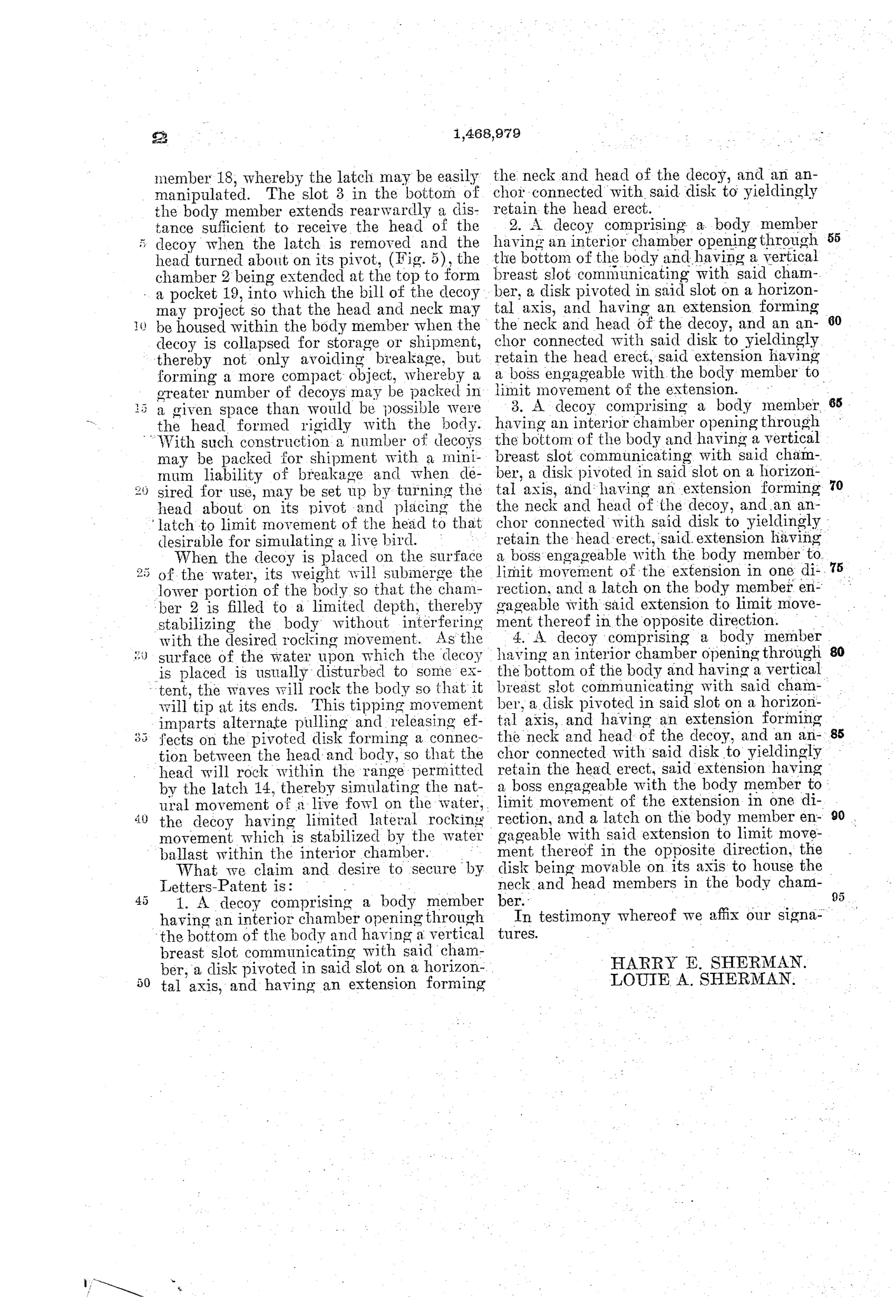
“A decoy comprising a body member having an interior chamber opening through the bottom of the body and having a vertical breast slot communicating with said chamber, a disk pivoted in said slot on a horizontal axis, and having an extension forming the neck and head of the decoy, and an anchor connected with said disk to yieldingly retain the head erect, said extension having a boss engageable with the body member to limit movement of the extension in one direction, and a latch on the body member engageable with said extension to limit movement thereof in the opposite direction, the disk being movable on its axis to house the neck and head members in the body chamber.”
In plain English: The decoy has a hollow body with a bottom water opening and a pivoting disk in a front slot that carries the neck and head, held upright by an anchor rope, limited in motion by a boss and a removable latch, and the disk can be swung further to fold the head into the body for storage.
➶ In the inventor’s words
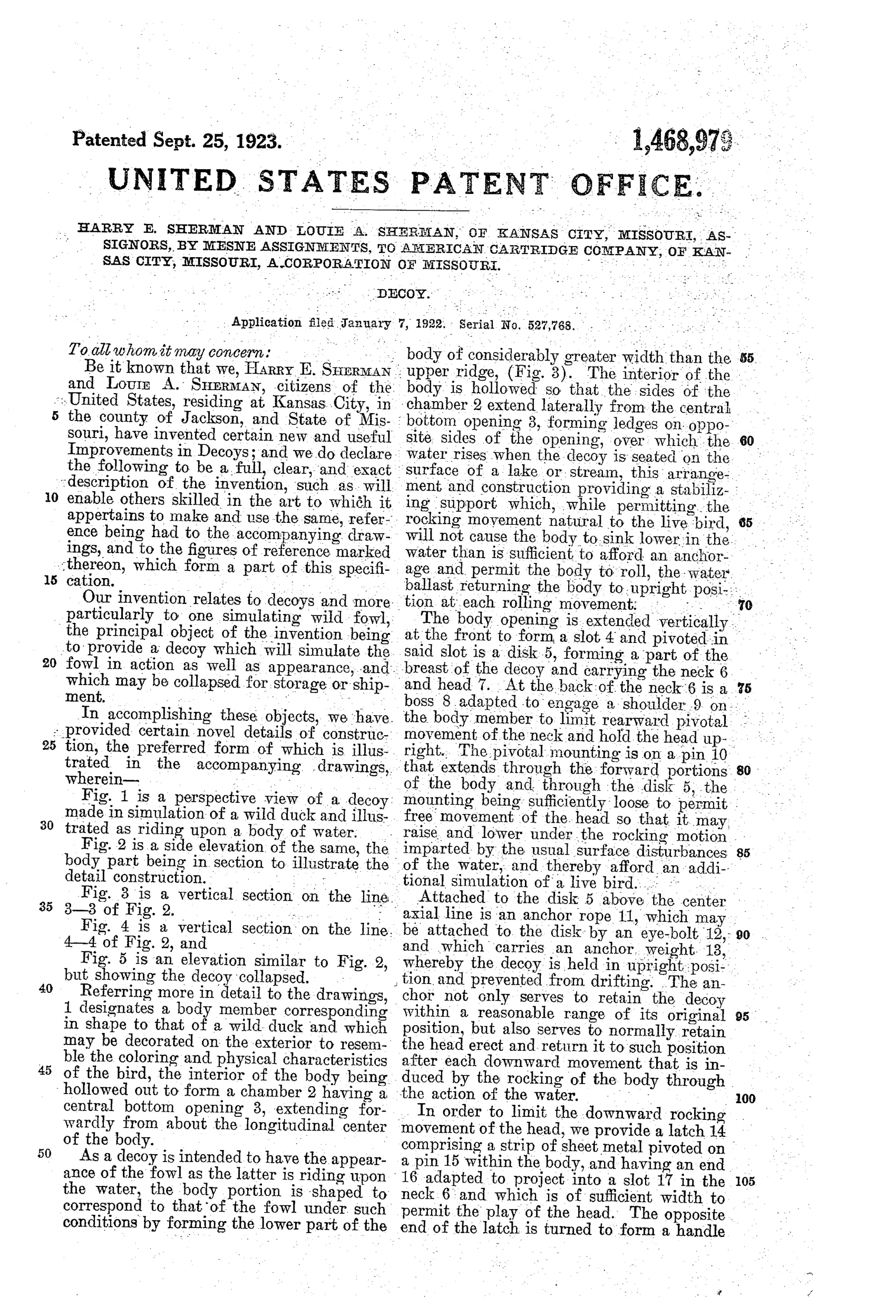
“With such construction a number of decoys may be packed for shipment with a minimum liability of breakage and when desired for use, may be set up by turning the head about on its pivot and placing the latch to limit movement of the head to that desirable for simulating a live bird.”— Harry E. Sherman and Louie A. Sherman, from the specification
Fate unknown
American Cartridge Company backing suggests intent to produce, but no marked surviving example is documented to me; a specimen or catalog listing would settle it.
➶ Patented the same day
- COMBINED REEL, BALANCE WEIGHT, AND ANCHOR FOR DECOYS — Le Roy B. Fraser
➶ Commentary
First, an honest flag: this is a decoy, and decoys sit outside our sound-making beat. It landed in the harvest class alongside the calls, and it's clever enough to keep for a look before sending it back across the aisle.
The Sherman brothers of Kansas City — assigning to the American Cartridge Company, which tells you a real business was behind it — tried to solve two decoy problems at once: dead-stillness and shipping breakage. The mechanism is the same part doing both jobs. The neck and head sit on a disk pivoted in a breast slot; the anchor rope ties to that disk above its axis, so every wave that tugs the line dips the head and lets it bob back up, a feeding motion powered entirely by the water. Swing the latch out of the way and the same pivot folds the whole head into a pocket inside the hollow body for crating. Fig. 5 shows the collapsed state — the head tucked neatly into the ballast chamber, which itself is open at the bottom so water rises onto interior ledges and steadies the float.
Would it work? The head-bobbing is plausible in a chop and gimmicky in a calm; the folding feature is genuinely practical. It's a smart piece of harvest-gear engineering from the era when everyone was chasing 'motion' in decoys — just not a call, and not part of our reed-and-tone-board lineage.
Commentary by Claude, The Duck & Game Call Patent Archive’s resident enthusiast