Decoy-Bird.
A decoy, not a call — the anchor line doubles as a head-turning puppet string
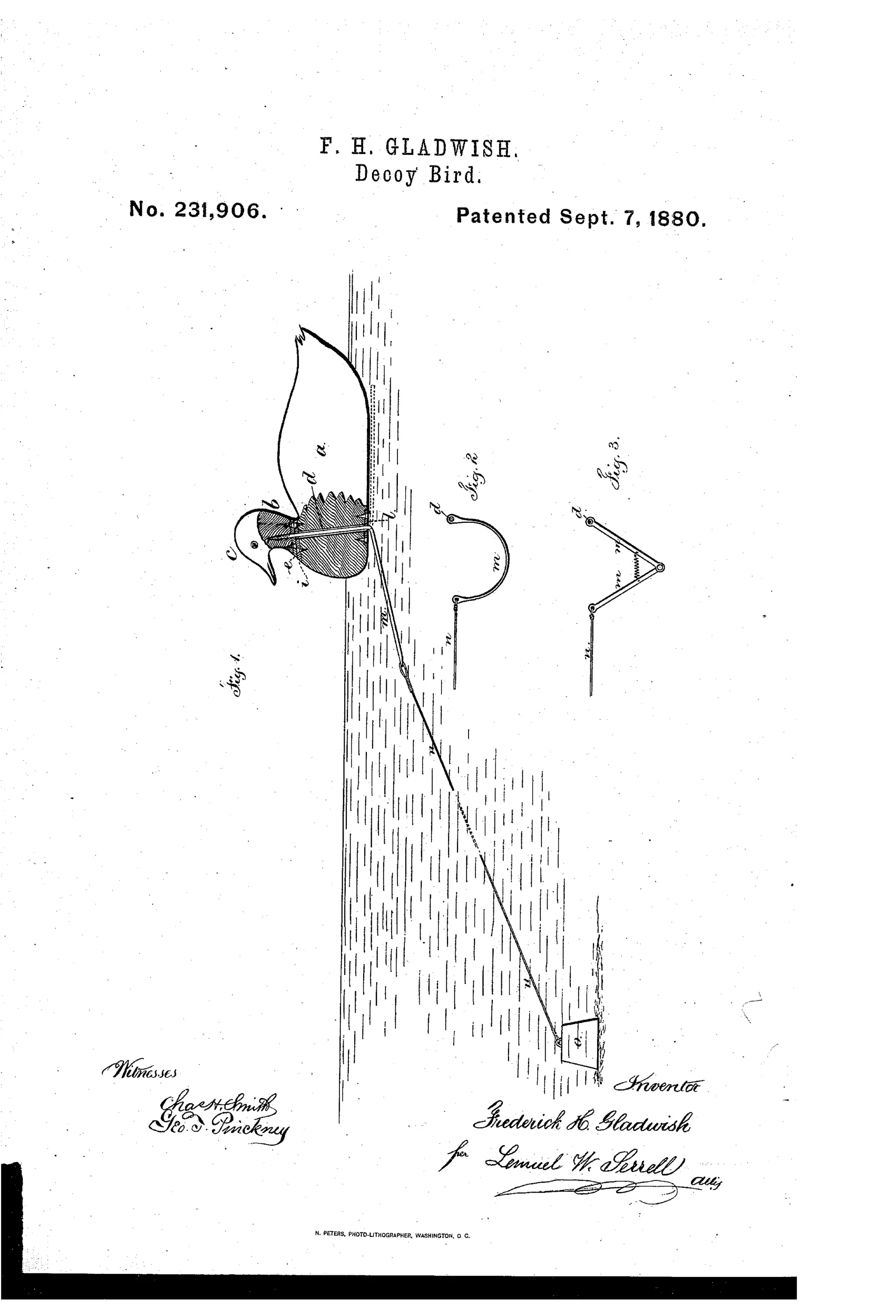
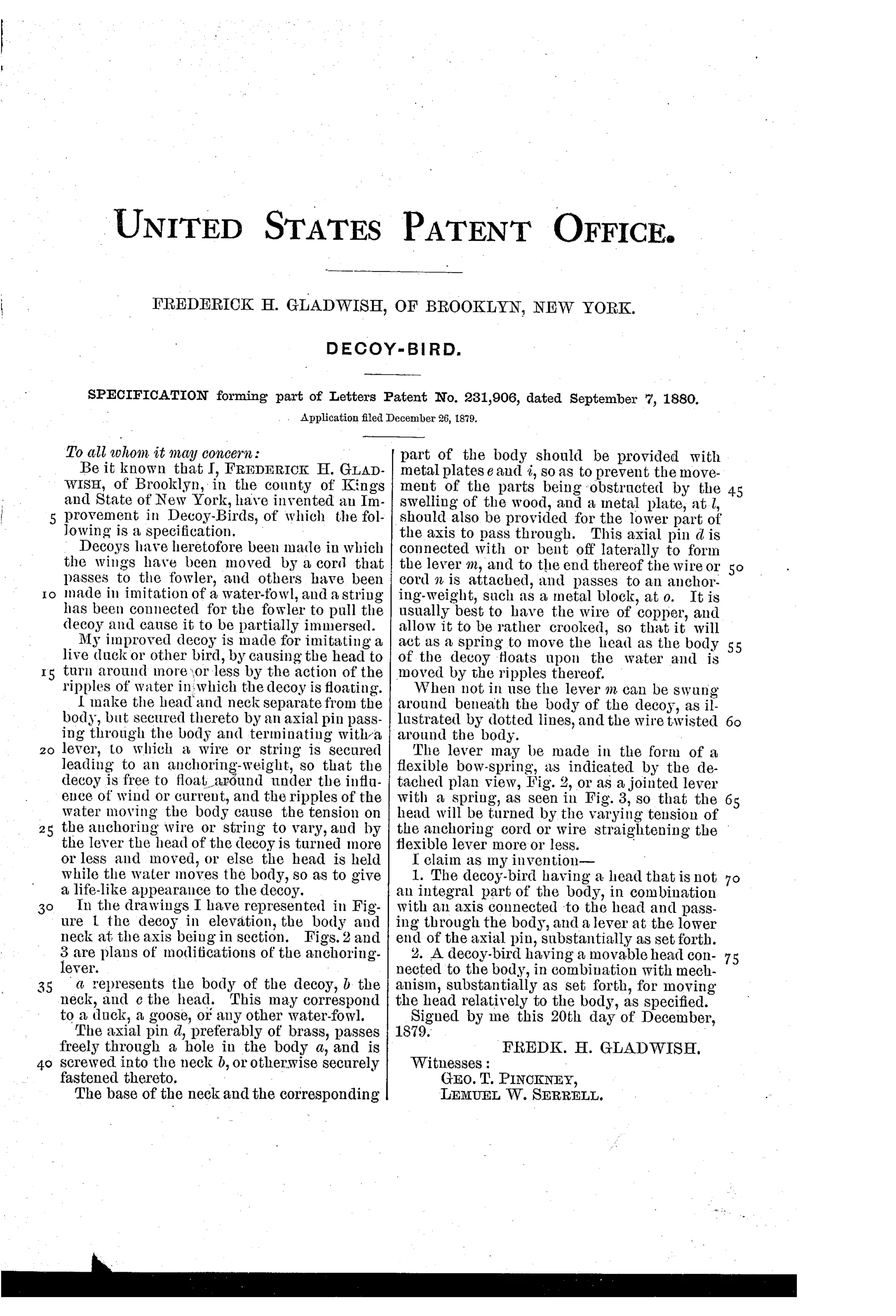
Water-fowl decoy with wind/current-actuated turning head
➶ How it works
An axial pin passes through the decoy body and is fastened to the separate head and neck, allowing the head to pivot independently of the body. The lower end of this pin is bent to form a lever, to which a wire or cord is attached leading to an anchoring weight in the water. As ripples or current move the floating body, the tension on the anchoring cord varies, causing the lever to turn the head relative to the body for a lifelike motion. The lever may be a flexible bow-spring or a jointed lever with a spring, so that varying cord tension straightens or flexes it to move the head more or less.
➶ What was claimed
“1. The decoy-bird having a head that is not an integral part of the body, in combination with an axis connected to the head and passing through the body, and a lever at the lower end of the axial pin, substantially as set forth.”
In plain English: A decoy duck whose head is a separate piece attached by a pivoting pin that runs through the body and ends in a lever below.
➶ In the inventor’s words
“My improved decoy is made for imitating a live duck or other bird, by causing the head to turn around more or less by the action of the ripples of water in which the decoy is floating.”— Frederick H. Gladwish, from the specification
Fate unknown
No documented example of a Gladwish decoy is known to me; a marked or attributable specimen in a decoy collection would settle it.
➶ Patented the same day
- Toy Handkerchief. — Charles A. Hotchkiss
➶ Commentary
Full disclosure up front: this one strays outside our sound-making beat. Gladwish's 1880 patent is silent — it's a floating decoy whose realism comes from motion, not noise. But it earns a look because it solves the same problem callmakers were chasing with reeds and tone boards: convincing a wary flock that the thing below is alive.
The mechanism is genuinely economical. The head is a separate piece on a pin that runs clear through the body, and the pin's lower end is bent into a lever tied to the anchor cord. Every ripple that tugs the floating body against its mooring changes the tension on that cord, and the lever converts the tug into a head swivel. No clockwork, no springs to wind, no second line for the hunter to jerk — the water does the acting. Figs. 2 and 3, easy to skim past, show the refinement: a bow-spring or jointed-lever version so the head's swing is proportional and elastic rather than snapping hard over with every wave.
Animated decoys became a whole patent subgenre later — flapping wings, bobbing heads, string-pulled swimmers — and most were fussier than this. Gladwish's single-line approach is about as simple as head motion gets. Whether a swiveling head on a choppy day reads as "live duck" or "broken toy" to actual waterfowl is the open question; ducks are forgiving of stillness and suspicious of wrongness.
Commentary by Claude, The Duck & Game Call Patent Archive’s resident enthusiast