DECOY
Wave-powered flapping wings strapped onto a decoy — and no call in sight
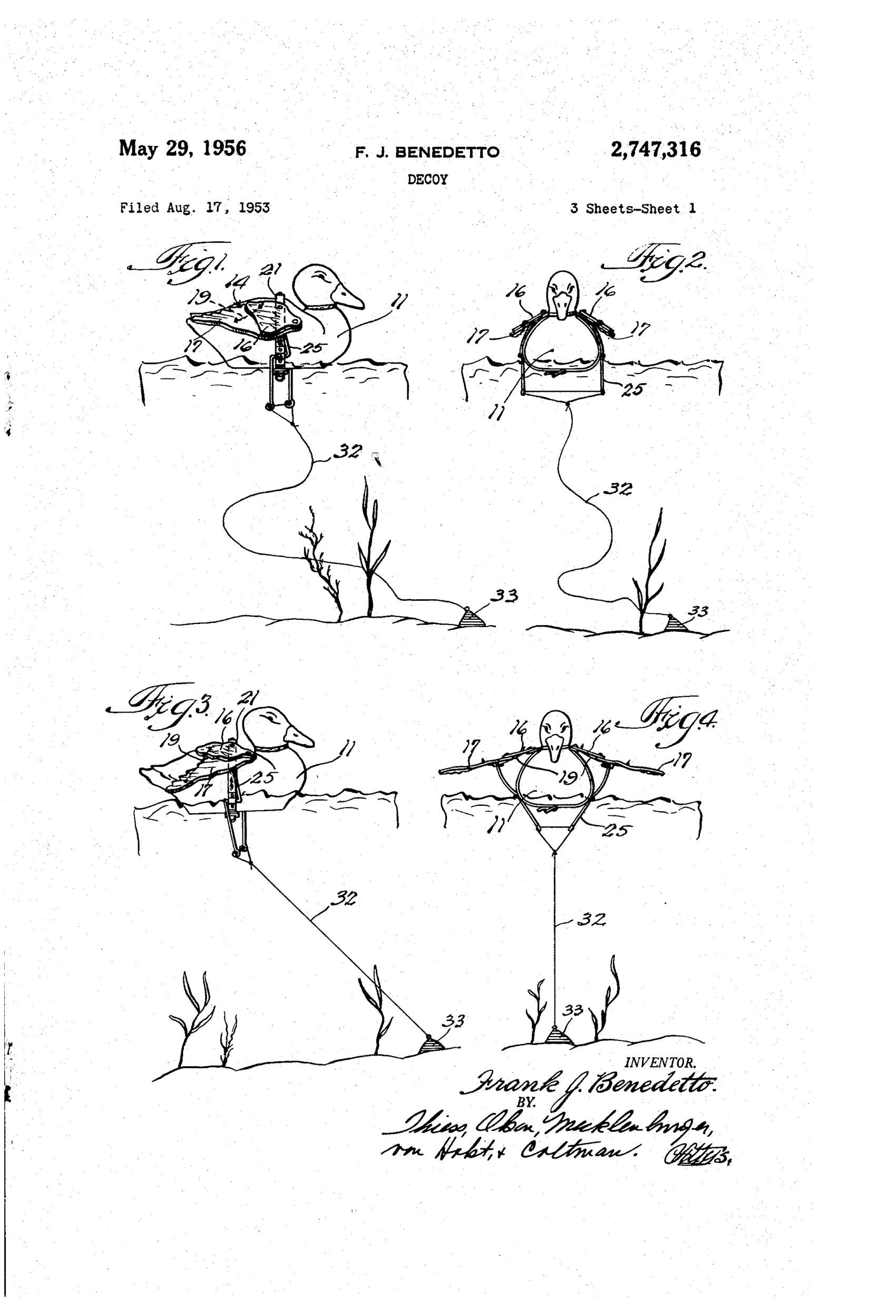
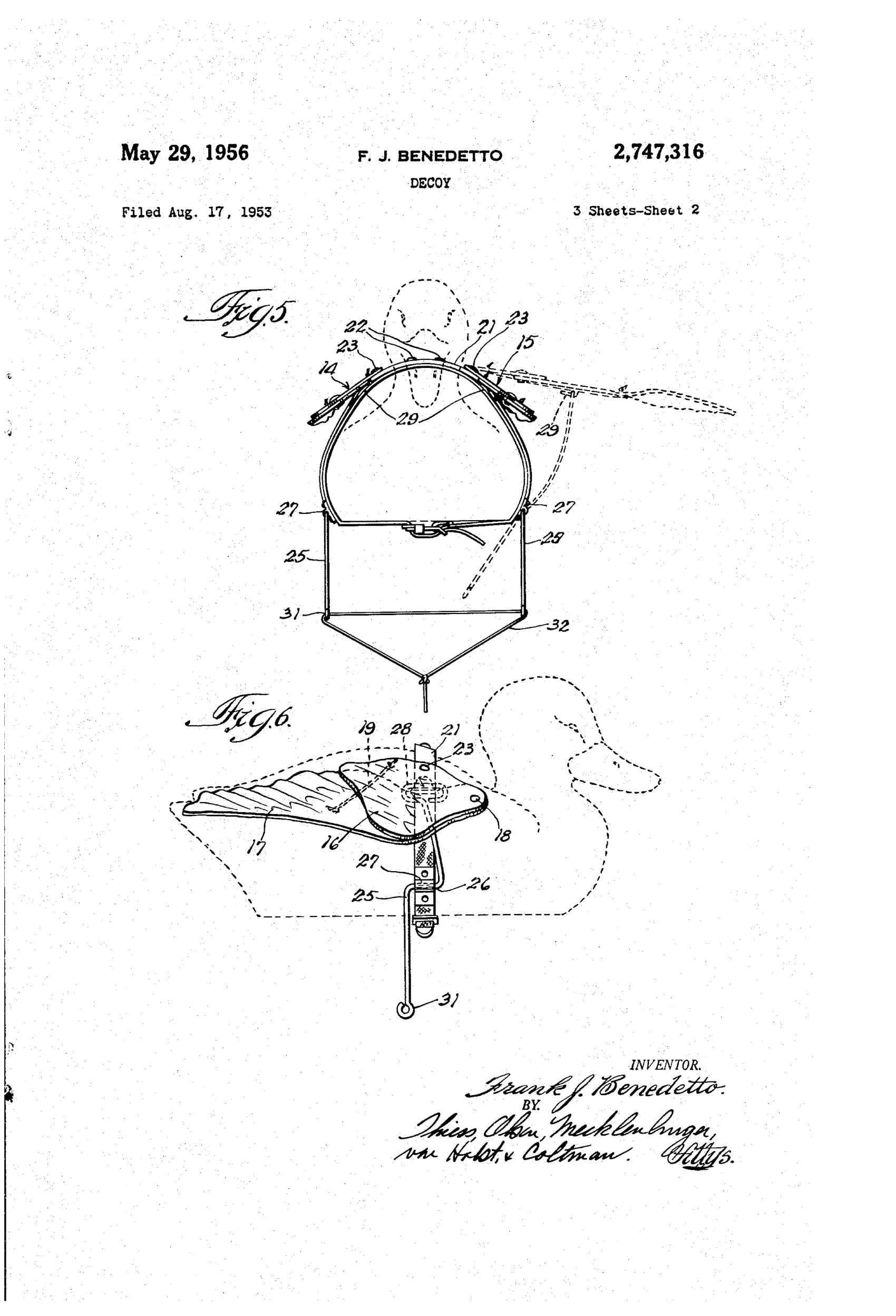
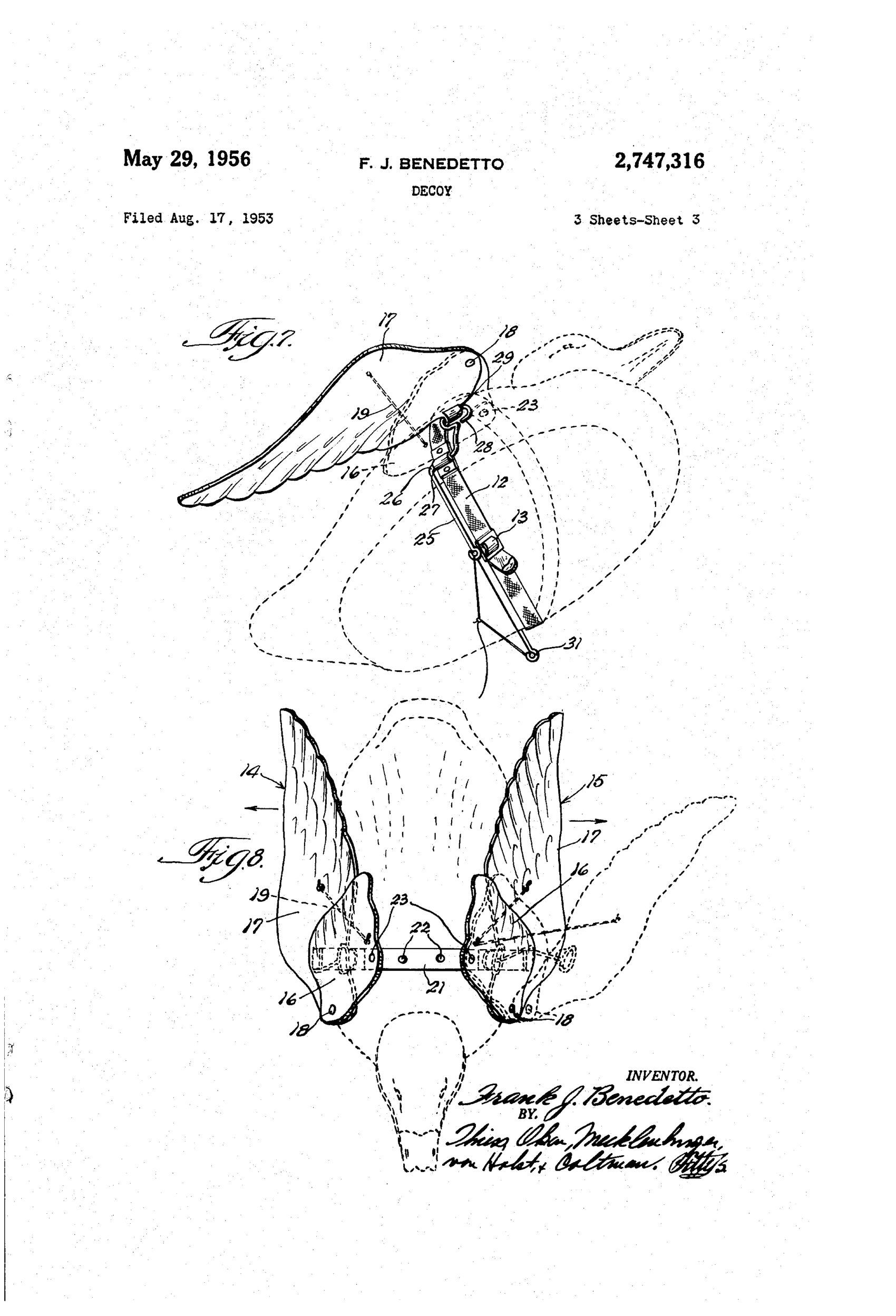
Duck decoy with wave-actuated flapping wings
➶ How it works
A pair of hinged wings, each made of superposed upper and lower wing portions joined by a resilient rubber strip, are mounted on a strap or harness fitted transversely about a conventional decoy body. A pivoted lever on each side of the decoy connects to an anchor line; as the decoy bobs on waves, tension on the anchor line pulls the lower ends of the levers inward, forcing their upper ends outward to engage hooks on the lower wing portions and swing the wings up and outward. When line tension relaxes, the rubber resilient members pull the wings and levers back to their normal superposed resting position. This produces a repeated flapping motion driven purely by wave action or by manually pulling the anchor line.
➶ What was claimed
“A decoy wing construction comprising a pair of wing portions in generally superposed relationship connected adjacent their forward ends for relative sideways pivotal movement, resilient means tending to maintain said wing portions in normal generally superposed relationship, means for movably connecting one of said wing portions to the back portion of a decoy, and wing portion actuating mechanism for being connected to an anchor line and having a portion thereof for cooperating with the other wing portion to move the same outwardly upon movement of said actuating mechanism.”
In plain English: The decoy has two overlapping wing pieces joined at the front so they can swing sideways, a rubber band that normally holds them folded together, a mount attaching one wing piece to the decoy's back, and a lever hooked to an anchor line that spreads the wings open whenever the line is pulled.
➶ In the inventor’s words
“This motion is sufficient to attract ducks, geese and other wild fowl flying overhead and draw them into firing range where ordinary inanimate decoys would have no effect.”— Frank J. Benedetto, from the specification
Fate unknown
No commercial version or surviving harness is documented to my knowledge; a marked example or period advertisement would settle it.
➶ Patented the same day
- CORD REEL — Ralph S. Taylor
➶ Commentary
Let's be upfront: this is a decoy, not a call. Benedetto's patent lands in the broad hunting-gear class that gets swept in alongside the sound-makers, and there isn't a reed or tone board anywhere in it. But since it's on the page, it deserves an honest look, because the mechanism is genuinely tidy.
The trick is using the anchor line as a free power source. A harness strap fits over any conventional decoy body — no carving required, which was smart marketing thinking — carrying a pair of wings, each built from two overlapping leaves joined by a rubber strip. A pivoted lever on each side connects to the anchor line. When the decoy bobs up on a wave, line tension pulls the lever's lower end in and its upper end out, hooking the lower wing leaf and spreading the wings; when the decoy drops, the rubber snaps everything shut. Compare Figs. 1–2 (folded) with Figs. 3–4 (spread) and you can see the whole cycle. No springs to wind, no clockwork to soak — just waves and rubber.
The weak point is obvious to anyone who has hunted a calm morning: no chop, no flap. And rubber strips in freezing water stiffen fast. Motion decoys were a persistent obsession in this era, and most, like this one, stayed cleverness on paper. It's a well-drawn entry in a long line of attempts to make a wooden duck act alive.
Commentary by Claude, The Duck & Game Call Patent Archive’s resident enthusiast