CORD REEL
A retractable-badge reel for decoys — silent gear from a calls-first collection
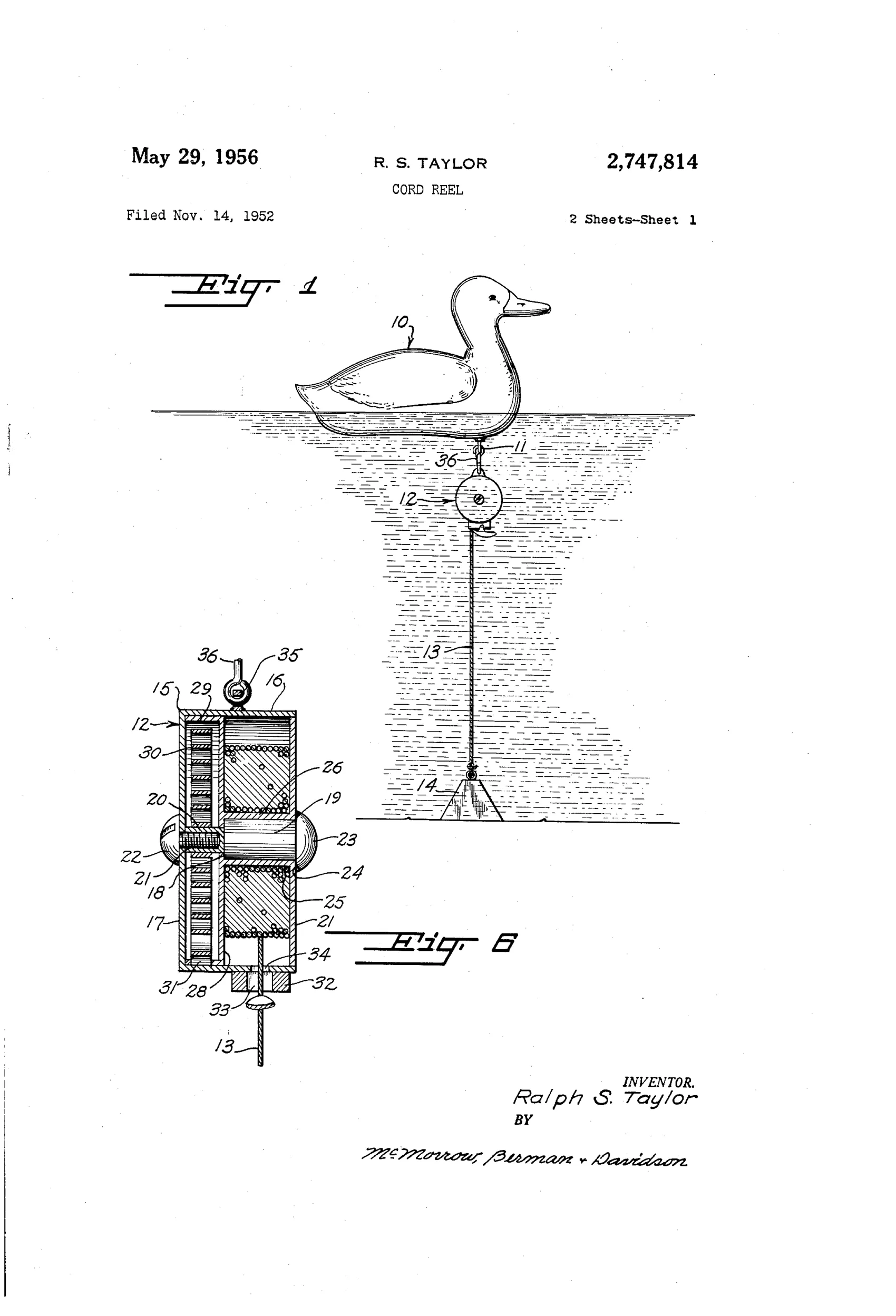
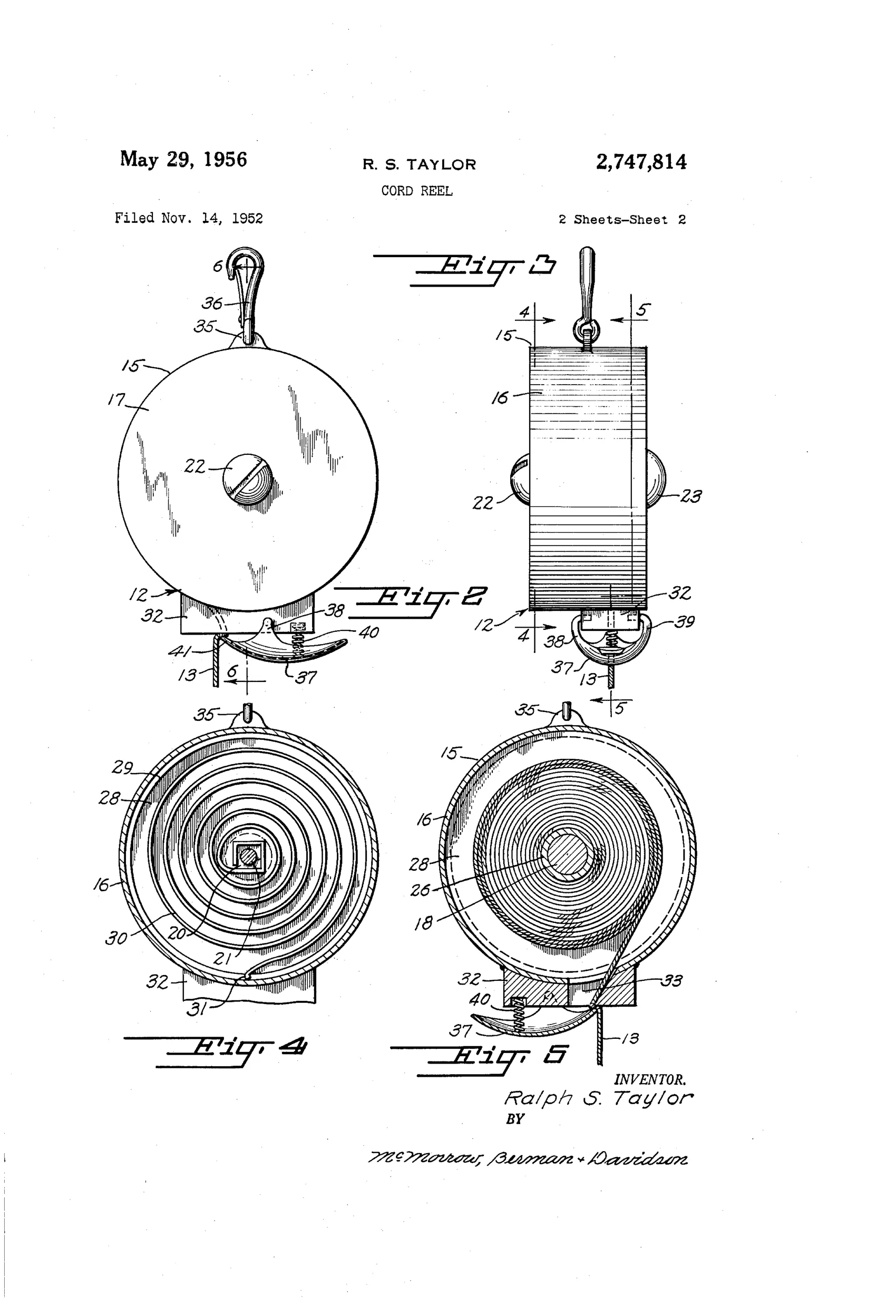
Spring-loaded automatic reel for decoy anchor cord
➶ How it works
A winding spool journaled inside a cylindrical housing is connected by a spiral clock spring to a rigid central shaft, so pulling cord out winds the spring while releasing the cord lets the spring rewind it onto the spool. The cord passes out through a registering aperture in the housing wall and a boss, where a pivoted, spring-loaded sheet metal clip presses the cord against an angled edge of the boss aperture to lock it at any desired extended length. Finger pressure against the clip's compression spring releases the clamp so the cord can be pulled out or freely rewound. A snap hook on a lug opposite the boss lets the reel be detachably connected to an eye bolt on the decoy's underside.
➶ What was claimed
“A cord reel attachable to a duck decoy for holding a decoy anchor cord comprising a housing having an annular wall and an end wall closing one end of said annular wall, a shaft disposed in said housing substantially perpendicular to said end wall and rigidly secured at one end to said end wall centrally of the latter, a winding spool journaled on said shaft and spaced from said end wall, an apertured boss on said annular wall, said annular wall having an aperture therein registering with the aperture in said boss, a cord wound on said spool and extending through said registering apertures, a cord rewinding spring disposed between said spool and said end wall with one end secured to said shaft and its other end connected to said spool, a releasable fastener secured to said annular wall at a location opposite said apertured boss for detachably connecting said reel to a decoy, a clip pivotally mounted on said apertured boss for movement in an arcuate path into the aperture in said boss and with one end positioned to intercept and engage said cord at the outer end of said boss, and spring means disposed between said boss and said clips resiliently urging said clip into the aperture in said boss and into engagement with said cord to hold the latter against movement into or out of said housing, said clip being manually movable against the force of said spring to free said cord.”
In plain English: A self-winding cord reel that snaps onto a duck decoy, automatically rewinds the anchor cord via an internal spring, and has a spring-loaded pivoting clip that clamps the cord to hold it at whatever length is pulled out until manually released.
➶ In the inventor’s words
“This decoy will float on the water with the greater portion thereof above the water, as illustrated in Figure 1, and is provided on its bottom surface near the front end thereof with an outwardly extending eye 11 which may be provided by the ring-shaped head of an eye bolt, the shank of which is threaded into the material of the decoy.”— Ralph S. Taylor, from the specification
Fate unknown
Spring decoy-cord reels did reach the market in later decades, but no example marked to this patent is documented; a surviving specimen would settle it.
➶ Patented the same day
- DECOY — Frank J. Benedetto
➶ Commentary
Full disclosure up front: this is not a call. Taylor's patent makes no sound at all — it lives in the broad hunting-gear class alongside blinds and scent bombs, and it earns its place on this page only as a neighbor to the decoys our calls were meant to work with. What it is, mechanically, is a retractable key-reel scaled for pond duty: a clock spring coiled around a fixed central shaft, a spool journaled on that shaft, and the anchor cord paying out through a boss in the housing wall. Pull cord, wind spring; release, and it rewinds itself.
The genuinely thoughtful part is the locking clip in Fig. 6 — a pivoted sheet-metal finger, spring-urged into the boss aperture, pinching the cord against an angled edge. That gives you infinitely variable depth setting with one thumb press, which matters when you're rigging three dozen decoys off a boat gunwale in the dark. The snap hook opposite the boss means the reel detaches, so tangled-cord decoy bags — the eternal misery of waterfowlers — become a solved problem, at least on paper.
The worry is the same one every spring-loaded reel faces in water: a clock spring in a housing that ices, silts, and corrodes. Later commercial decoy rigs mostly went the other way — dumb, robust cord wraps and weighted keels. Taylor bet on mechanism where the market eventually chose simplicity.
Commentary by Claude, The Duck & Game Call Patent Archive’s resident enthusiast