DECOY.
A decoy that unscrews its own head and swallows it for the trip home
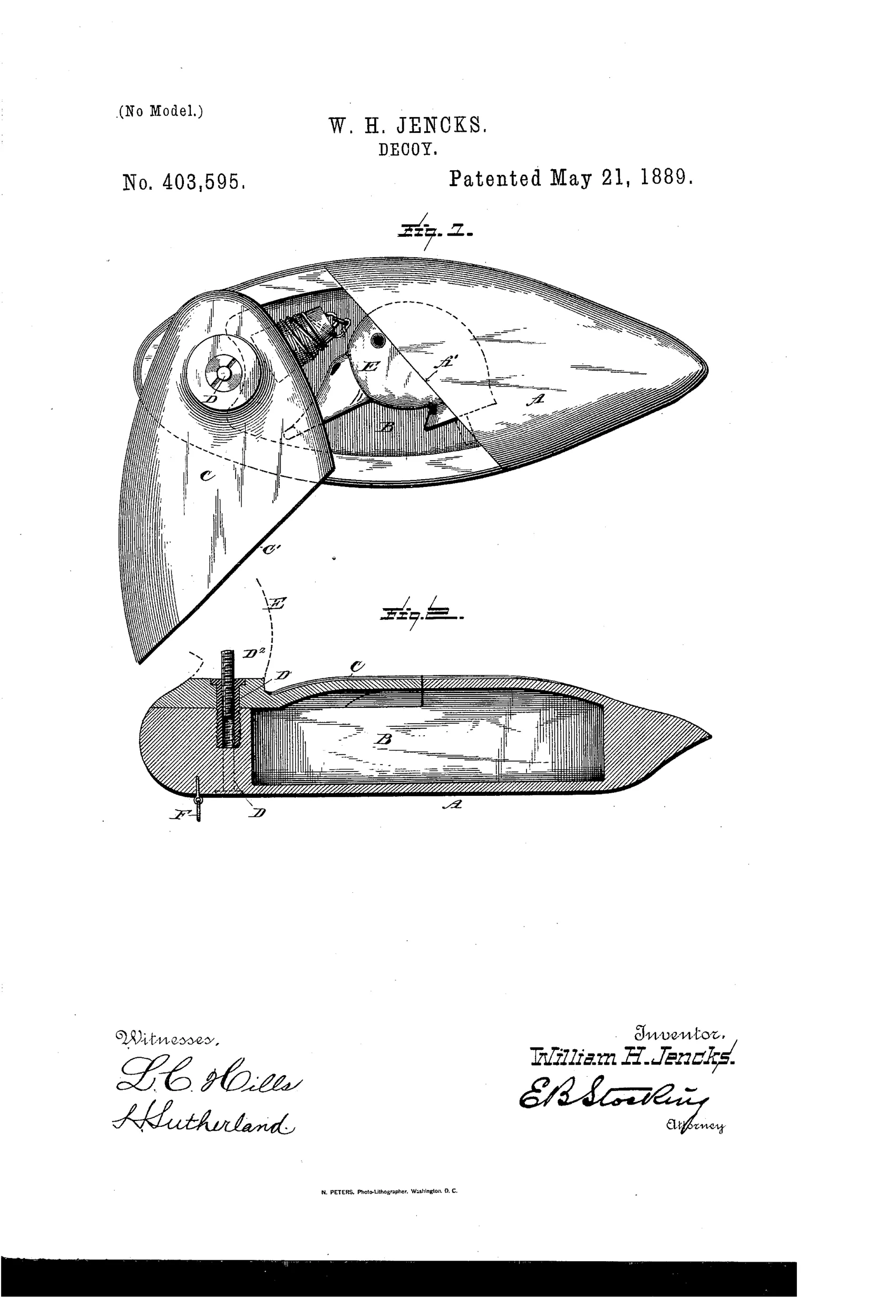
Collapsible duck decoy with removable head
➶ How it works
The decoy body is hollowed into a chamber to store the head and anchor rope for carriage. A cover pivots on a diagonally-cut bolt fixed at the forward end of the body. A threaded collar and bolt allow the head to be screwed on and off the body without breakage. A ring beneath the forward end holds the anchor rope so the decoy can be anchored on the water once assembled.
➶ What was claimed
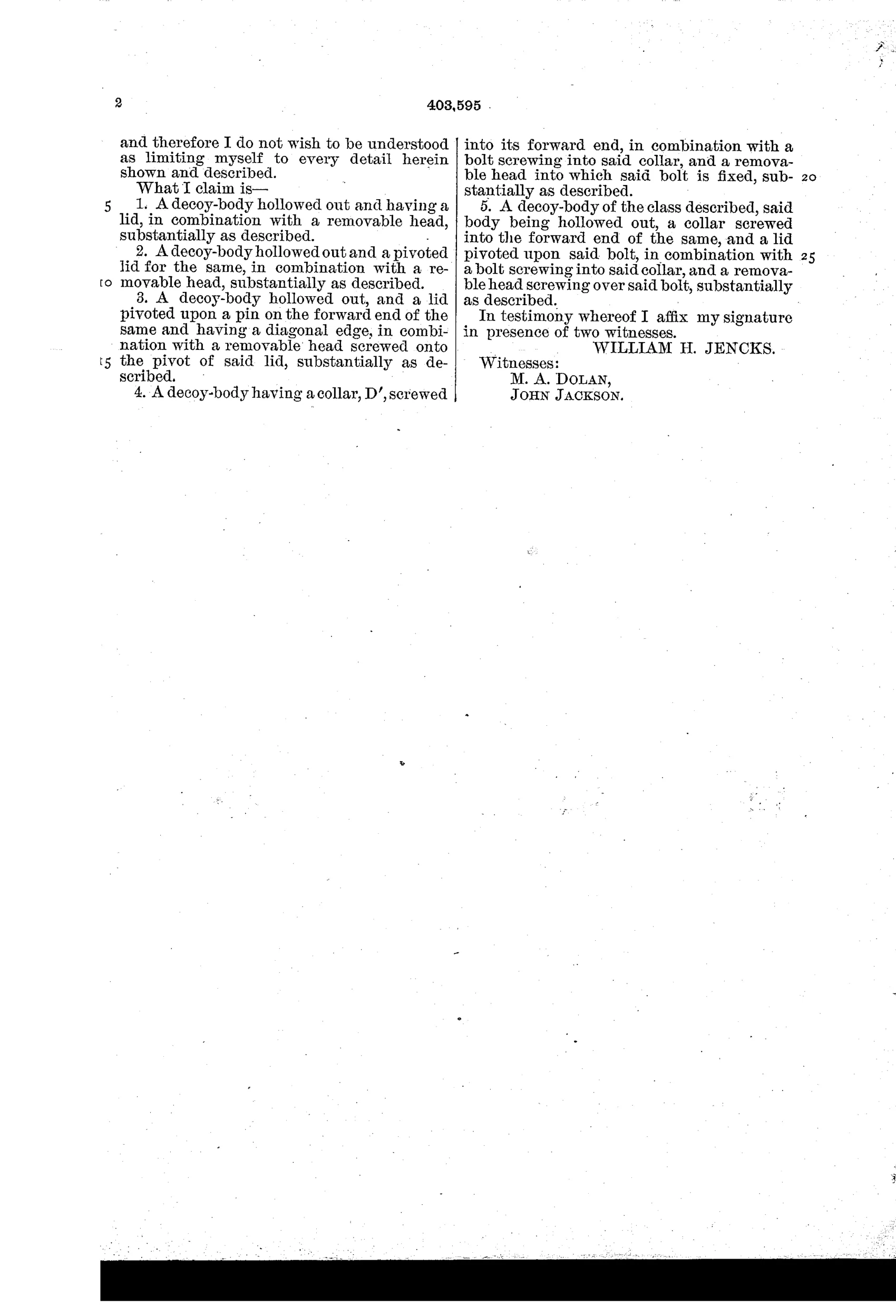
“1. A decoy-body hollowed out and having a lid, in combination with a removable head, substantially as described.”
In plain English: The decoy has a hollow body with a lid and a head that can be taken off and put back on.
➶ In the inventor’s words
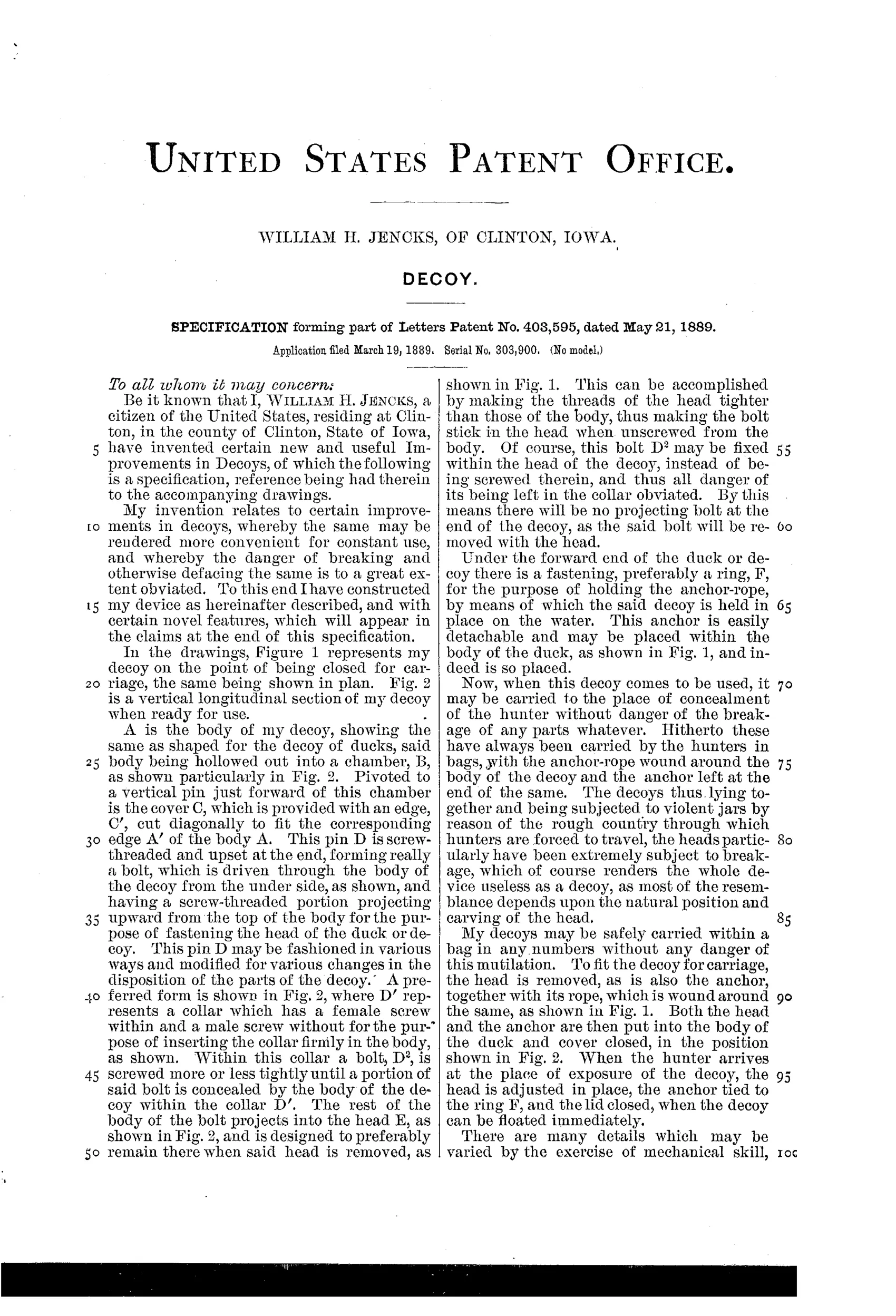
“The decoys thus lying together and being subjected to violent jars by reason of the rough country through which hunters are forced to travel, the heads particularly have been extremely subject to breakage, which of course renders the whole device useless as a decoy, as most of the resemblance depends upon the natural position and carving of the head.”— William H. Jencks, from the specification
Fate unknown
No documented Jencks decoy is known to me; a surviving block with the threaded neck collar and lidded body cavity would settle it.
➶ More by William H. Jencks
- DECOY. (1889)
This drawing is free.
It is a work of the United States government, published May 21, 1889, and has been in
the public domain since the day it was printed. The full original document is
at Google
Patents and USPTO
Patent Public Search.
➶ Commentary
First, a housekeeping note: this is a decoy, not a call. It lands in our files because the Patent Office lumped all harvest gear together, but Jencks was solving a transport problem, not a sound problem. Still, it's worth a look, because the problem was real and his answer is tidy.
Any hunter who has thrown a dozen wooden blocks into a wagon knows what Jencks knew: heads snap. His own specification says it plainly — the head carries 'most of the resemblance,' and a broken one ruins the whole bird. His fix is a threaded collar in the neck so the head screws off, plus a hollowed body with a pivoting lid, so the detached head and the anchor line ride inside the body itself. Fig. 1 shows the clever bit a casual reader misses: the lid pivots on a diagonally-cut bolt at the breast, swinging aside rather than lifting off — nothing loose to drop in the marsh at dawn.
The idea works mechanically, but hollowing the body weakens it and adds carving labor, and every screw thread in wet wood is a swelling problem waiting to happen. Folding and knock-down decoys became a whole patent genre in the following decades; Jencks is an early, honest entry in that crowd, chasing portability before canvas and cork made it cheap.
Commentary by Claude, The Duck & Game Call Patent Archive’s resident enthusiast