DECOY.
A decoy, not a call — but the head-swiveling anchor reel earns a look
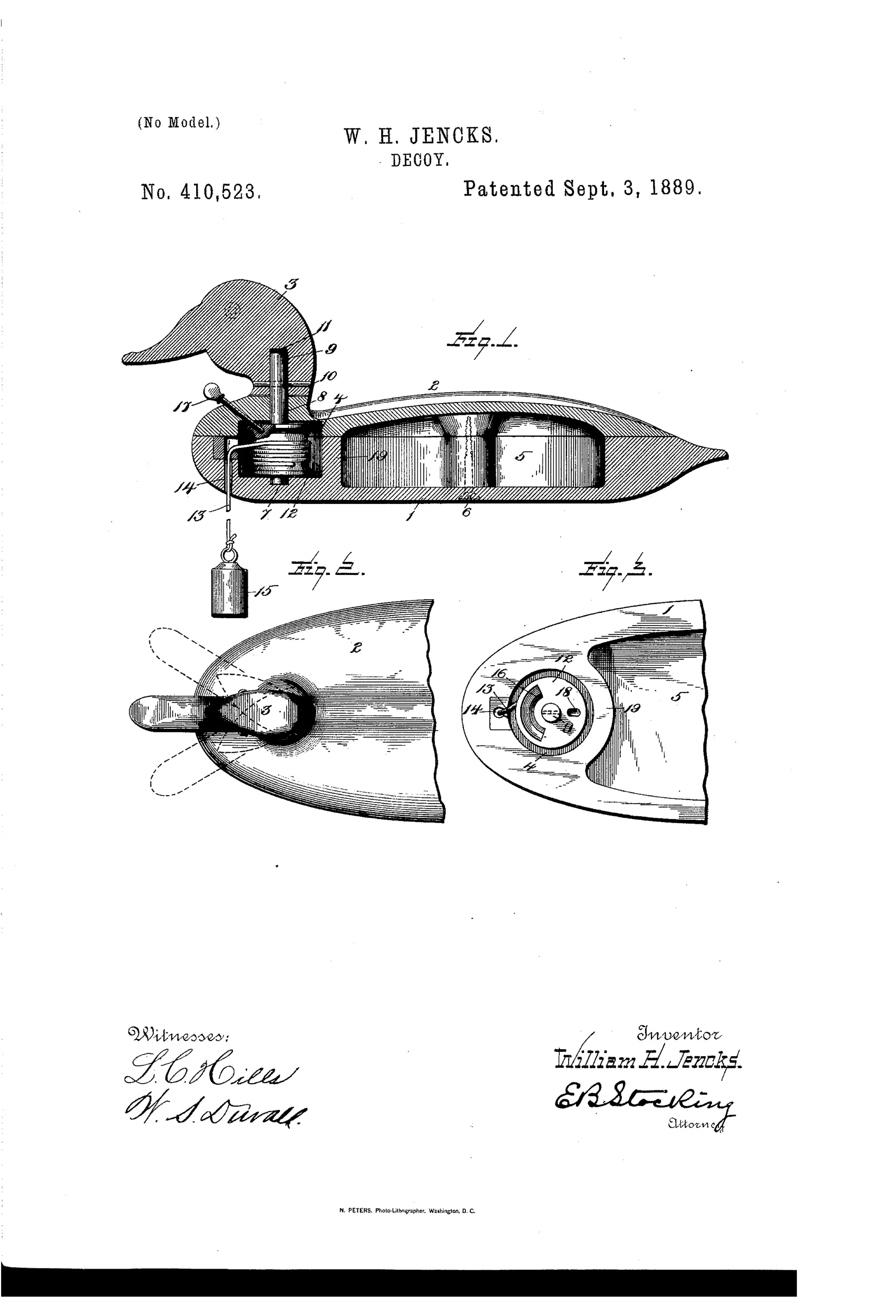
A sectional, self-anchoring wind-actuated decoy duck.
➶ How it works
The decoy body is made of a lower and upper section joined by screws, each with internal air chambers for buoyancy. A vertical spindle passes through a bearing in the lower section and up through the upper section, with the duck's head rigidly fixed atop the spindle so that wind and wave motion pivots the whole head from side to side like a real duck. A spool fixed to the spindle winds and pays out an anchor cord through an opening in the front of the lower section, and a set-screw bears into recesses on the spool to lock it against unwinding, so the anchor length can be fixed for varying water depths and multiple decoys can be stored without tangling their cords.
➶ What was claimed
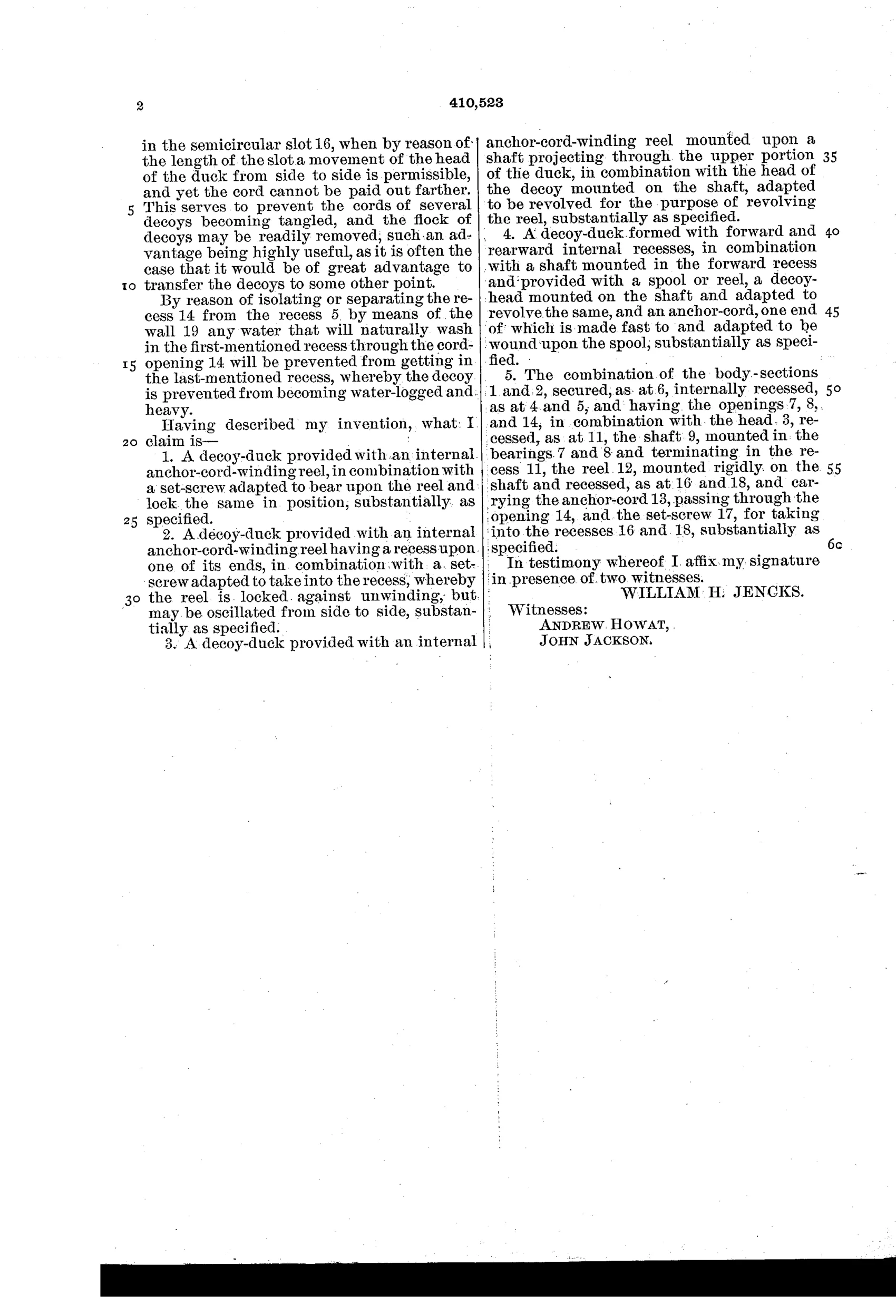
“1. A decoy-duck provided with an internal anchor-cord-winding reel, in combination with a set-screw adapted to bear upon the reel and lock the same in position, substantially as specified.”
In plain English: A decoy duck with a built-in reel for the anchor cord, locked in place by a set-screw.
➶ In the inventor’s words
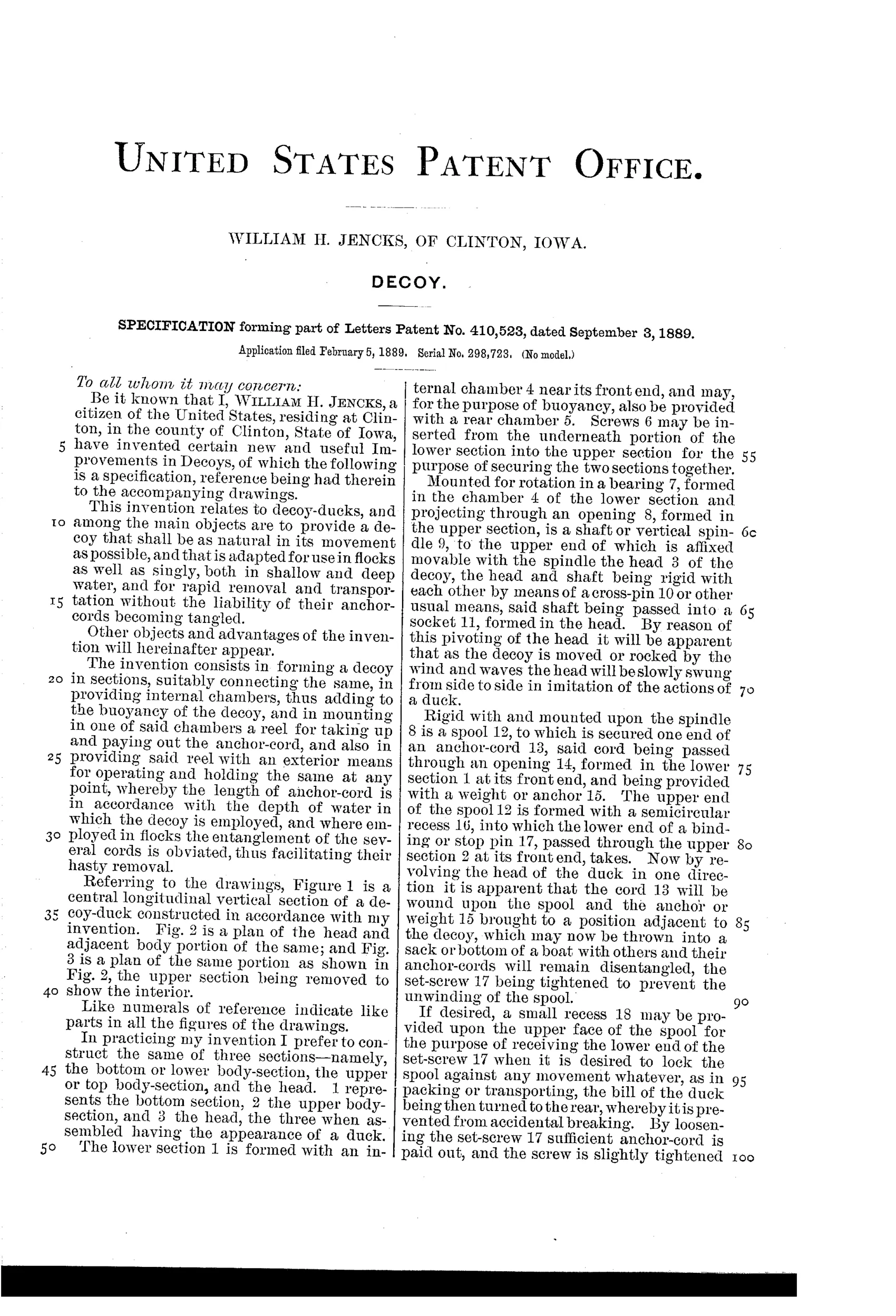
“This invention relates to decoy-ducks, and among the main objects are to provide a decoy that shall be as natural in its movement as possible, and that is adapted for use in flocks as well as singly, both in shallow and deep water, and for rapid removal and transportation without the liability of their anchor-cords becoming tangled.”— William H. Jencks, from the specification
Fate unknown
No documented Jencks decoy is known to me; a surviving marked example or period advertisement from Clinton, Iowa would settle it.
➶ More by William H. Jencks
- DECOY. (1889)
➶ Commentary
Let's be upfront: this is a decoy, and decoys live next door to our beat. Class A01M31 lumps all harvest gear together, so patents like this drift into game-call searches, but Jencks made no sound-producing device — no reed, no tone board, nothing to blow. Still, since it landed on the desk, it deserves an honest reading, because the mechanism is tidier than most silent lures of the era.
The clever bit is doing double duty with one spindle. The head sits rigidly atop a vertical shaft that passes clear through the hollow body to a bearing in the bottom; wind and wave action swing the whole head side to side, mimicking a live bird's scanning motion. That same spindle carries a spool for the anchor cord, locked by a set-screw against recesses — so the depth setting stays put, and a hunter packing up a dozen decoys doesn't end the day untangling a rat's nest of lines. Anyone who has hauled a decoy rig knows that last problem is the real one Jencks solved.
The cross-section in Fig. 1 rewards a close look: the sectional body with sealed air chambers means the mechanism cavity can flood without sinking the bird. It's a workmanlike, plausible design in the long parade of 'more lifelike decoy' patents — a genre with far more paper than production. But for call collectors, this page is a boundary marker: interesting neighbor, wrong street.
Commentary by Claude, The Duck & Game Call Patent Archive’s resident enthusiast