DECOY.
A stuff-it-yourself fabric duck: pack it with marsh grass on arrival
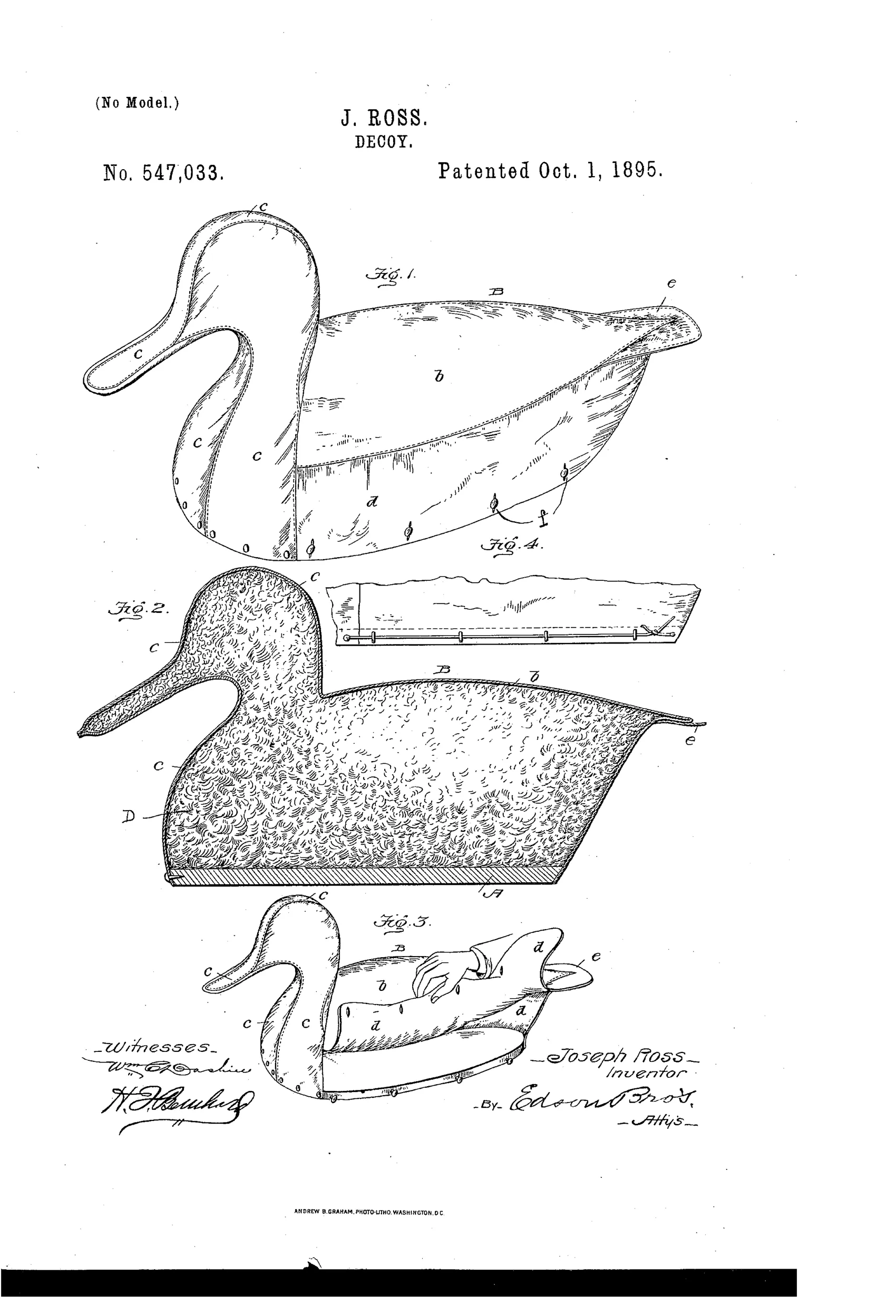
Collapsible fabric-body duck decoy on wooden float.
➶ How it works
A wooden float shaped like the underside of a fowl supports a hollow textile body cut and sewn into breast, neck, head, side, and tail pieces. One side piece (the flap d) is left detachable via buttonholes, staples, tacks, or cords so it can be lifted away from the float. This exposes a large opening through which the sportsman can pack in filling material such as grass, straw, leaves, or excelsior to distend the body into an upright decoy shape. When the filling is no longer needed, the side is unfastened and the material withdrawn, letting the whole decoy fold flat onto the float for compact storage.
➶ What was claimed
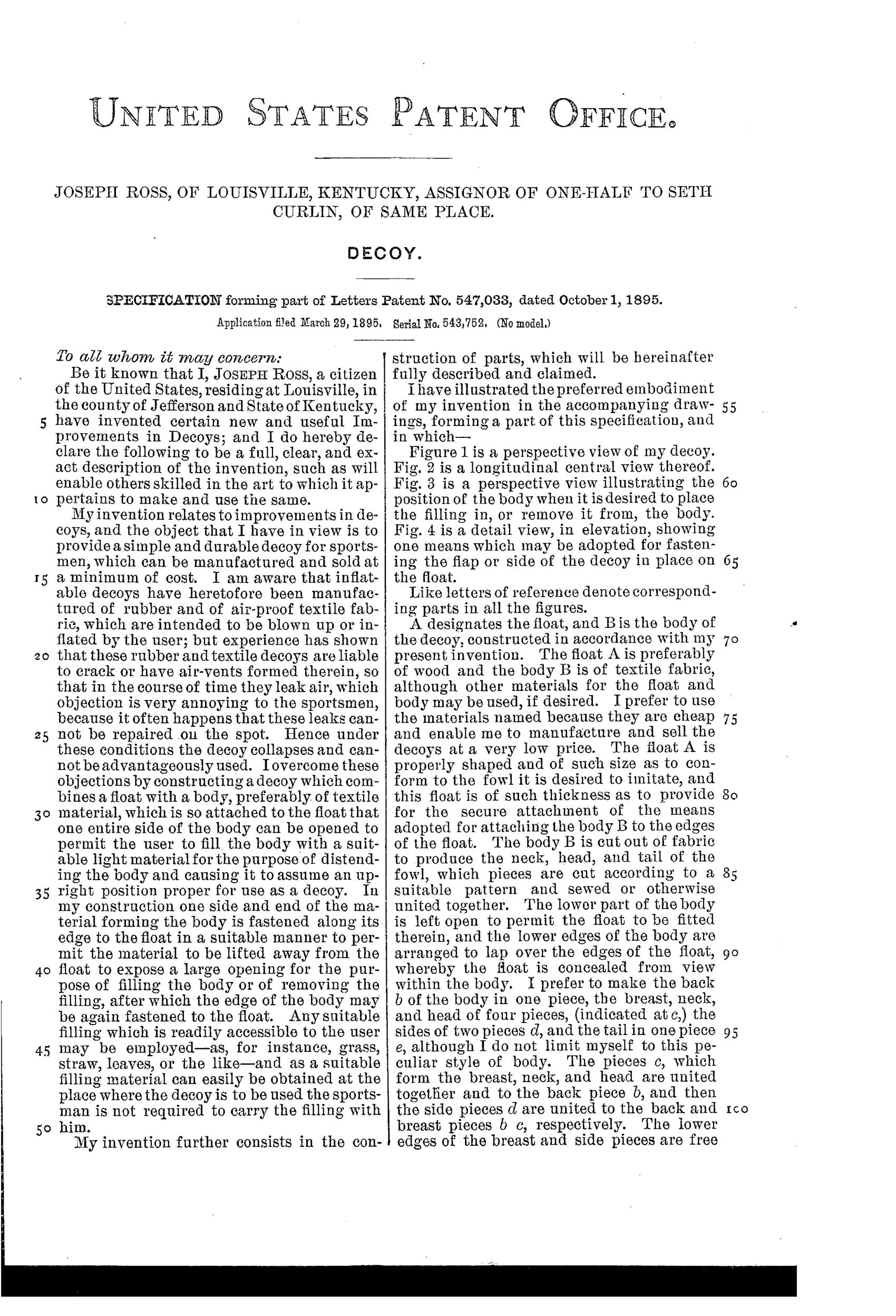
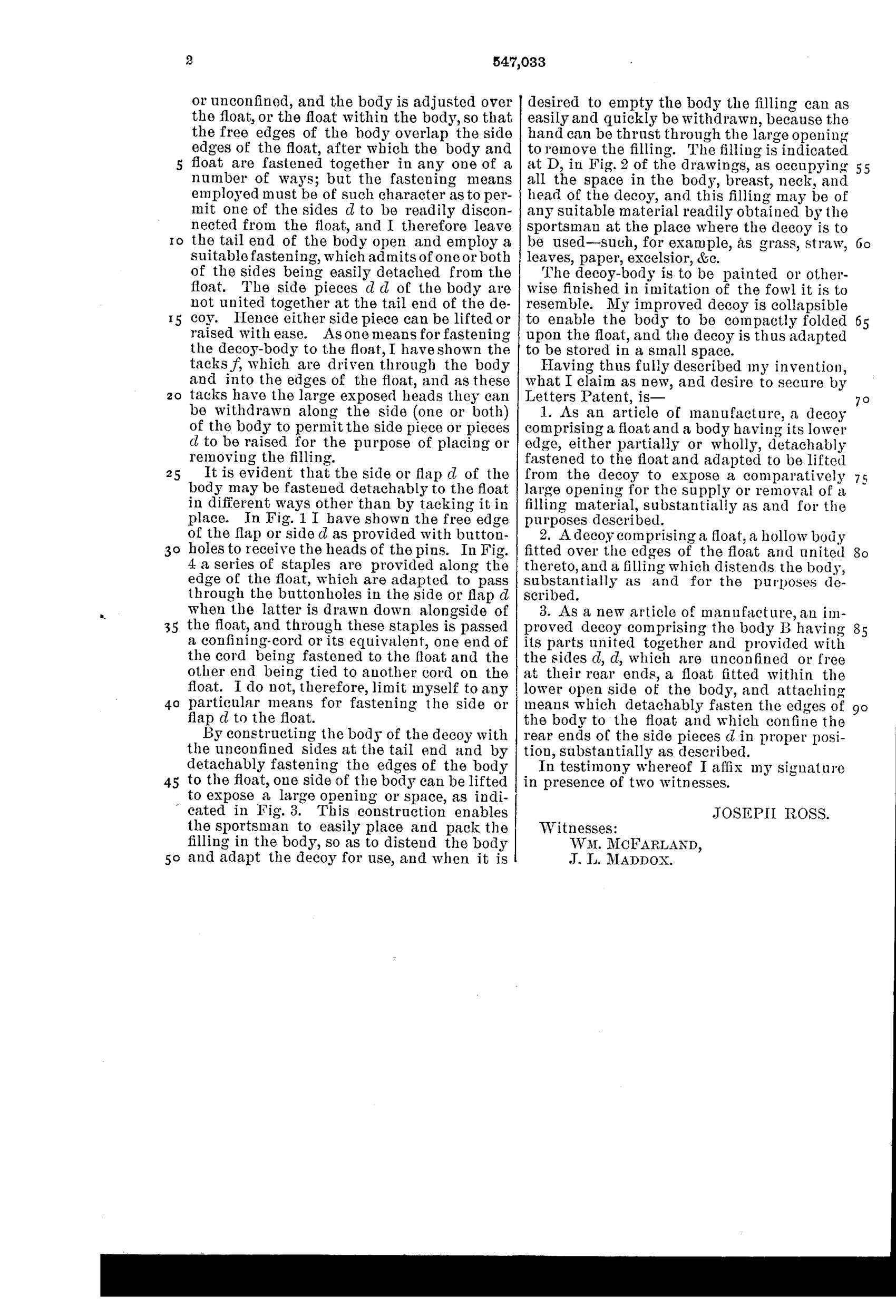
“As an article of manufacture, a decoy comprising a float and a body having its lower edge, either partially or wholly, detachably fastened to the float and adapted to be lifted from the decoy to expose a comparatively large opening for the supply or removal of a filling material, substantially as and for the purposes described.”
In plain English: A decoy made of a float with a body whose lower edge can be partly or fully unfastened and lifted up to create a big opening for adding or removing stuffing.
➶ In the inventor’s words
“Any suitable filling which is readily accessible to the user may be employed—as, for instance, grass, straw, leaves, or the like—and as a suitable filling material can easily be obtained at the place where the decoy is to be used the sportsman is not required to carry the filling with him.”— Joseph Ross, from the specification
Fate unknown
No documented commercial production or surviving marked example is known to me; a specimen or period advertisement would settle it.
➶ Patented the same day
- FOLDING DECOY. — Joseph Ross
➶ More by Joseph Ross
- FOLDING DECOY. (1895)
➶ Commentary
Full disclosure: this is a decoy, not a call — it makes no sound at all, and strictly speaking it belongs to the broader hunting-gear class rather than our home turf. But it lands on the page, so let's give Joseph Ross of Louisville his due, because the idea is genuinely tidy. The problem he's solving is bulk: a dozen carved wooden blocks are heavy and awkward to haul into a marsh. His answer is a flat wooden float carrying a sewn fabric skin — breast, neck, head, sides, tail — that folds down flat for transport.
The clever stroke is the detachable side flap and, especially, the logistics behind it. The best line in the specification points out that grass, straw, or leaves can be found at the hunting spot itself, so the hunter carries only the empty shells and stuffs them on site. Fig. 3 shows exactly this: a disembodied hand tucking filling in through the lifted flap. Fig. 4's staple-and-cord fastening detail is the practical heart of it — buttons in cold wet hands are misery.
The weak point is obvious to anyone who has hunted over water: a stuffed cloth duck in rain or spray becomes a sodden, sagging lump, and wet straw doesn't hold a mallard's profile. Collapsible decoys kept being reinvented for decades — canvas over frames, inflatables — which tells you the weight problem was real and this particular answer never quite won.
Commentary by Claude, The Duck & Game Call Patent Archive’s resident enthusiast