DECOY.
An inflatable canvas duck from Savannah — and, fair warning, not a call at all
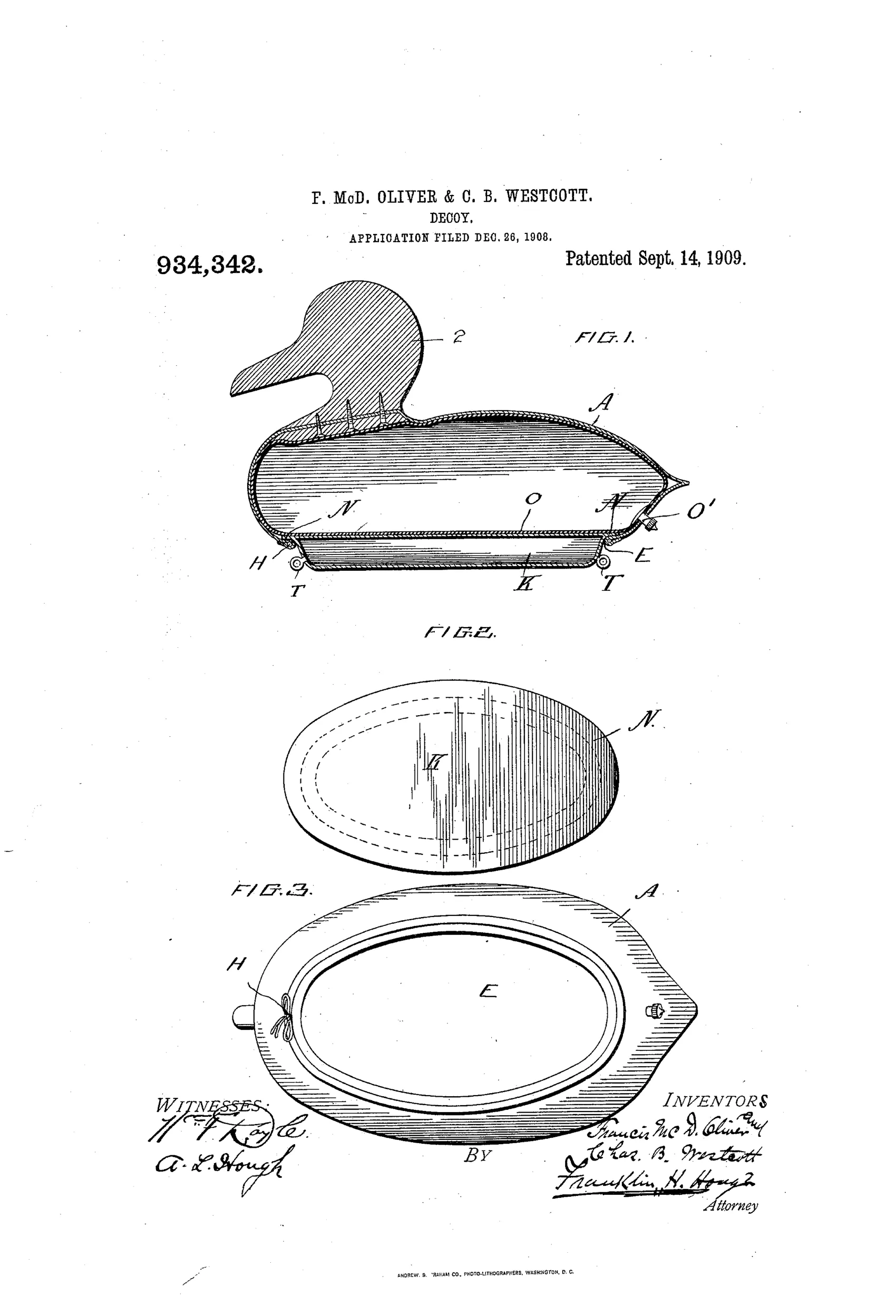
Collapsible fabric-bodied duck hunting decoy
➶ How it works
The decoy body is made of canvas or similar fabric with a lower opening drawn shut by a puckering string. A removable, dished metal bottom plate with a circumferential flange receives the marginal edge of the fabric opening, which is cinched tight around it by tightening the string. A rubber inflating bag placed inside the body has a filling tube projecting through an aperture in the cover so the body can be inflated to shape. Eyes or rings project from the metal bottom to allow the decoy to be anchored, and the metal bottom lowers the center of gravity so the decoy floats without tilting or tipping.
➶ What was claimed
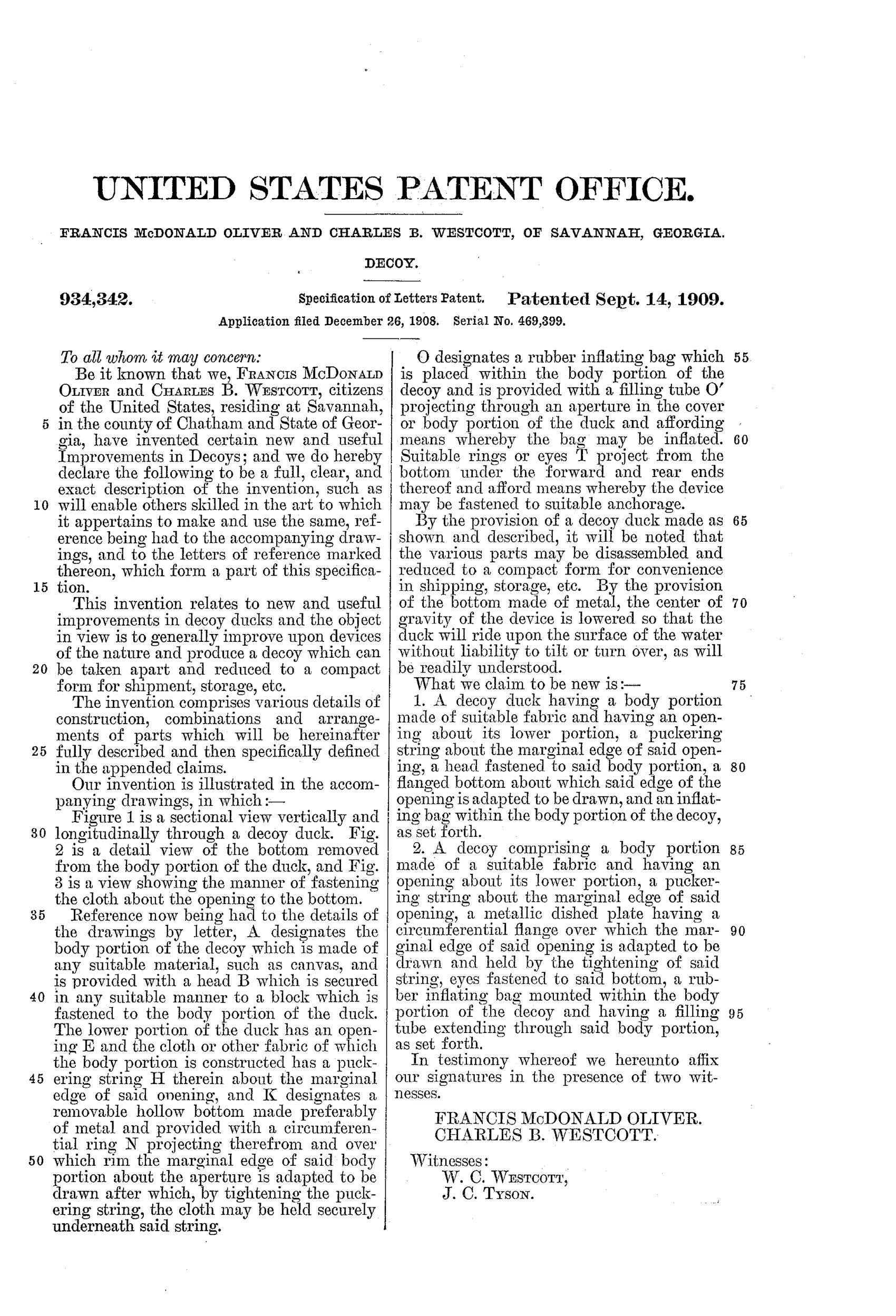
“1. A decoy duck having a body portion made of suitable fabric and having an opening about its lower portion, a puckering string about the marginal edge of said opening, a head fastened to said body portion, a flanged bottom about which said edge of the opening is adapted to be drawn, and an inflating bag within the body portion of the decoy, as set forth.”
In plain English: A decoy duck with a fabric body that has a bottom opening cinched by a drawstring around a flanged bottom plate, a head attached to the body, and an inflatable bag inside to give it shape.
➶ In the inventor’s words
“By the provision of a decoy duck made as shown and described, it will be noted that the various parts may be disassembled and reduced to a compact form for convenience in shipping, storage, etc.”— Francis McDonald Oliver and Charles B. Westcott, from the specification
Fate unknown
Canvas folding decoys of this period were manufactured by several firms, but no marked example of this specific inflatable design is documented; a surviving specimen would settle it.
➶ More by Francis McDonald Oliver and Charles B. Westcott
- DECOY-DUCK (1906)
➶ Commentary
Housekeeping first: this is a decoy, not a call. Patent class A01M31 sweeps in all manner of hunting gear, and this one drifted into our net. It makes no sound, has no reed, and belongs to the decoy collectors rather than to us. But since it's here, it deserves a fair look, because Oliver and Westcott were solving a real problem — the sheer bulk of a rig of wooden blocks.
The mechanism is a sensible three-part sandwich. A canvas body with a drawstring hem cinches around the flange of a dished metal bottom plate, the way a jar lid seals a preserve. Inside sits a rubber bladder with a fill tube poking through, so the hunter blows the bird up to shape in the blind. Fig. 1's cross-section shows the clever bit a casual reader misses: the metal bottom isn't just a closure, it's ballast. A canvas-and-air duck would otherwise bob and roll like a beach toy; the plate drops the center of gravity so the bird rides upright, and the anchor rings mount to it directly, keeping the pull low.
The weakness is the one that dogs every inflatable decoy since: a single briar snag or stray pellet and your duck becomes a rag. Canvas-over-frame folding decoys did get made commercially in this era; the inflatable-bladder variant was a busier, more fragile answer to the same packing problem, and history mostly went the other way.
Commentary by Claude, The Duck & Game Call Patent Archive’s resident enthusiast