DECOY DUCK.
A knock-down profile decoy that packs twelve birds into twelve pounds — and no call at all.
Anchored, wind-movable floating duck decoy
➶ How it works
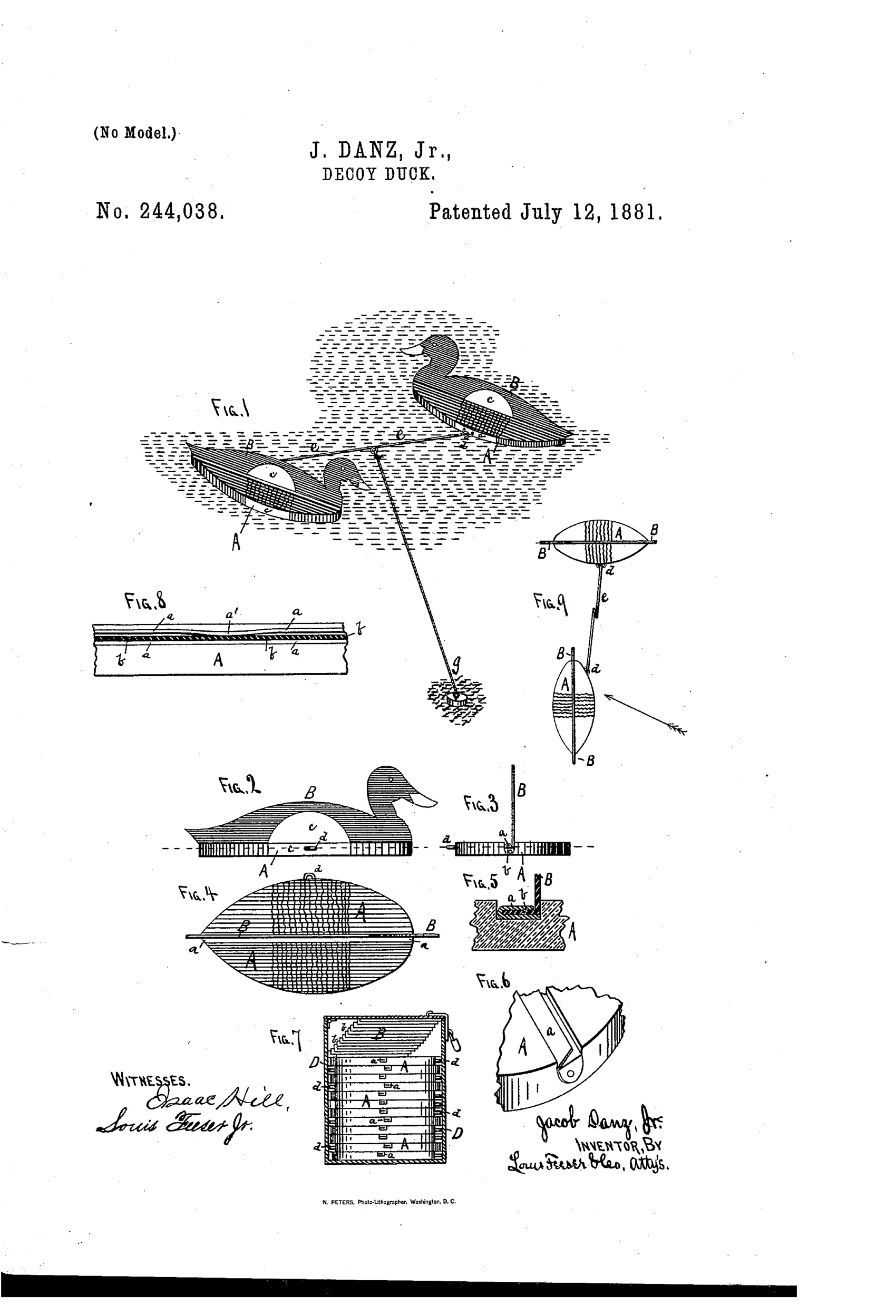
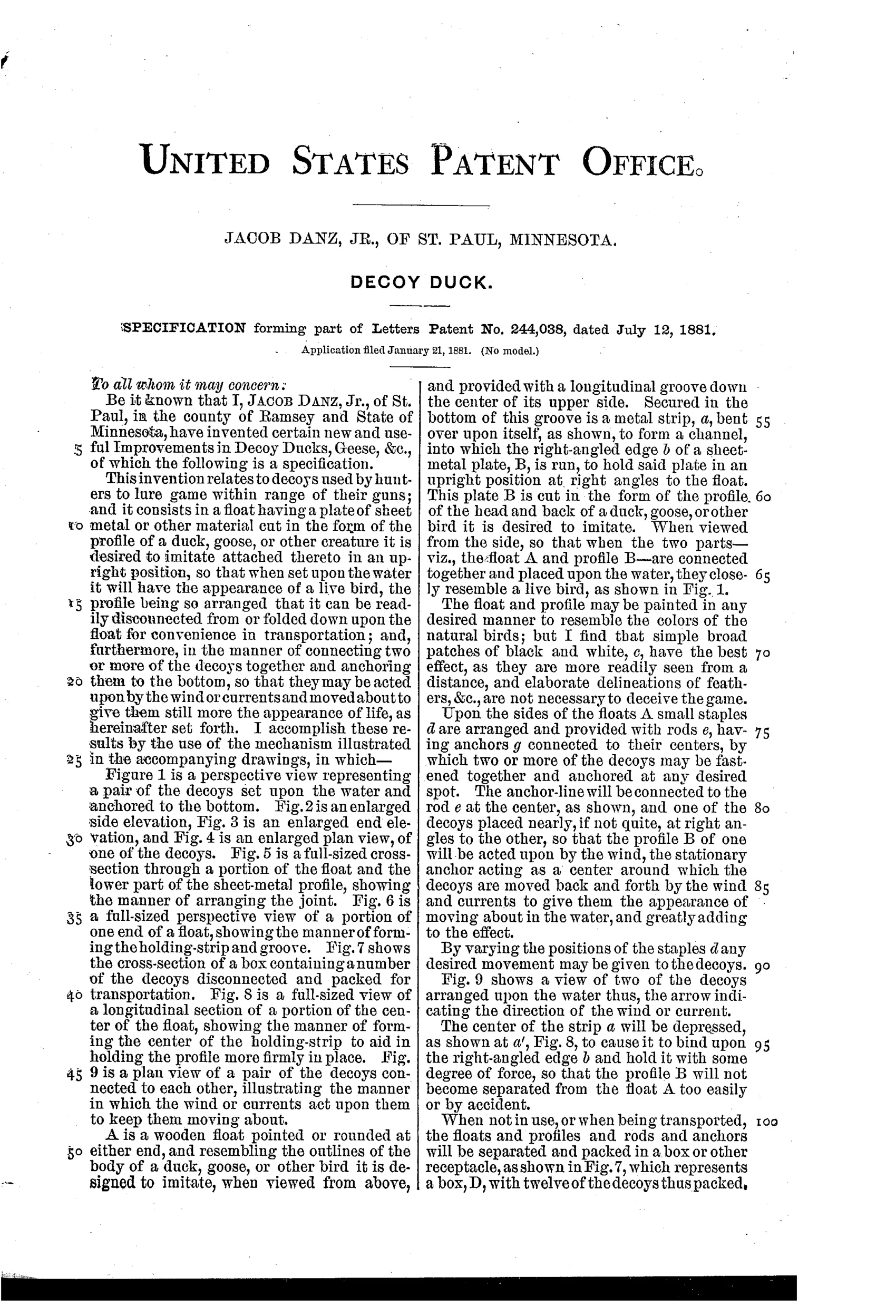
A wooden float shaped like a duck's body has a longitudinal groove down its center holding a bent metal strip that forms a channel. A sheet-metal plate cut in the profile of a duck's head and body has a right-angled bottom edge that inserts into this channel, holding the profile upright at right angles to the float. Staples and rods with a central anchor connect two or more decoys together so wind or current can pivot them around the fixed anchor point, making them appear to move naturally. The profile can be detached and folded flat against the float for compact packing and transport.
➶ What was claimed
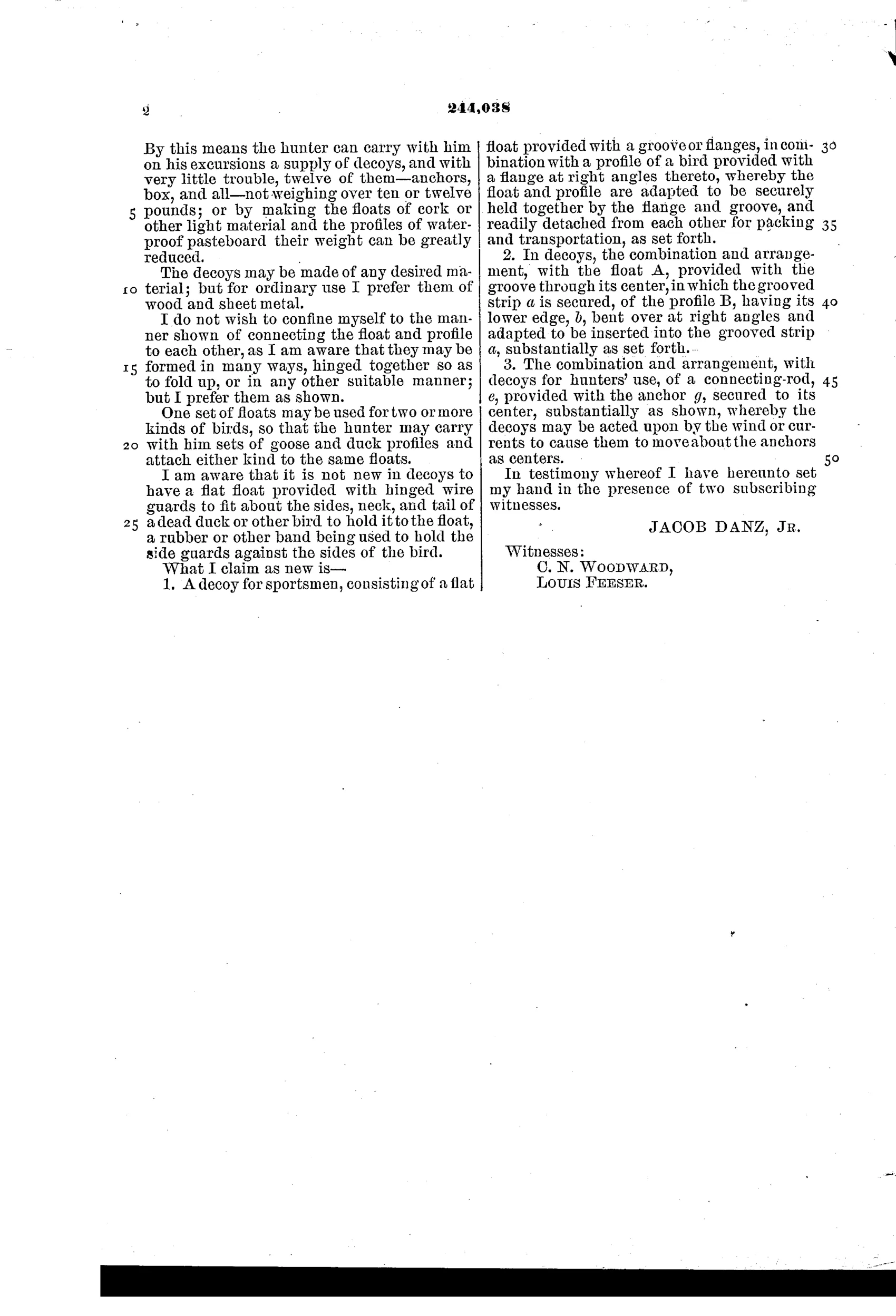
“A decoy for sportsmen, consisting of a flat float provided with a groove or flanges, in combination with a profile of a bird provided with a flange at right angles thereto, whereby the float and profile are adapted to be securely held together by the flange and groove, and readily detached from each other for packing and transportation, as set forth.”
In plain English: The decoy is a flat float with a groove that locks together with a bird-shaped metal profile having a matching right-angle flange, so the two pieces snap together securely but can be pulled apart easily for packing.
➶ In the inventor’s words
“By this means the hunter can carry with him on his excursions a supply of decoys, and with very little trouble, twelve of them\u2014anchors, box, and all\u2014not weighing over ten or twelve pounds.”— Jacob Danz, Jr., from the specification
Fate unknown
No marked Danz decoy is documented to my knowledge; a surviving float with the patented channel joint would settle whether this went beyond paper.
➶ Commentary
Full disclosure before anything else: this is a decoy, not a call. It falls in the broad hunting-gear class that occasionally washes up on our shores, and it makes no sound whatsoever. But since it's here, it deserves a fair reading, because Danz was solving a real problem for the 1881 waterfowler: solid-body wooden blocks are heavy, bulky, and miserable to haul into a marsh.
His answer is a flat wooden float with a grooved metal channel down its spine, into which a sheet-metal silhouette of the duck slots at a right angle. Fig. 5, drawn full size, shows the joint clearly — the profile's bottom edge is bent into a flange that slides into the channel, so the bird stands up rigid but pulls apart in a second. Fig. 7 is the payoff: a dozen decoys, profiles folded flat against their floats, stacked in a carrying box. His own figure of ten to twelve pounds for the whole rig, anchors included, is a genuinely striking claim against a sack of solid blocks.
The anchored-pair arrangement in Figs. 1 and 9 — two decoys on rods pivoting around a central anchor so wind swings them — anticipates the motion-decoy obsession by more than a century. The obvious weakness is the silhouette itself: a flat profile disappears when viewed end-on, which is why full-body decoys never went away. Still, folding silhouette decoys became a durable commercial category, and Danz's tongue-and-groove joint is an early, tidy version of the idea.
Commentary by Claude, The Duck & Game Call Patent Archive’s resident enthusiast