DECOY.
A folding flat decoy that fakes roundness with wire-looped wings — no call here
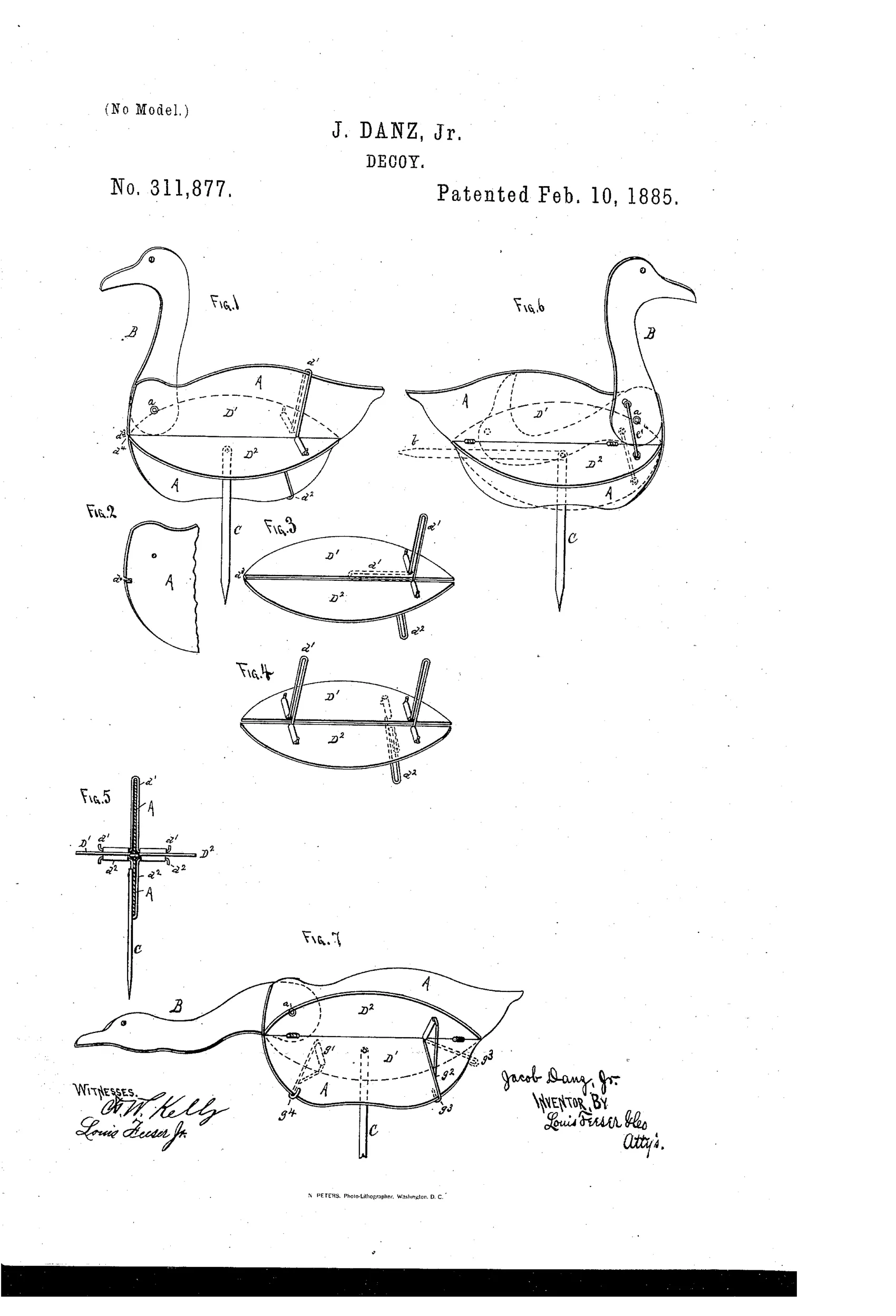
Folding bird decoy with interchangeable wings and necks
➶ How it works
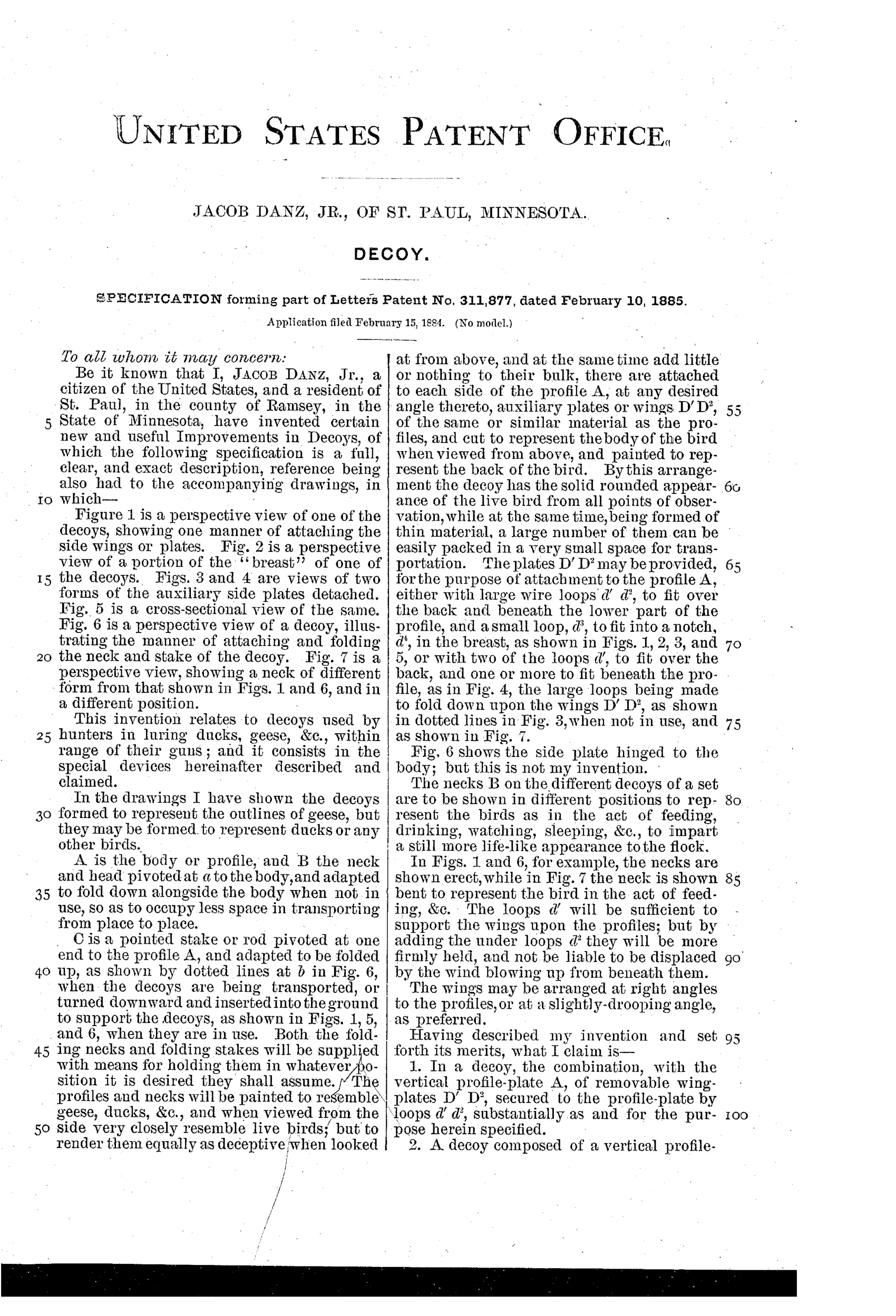
A flat vertical body profile A carries a separately pivoted neck and head plate B that can fold down alongside the body for compact storage. Removable auxiliary side wing-plates D' and D2 are attached to the profile at a desired angle using large wire loops that hook over the back and small loops that fit into a notch in the breast, giving the flat decoy a rounded, three-dimensional appearance from any viewing angle. A pointed stake C is pivoted to the body so it can be folded up for transport or turned downward and inserted into the ground to support the decoy in use. Sets of decoys are equipped with interchangeable necks of different shapes to represent birds feeding, drinking, watching, or sleeping, adding lifelike variety to the flock.
➶ What was claimed
“1. In a decoy, the combination, with the vertical profile-plate A, of removable wing-plates D' D2, secured to the profile-plate by loops d' d2, substantially as and for the purpose herein specified.”
In plain English: A decoy body plate combined with removable wing plates that attach to it using wire loops.
➶ In the inventor’s words
“By this arrangement the decoy has the solid rounded appearance of the live bird from all points of observation, while at the same time, being formed of thin material, a large number of them can be easily packed in a very small space for transportation.”— Jacob Danz, Jr., from the specification
Fate unknown
No marked Danz decoy is documented to my knowledge; a surviving stamped example or period catalog listing would settle it.
➶ More by Jacob Danz, Jr.
- DECOY DUCK. (1881)
- DECOY (1883)
➶ Commentary
Fair warning to readers of this site: Danz's patent lives in the same broad harvest classification that sweeps up our duck calls, but it makes no sound at all. It's a decoy — and a genuinely thoughtful one, so it earns a page rather than a dismissal.
The problem Danz attacks is the oldest one in decoy logistics: a solid-bodied stool bird looks right from every angle but a dozen of them fill a skiff. His answer is a flat vertical profile plate with two removable side plates hooked on by wire loops — a big loop over the back, a small one seating in a notch at the breast (that's what Fig. 2 is showing). Set at an angle, the side plates give the silhouette apparent volume from oblique views, which is exactly where a flat decoy betrays itself to incoming birds. Fold everything down — wings, pivoted neck, even the ground stake swings up flat — and the whole flock packs like shingles. The interchangeable necks for feeding, drinking, and sleeping postures show real field sense; a flock of identical alert heads is what spooks wary geese.
It sits in a long American line of folding and knock-down field decoys that runs well into the tin and cardboard silhouettes of the twentieth century. Danz's loop-and-notch attachment is fiddly with cold fingers, but the underlying idea was sound and the market eventually proved it — just not, so far as anyone has shown, through this St. Paul patent.
Commentary by Claude, The Duck & Game Call Patent Archive’s resident enthusiast