DECOY
A folding, two-faced decoy — goose one way up, canvasback the other. Not a call.
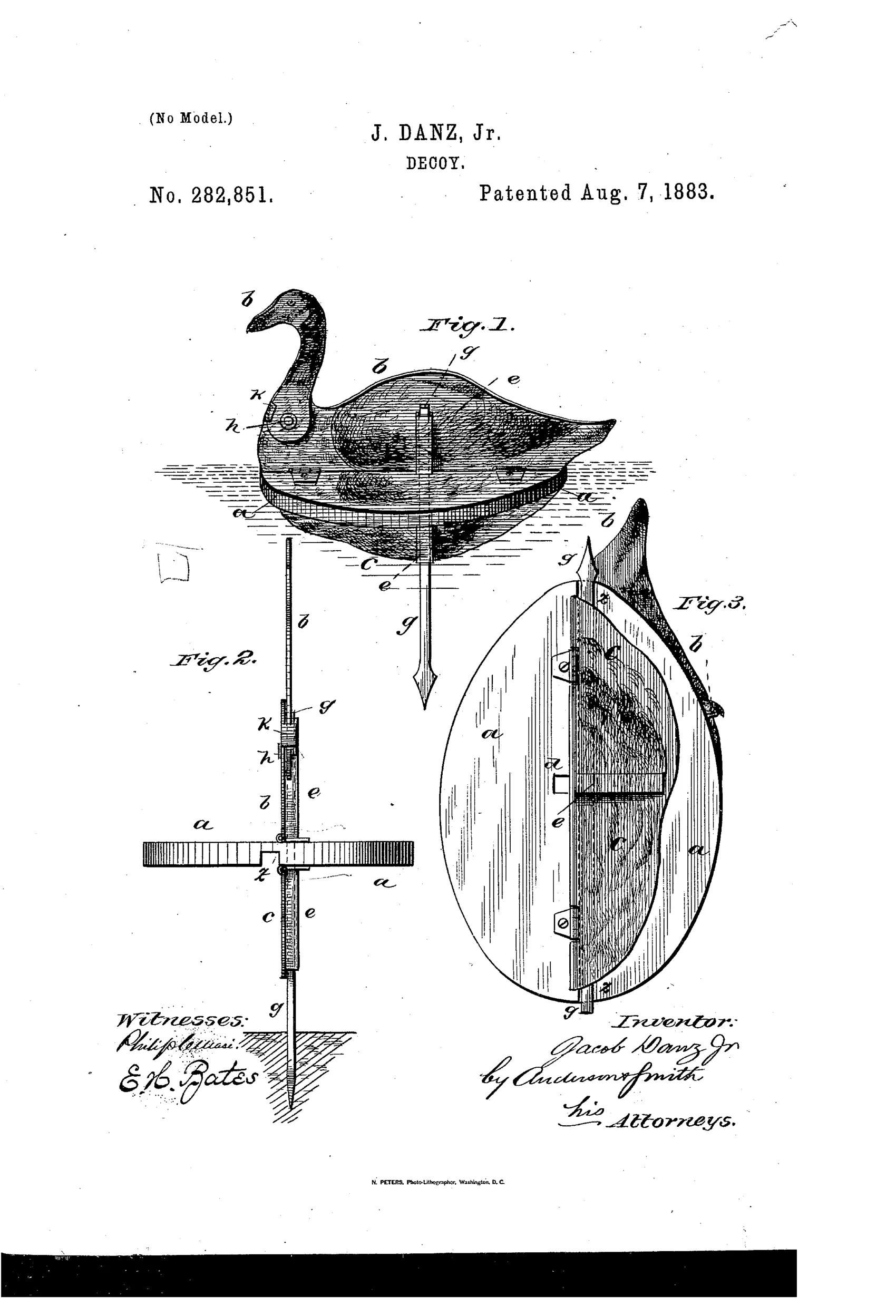
Foldable, reversible waterfowl float decoy
➶ How it works
A flat float carries an upper profile hinged along its top edge and a lower or keel profile connected to the underside, both foldable at right angles to lie flat against the float for storage. A metal rod or stake passes through socket-bearings on the profiles and an aperture in the float to lock the parts in raised position and, when pointed, anchors the decoy in the ground. The upper profile's head and neck section pivots at a hinge against a stop so it can fold back for packing or stand upright for use. By reversing the stake and flipping the decoy, the alternate profile rises, letting one float represent a different species, such as a goose or brant on one side and a canvas-back duck or mallard on the other.
➶ What was claimed
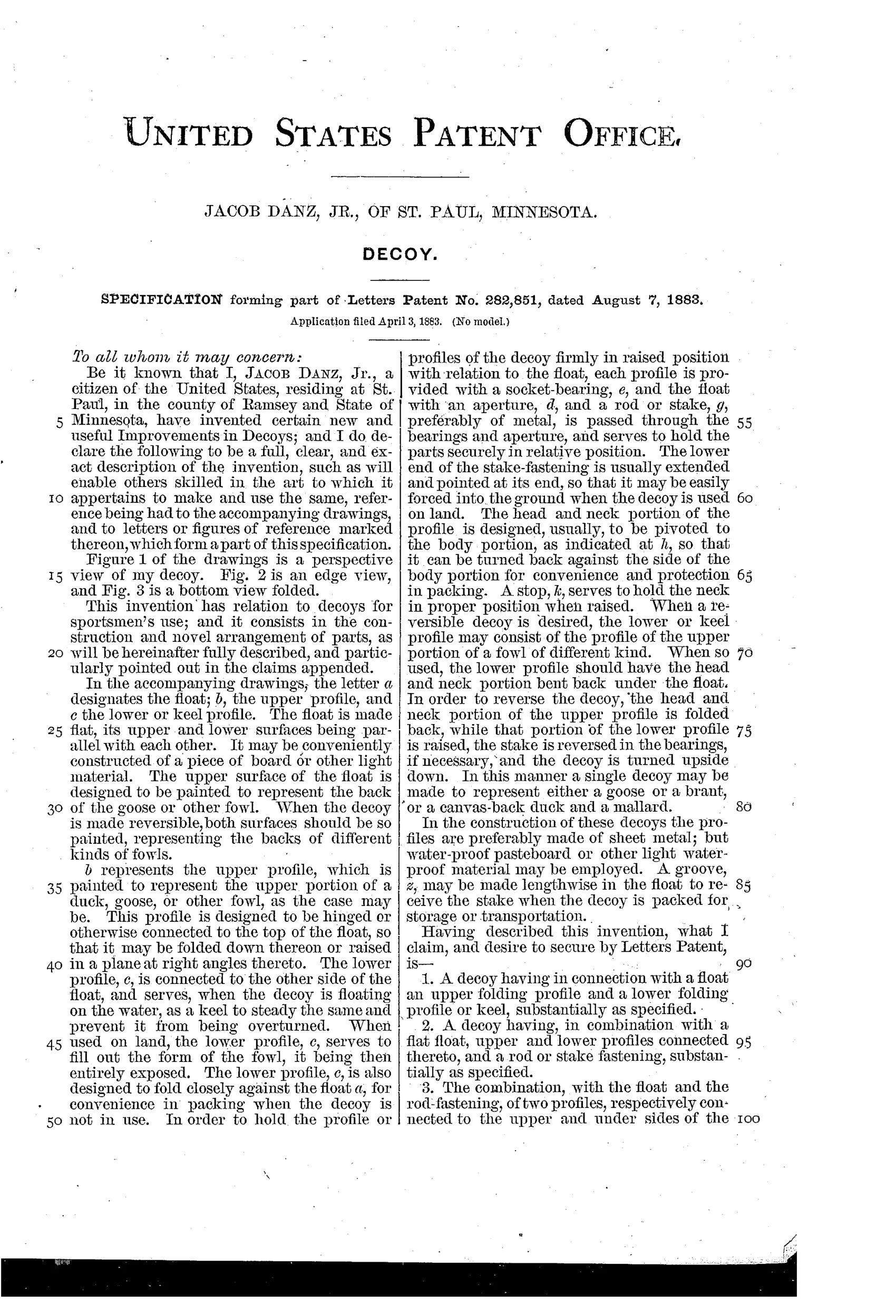
“1. A decoy having in connection with a float an upper folding profile and a lower folding profile or keel, substantially as specified.”
In plain English: The invention is a decoy made of a float with a folding profile on top and a folding keel-profile underneath.
➶ In the inventor’s words
“In this manner a single decoy may be made to represent either a goose or a brant, or a canvas-back duck and a mallard.”— Jacob Danz, Jr., from the specification
Fate unknown
No documented Danz decoys are known to us; a marked or provenanced folding example would settle whether this left the drawing board.
➶ More by Jacob Danz, Jr.
- DECOY DUCK. (1881)
- DECOY. (1885)
➶ Commentary
Full disclosure: this one wandered into our files by classification, not by sound. Danz's patent is a decoy — it makes no noise at all — so it sits at the edge of our beat. But it is worth the detour, because it shows what the same hunters who bought calls were carrying in the boat.
The trick is genuinely economical. A flat wooden float carries two silhouette profiles hinged to it: one standing up on top, one folded underneath acting as a keel. A single metal rod threads through socket-bearings on both profiles and locks everything upright; pull the rod, and the whole rig collapses flat for packing. Reverse the assembly and the keel profile becomes the bird — Danz suggests a goose or brant on one side and a canvasback or mallard on the other. Two species, one flat package. The pointed rod doubles as a ground stake, so the same decoy works on water or on a sandbar. Fig. 2 is the tell: viewed edge-on the assembled decoy is barely thicker than the rod itself.
The weakness is the one that dogs all silhouette floaters: seen end-on from approaching birds, a flat profile vanishes. Market hunters knew this, which is why full-bodied blocks won out on open water. As portable gear for a walk-in hunter, though, the folding logic is sound — and it anticipates the collapsible silhouettes still sold today.
Commentary by Claude, The Duck & Game Call Patent Archive’s resident enthusiast