DECOY.
An inflatable canvas duck whose brass air valve doubles as its keel
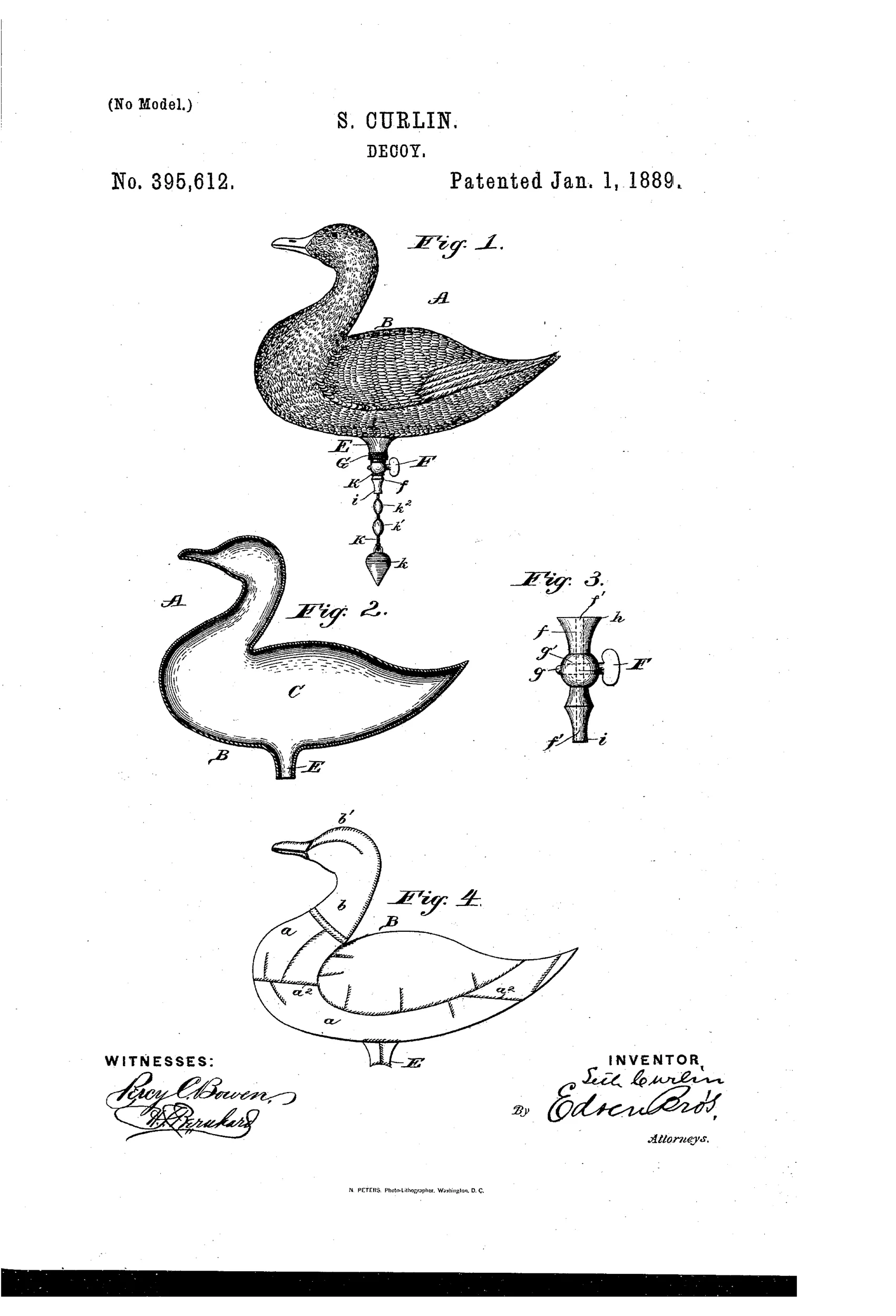
Collapsible inflatable duck hunting decoy
➶ How it works
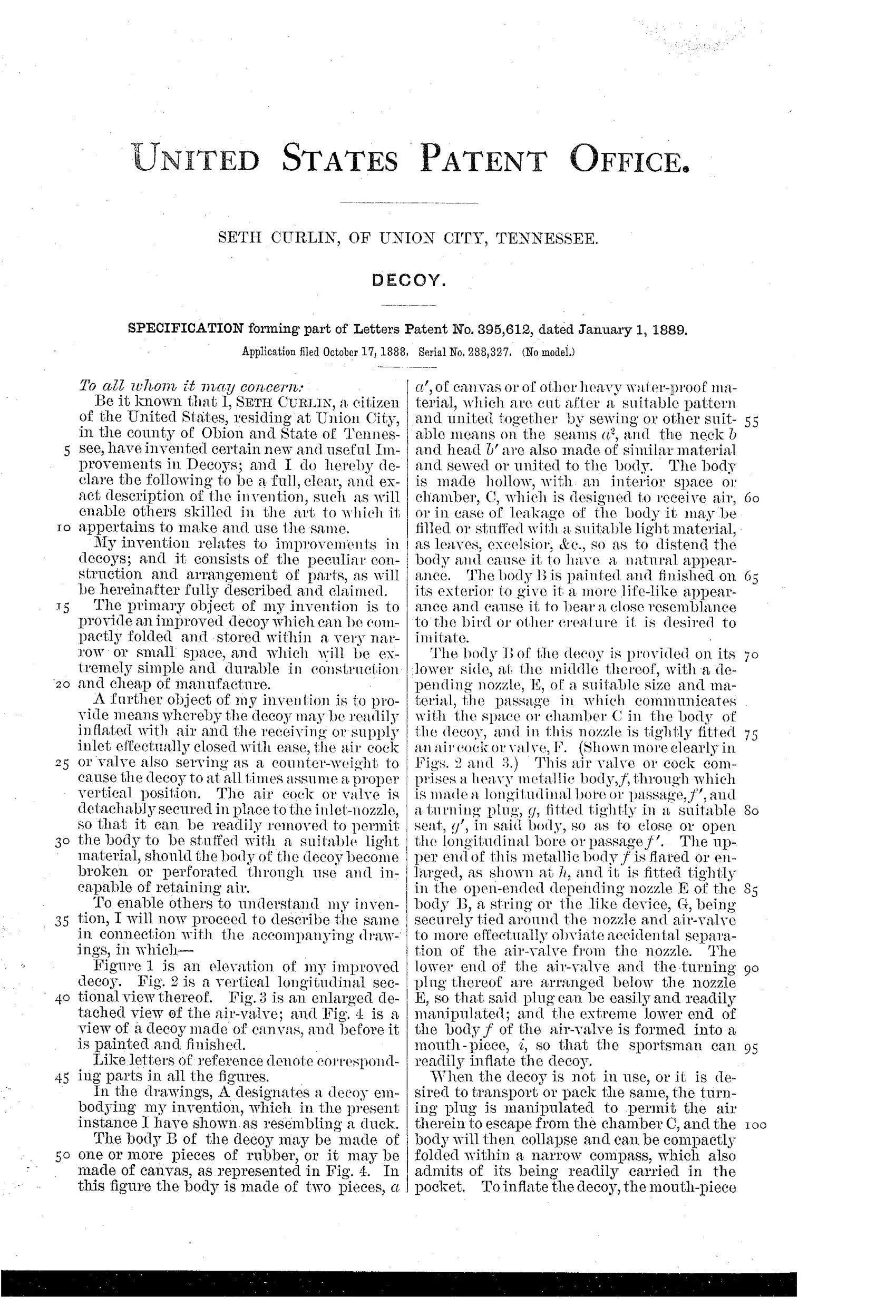
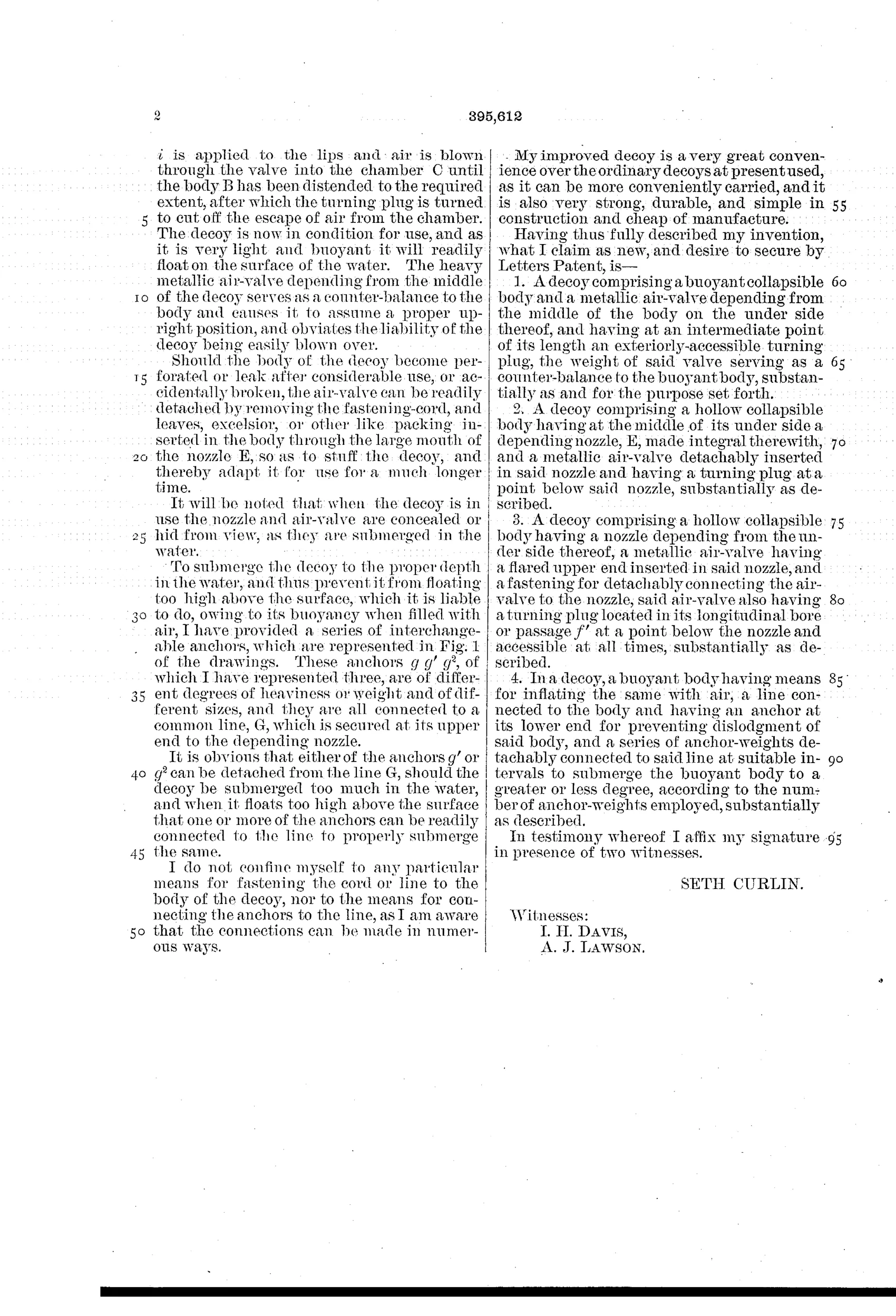
The decoy body is made of rubber or sewn canvas pieces forming a hollow chamber that can be inflated with air through a metal air-valve depending from its underside. The valve has a turning plug in its bore that opens or closes to admit or release air, and a flared mouthpiece at its lower end lets the sportsman blow air in directly. The heavy metallic valve hangs below the body and acts as a counterweight, keeping the decoy upright and stable on the water. A line with interchangeable weighted anchors of varying sizes attaches to the nozzle to control how deep the buoyant body sits in the water.
➶ What was claimed
“A decoy comprising a buoyant collapsible body and a metallic air-valve depending from the middle of the body on the under side thereof, and having at an intermediate point of its length an exteriorly-accessible turning plug, the weight of said valve serving as a counter-balance to the buoyant body, substantially as and for the purpose set forth.”
In plain English: The decoy has a floating, foldable body with a metal air valve hanging underneath that both fills it with air and weighs it down to keep it upright.
➶ In the inventor’s words
“The primary object of my invention is to provide an improved decoy which can be compactly folded and stored within a very narrow or small space, and which will be extremely simple and durable in construction and cheap of manufacture.”— Seth Curlin, from the specification
Fate unknown
No marked Curlin decoy is documented to my knowledge; a surviving specimen or period advertisement would settle it.
➶ More by Seth Curlin
- DECOY. (1890)
- INFLATABLE DECOY. (1894)
➶ Commentary
First, a housekeeping note: this is not a call. Seth Curlin's patent makes no sound at all — it belongs to the broad hunting-gear class where decoys, blinds, and scent gadgets live, and it wanders onto these pages only because the classification net catches it. But since it's here, it deserves a fair look, because the central idea is genuinely tidy.
The problem Curlin attacks is real. Wooden decoys of 1888 were heavy, and a market hunter's rig might run to dozens of birds hauled by skiff. A rubber or sewn-canvas duck that folds flat solves the transport problem — but a bag of air is dangerously tippy on water. Curlin's answer is the elegant part: the metal air valve you blow through to inflate the bird hangs from the belly and stays there, its weight acting as ballast. One part does two jobs, and it puts the mass exactly where a boatbuilder would want it, low on the centerline. Fig. 3 shows the turning plug that seals the chamber; Fig. 4 is worth a pause too — it maps the sewn panel seams of the canvas body before painting, essentially a soft-goods pattern hidden in a patent drawing.
Inflatable decoys did eventually become a commercial reality decades later, so the instinct was sound. Whether 1880s rubberized fabric could hold air through a cold morning on Reelfoot Lake — Curlin's Union City sits near it — is another matter.
Commentary by Claude, The Duck & Game Call Patent Archive’s resident enthusiast