DECOY.
A self-sealing inflatable canvas duck — and, fair warning, not a call at all
Inflatable textile hunting decoy that self-seals leaks
➶ How it works
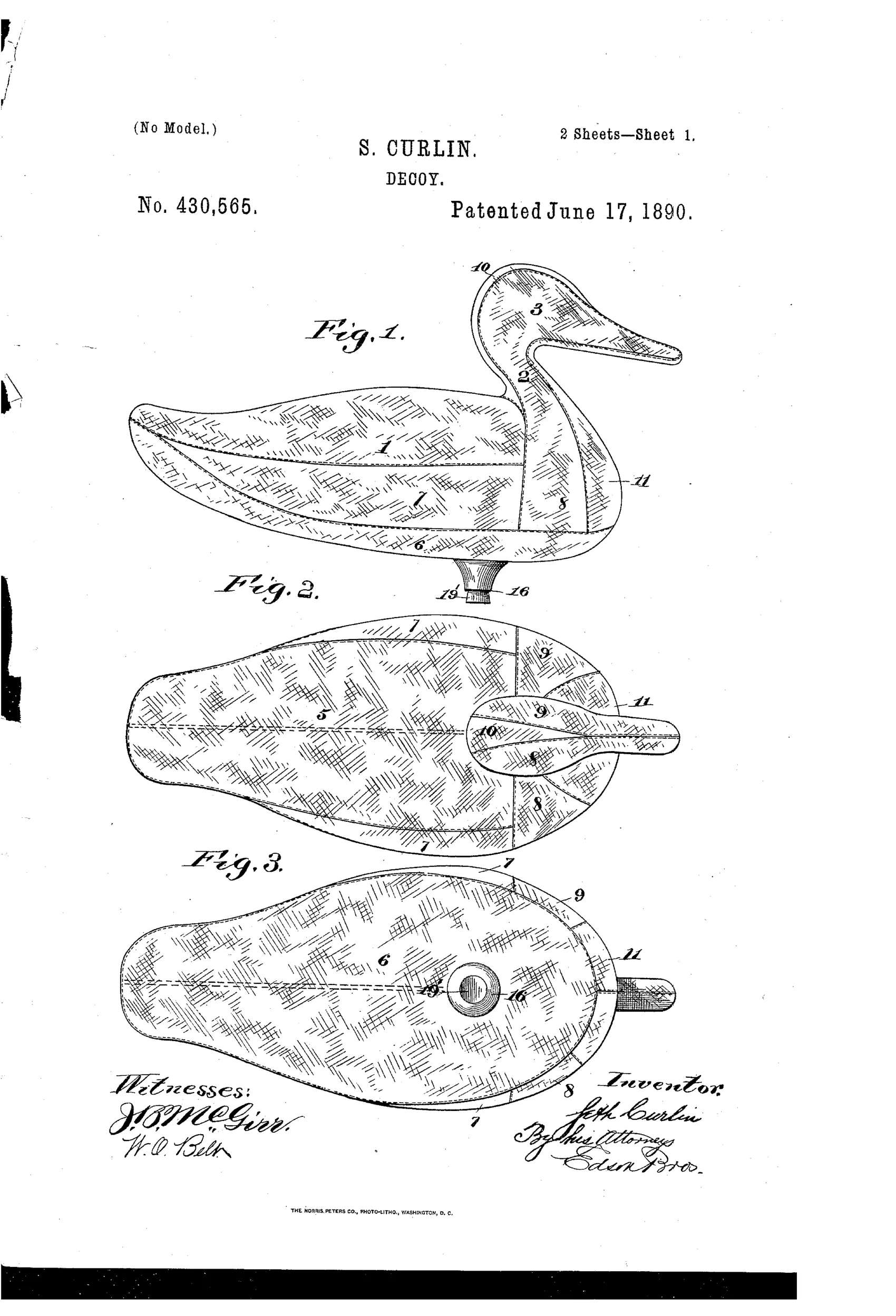
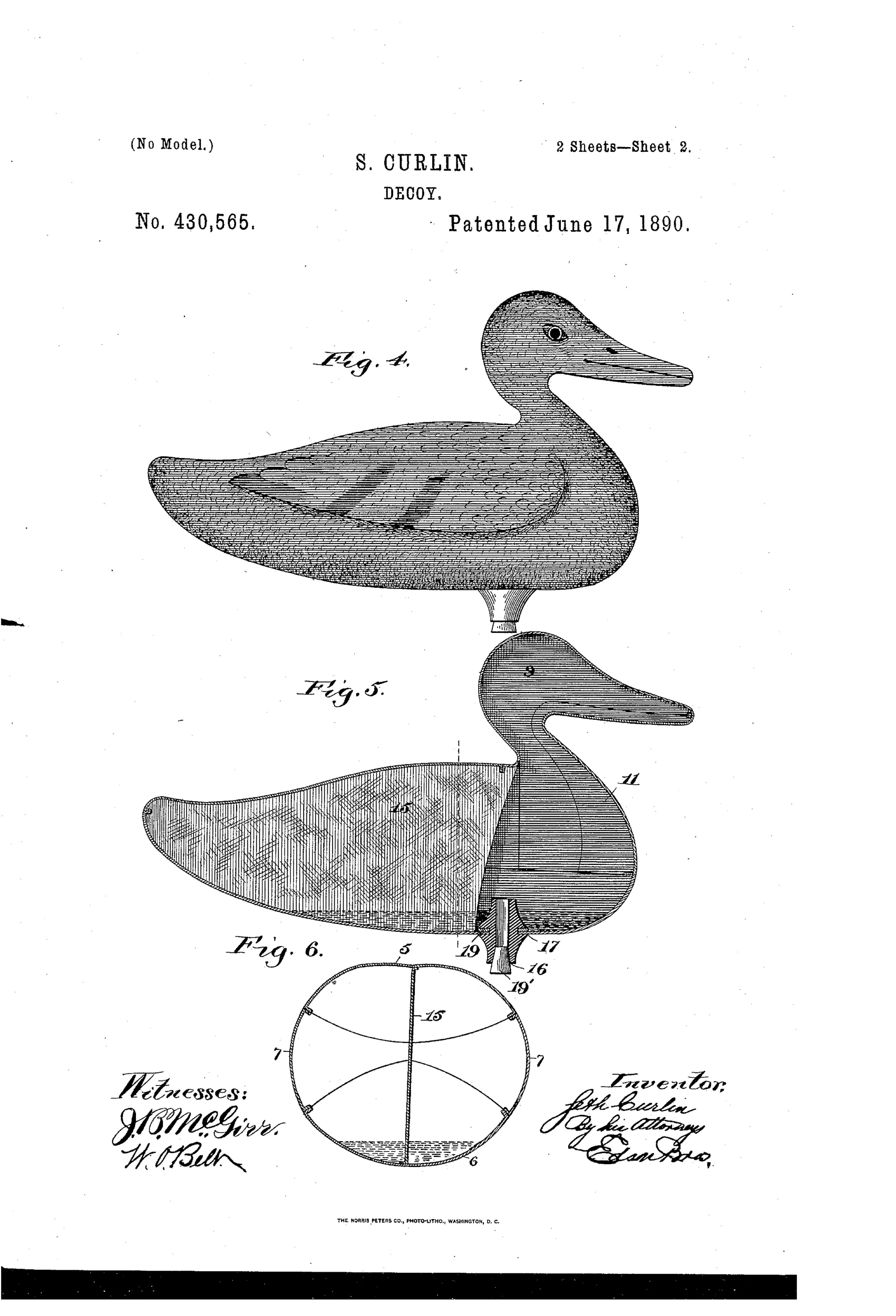
The decoy body is made of separate textile pieces—top, bottom, side, breast, neck, head, and back pieces—cut to shape and sewn together to form an airtight, inflatable hollow form resembling a duck. The fabric is treated with a waterproof oil and then painted to imitate the desired fowl. Inside the body, a free liquid such as oil or a thin paste is placed so that when air pressure inflates the decoy, the liquid diffuses over the interior surface and fills or seals any cracks or vents that develop. An internal fabric brace or stay runs longitudinally (or transversely) inside the body, uniting the top and bottom or side walls to limit their displacement and maintain proper shape when inflated, and the decoy is inflated through a metal air-valve depending from the bottom, closed by a plug.
➶ What was claimed
“As a new article of manufacture, a buoyant decoy constructed of textile material cut in suitable shape and united together, said decoy being rendered water-proof and painted in imitation of a desired fowl, the body of the decoy containing a free liquid, which, owing to the pressure of the air within the decoy, is adapted to fill or close any crevices or vents which may occur in the decoy, substantially as and for the purpose described.”
In plain English: A waterproofed, painted textile decoy that holds a small amount of free liquid inside so that air pressure forces the liquid to seal any leaks that form.
➶ In the inventor’s words
“I have discovered that by placing a small quantity of live or free liquid—such as oil or a thin paste—in the body of the decoy when the latter is inflated the liquid will close or fill up the vents or crevices formed in the body owing to the pressure of the air within the decoy, and thereby prevent the escape of the air and the consequent collapsing of the decoy.”— Seth Curlin, from the specification
Fate unknown
No manufactured example or trade record is documented; a marked or provenanced canvas specimen would settle it.
➶ More by Seth Curlin
- DECOY. (1889)
- INFLATABLE DECOY. (1894)
➶ Commentary
Let's be upfront: this is a decoy patent, not a game call. It lives in the same broad hunting-gear class the Patent Office used, which is how it wanders into our net, but Seth Curlin of Union City, Tennessee wasn't making sound — he was making a duck-shaped balloon. Still, it's worth two minutes of your time, because the central idea is genuinely ahead of its moment.
The decoy is sewn from shaped textile panels — you can see the seam layout clearly in Figs. 1 through 3, gore-cut like a tailor's pattern — waterproofed with oil, painted, and inflated through a metal valve on the belly. The clever bit is inside: a small quantity of free oil or thin paste sloshes around the cavity, and internal air pressure drives it into any pinhole or cracked seam that develops. That is, in plain terms, a self-sealing pneumatic vessel, patented decades before the self-sealing fuel tank made the same principle famous. The internal fabric stay tying top to bottom is a nice practical touch too — without it an inflated bag balloons into a sphere, not a duck.
Whether 1890 canvas and oil-paint seams could actually hold air through a cold November morning is another question, and I have my doubts. Collapsible canvas decoys did eventually find a market for exactly the reason Curlin saw — a rig of wooden blocks is heavy — but I know of no Curlin-marked example. A charming, plausible dead end from a man thinking about portage.
Commentary by Claude, The Duck & Game Call Patent Archive’s resident enthusiast