DEVICE FOR DECOYING DUCKS.
Not a call at all: Coudon's folding V-board of sheet-metal ducks
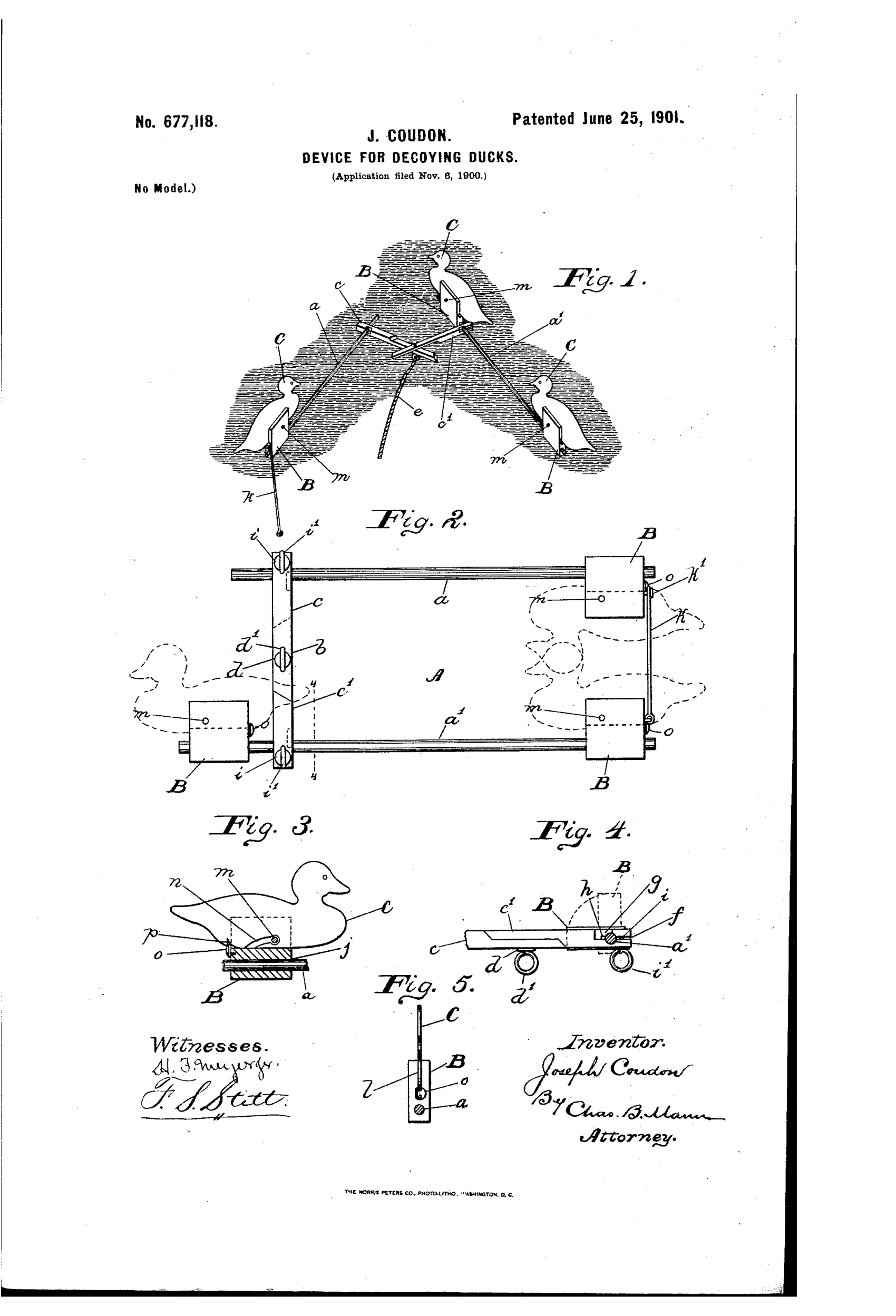
Folding floating support for decoy ducks
➶ How it works
Two rods are joined near one end by a jointed, pivoting brace so their opposite ends can be spread apart or folded parallel. A clamp-bolt on the brace locks the two rod sections at any desired angle and provides a loop for an anchor rope. Sliding blocks with friction-fit longitudinal openings are positioned along the rods, each holding a sheet-metal decoy duck via a slotted engagement and a turn-button, and a tie-wire with a keeper connects the rod ends when folded for transport.
➶ What was claimed
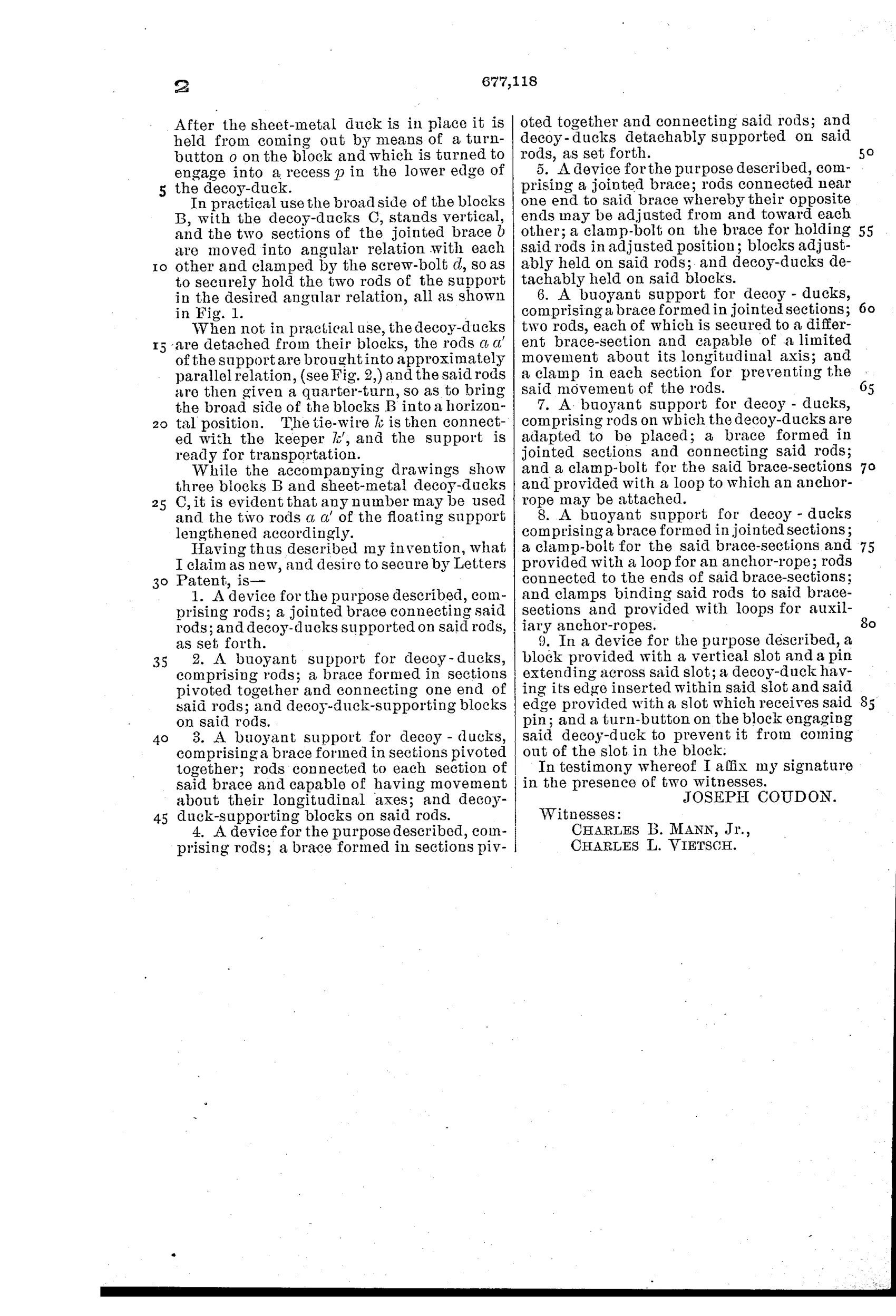
“1. A device for the purpose described, comprising rods; a jointed brace connecting said rods; and decoy-ducks supported on said rods, as set forth.”
In plain English: A device with rods joined by a hinged brace, with decoy ducks mounted on the rods.
➶ In the inventor’s words
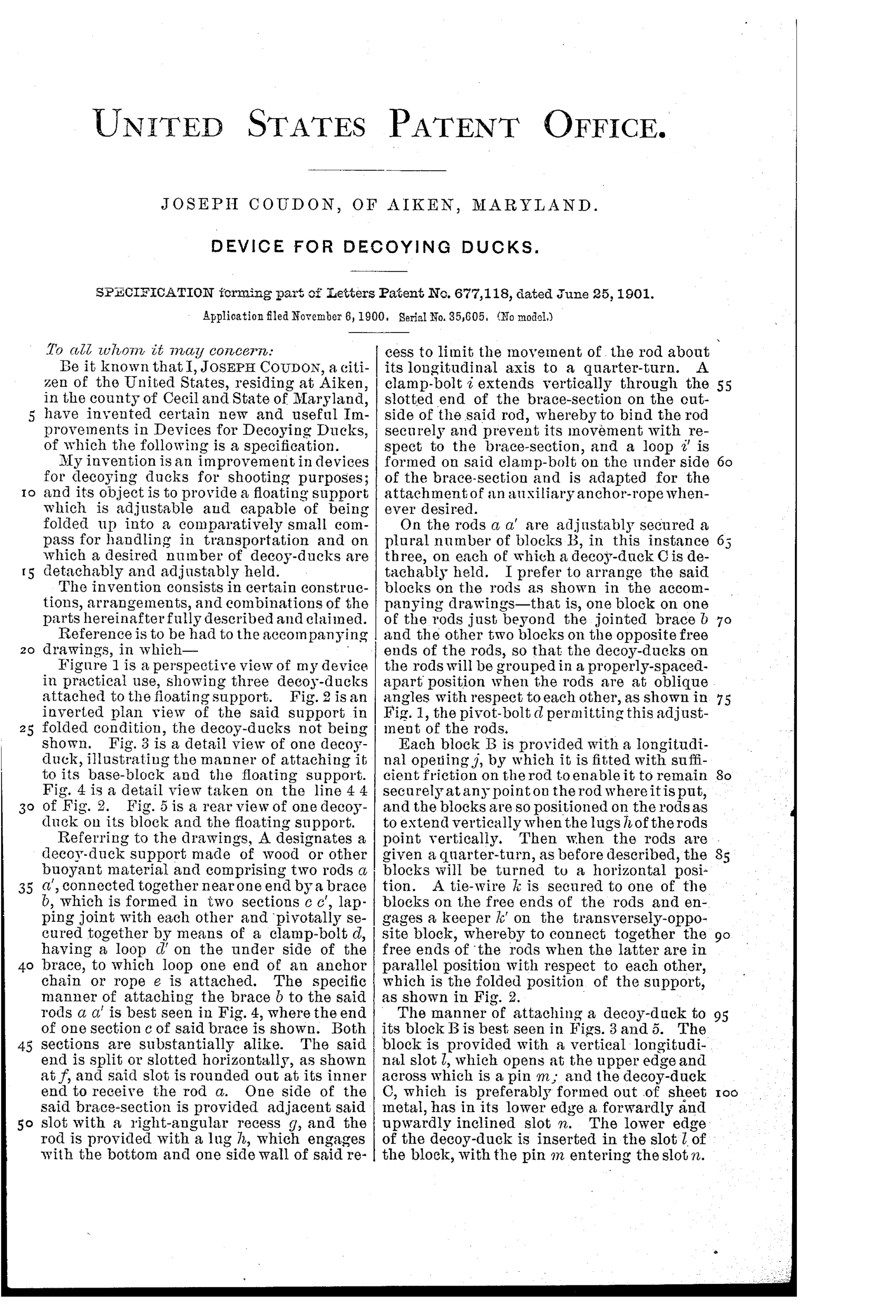
“My invention is an improvement in devices for decoying ducks for shooting purposes; and its object is to provide a floating support which is adjustable and capable of being folded up into a comparatively small compass for handling in transportation and on which a desired number of decoy-ducks are detachably and adjustably held.”— Joseph Coudon, from the specification
Manufactured and sold
Coudon's folding silhouette V-board rigs were produced and used on the Susquehanna Flats, and surviving examples are documented among decoy collectors.
➶ More by Joseph Coudon
- DECOY-DUCK. (1902)
- DECOY-DUCK. (1904)
➶ Commentary
Full disclosure before we go further: this is a decoy patent, not a call. It makes no sound. It wandered into our files because it lives in the same broad hunting-gear class as our reeds and tone boards, but Joseph Coudon of Aiken, Maryland was solving a different problem — how to carry a whole raft of decoys in a sneak boat without filling it to the gunwales with wooden bodies.
His answer is the flat-pack rig. Two rods hinge at a jointed brace, opening into a V and locking at any angle with a clamp-bolt that doubles as the anchor-rope loop. Sliding blocks friction-fit along the rods, and each block takes a flat sheet-metal silhouette duck by a slotted engagement and turn-button — Fig. 3 shows how quick that attachment is. Fold the rods parallel, secure them with the tie-wire keeper in Fig. 2, and the whole spread stows like a bundle of lath. The clever part a casual reader misses: silhouettes read as full bodies from a duck's low angle over water, so the weight savings cost almost nothing in realism.
This is the patent behind the Susquehanna Flats 'V-board' rigs, and Coudon actually built them — his silhouette batteries are a documented chapter of Chesapeake waterfowling. For our purposes, though, it stays a well-made neighbor: interesting hardware, zero acoustics.
Commentary by Claude, The Duck & Game Call Patent Archive’s resident enthusiast