DECOY-DUCK.
Three decoys on pivoting links fold flat — but it's a decoy, not a call
Foldable multi-decoy duck device for hunting
➶ How it works
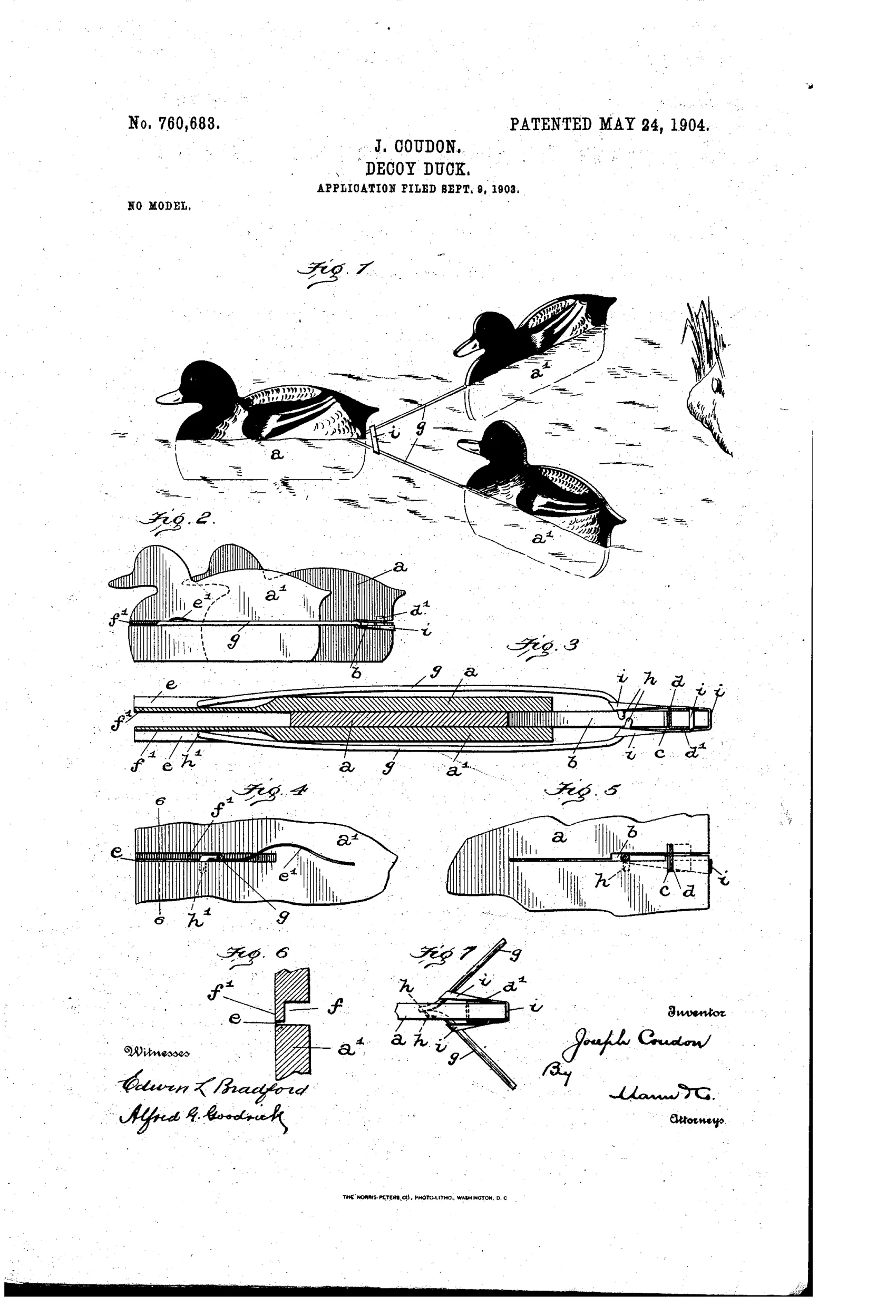
A main decoy and two pivoted decoys are connected by hook-ended links that engage horizontal and vertical slots. The links pivot at each decoy, allowing the outer decoys to swing outward and independently rotate a half-turn on their hooks while an elastic band holds the links spread apart. Curved portions of the links contact each other to form a stop preventing the pivoted decoys from swinging parallel to the main decoy. The whole assembly folds flat for compact packing and transport, then spreads out to float in varied positions on the water.
➶ What was claimed
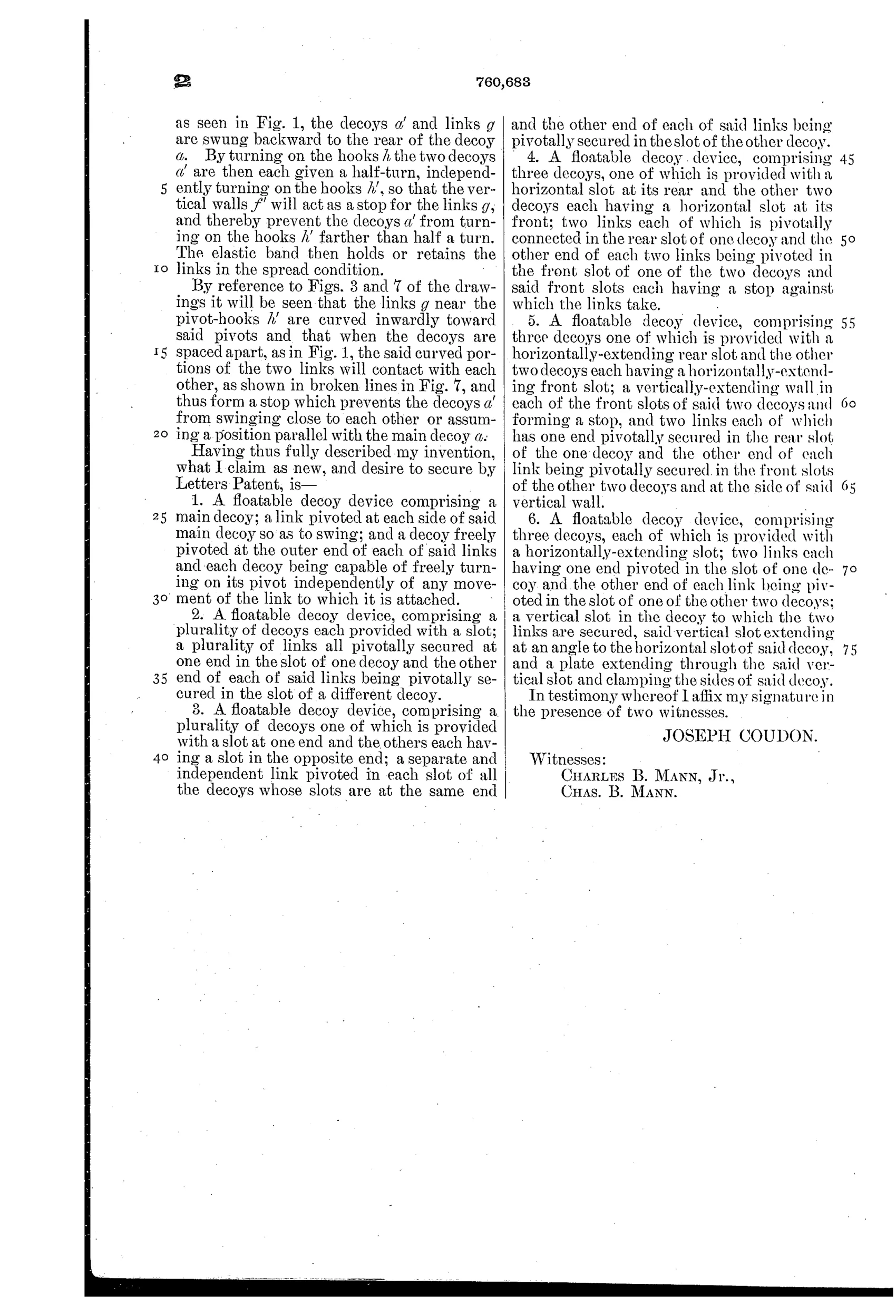
“1. A floatable decoy device comprising a main decoy; a link pivoted at each side of said main decoy so as to swing; and a decoy freely pivoted at the outer end of each of said links and each decoy being capable of freely turning on its pivot independently of any movement of the link to which it is attached.”
In plain English: A floating decoy system where a main decoy has swinging links on each side, each link ending in a second decoy that can freely rotate on its own pivot regardless of what the link does.
➶ In the inventor’s words
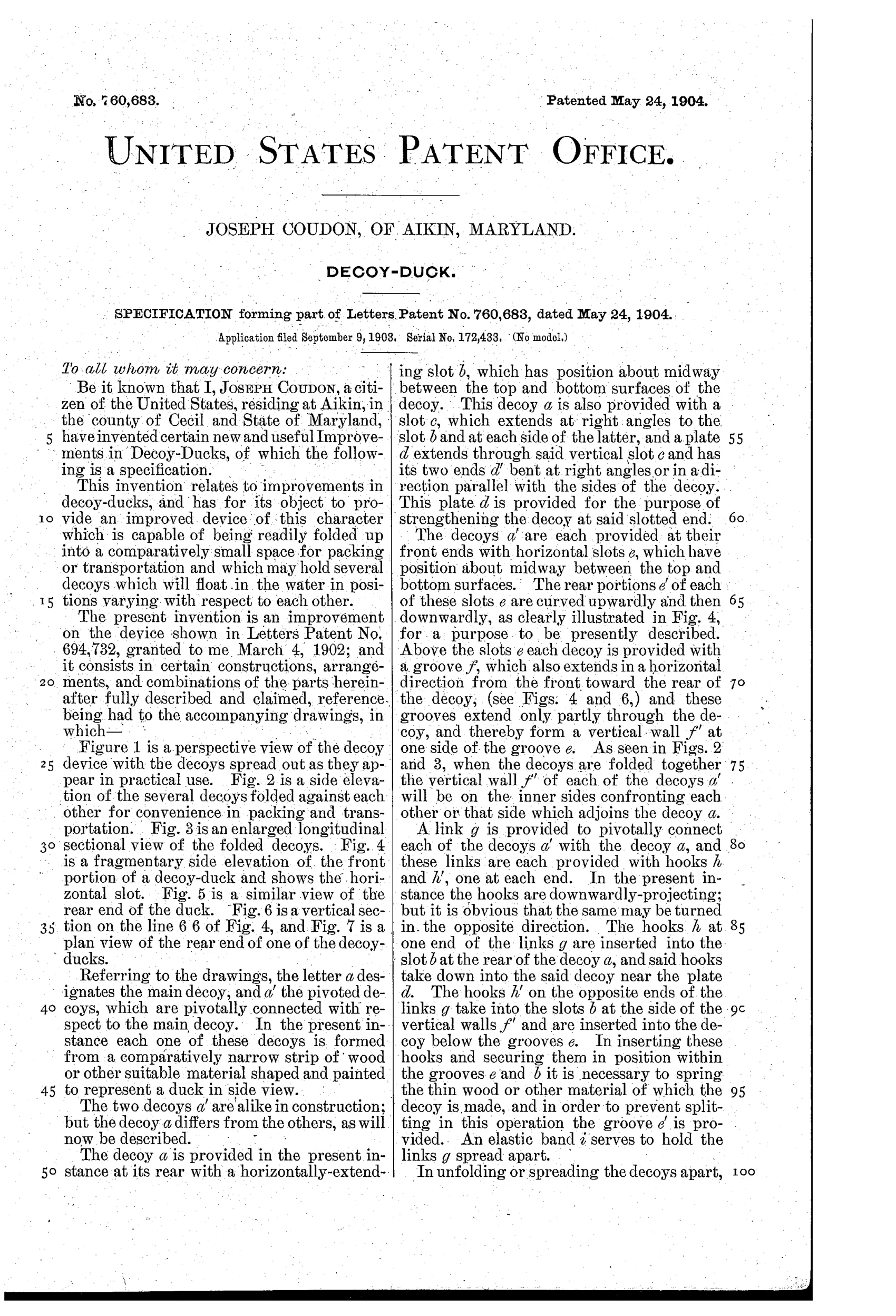
“An elastic band i serves to hold the links g spread apart.”— Joseph Coudon, from the specification
Fate unknown
Coudon was a documented Maryland decoy maker, but I know of no confirmed example of this specific linked three-bird rig; a surviving marked set would settle it.
➶ More by Joseph Coudon
- DEVICE FOR DECOYING DUCKS. (1901)
- DECOY-DUCK. (1902)
➶ Commentary
Full disclosure: this one strays outside our beat. It sits in the same harvest-gear patent class as duck calls, but Joseph Coudon's invention makes no sound at all. It solves a different market-hunter problem — the sheer bulk of a decoy spread. Anyone who has hauled a sack of wooden blocks to a blind before dawn will grasp the appeal instantly.
The mechanism is neater than it first appears. A main decoy carries a hook-ended link pivoted at each side; each link ends in a second decoy that turns freely on its own pivot. Figure 1 shows the payoff: three birds riding at natural, slightly different angles, because the outer two can weathervane independently. The detail a casual reader will miss is in Figures 3 through 7 — the curved portions of the links bear against each other as a stop, so the outer birds can never swing dead parallel to the center one and betray the rig's rigidity. The elastic band holding the links spread is the humble part; everything on the water depends on a rubber band staying springy.
Folded, per Figure 2, the whole trio packs like one decoy. Coudon was a real Susquehanna Flats gunner from Aikin, Maryland, and this reads like a working hunter's patent — every feature earns its keep. It just belongs on a decoy collector's shelf, not a callmaker's.
Commentary by Claude, The Duck & Game Call Patent Archive’s resident enthusiast