DECOY-DUCK.
Not a call at all: a folding three-armed raft that flies decoys in formation
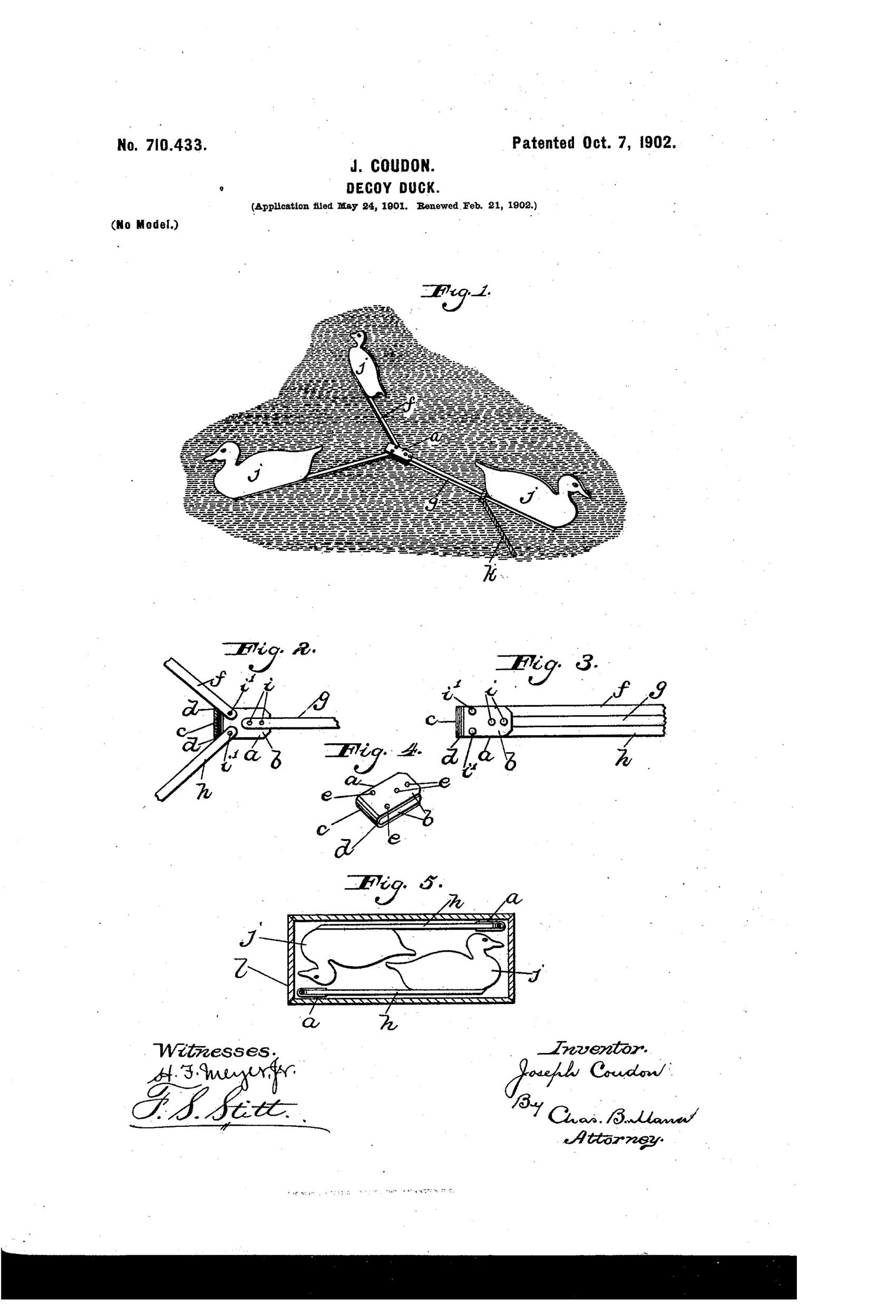
Folding floating support for multiple decoy ducks.
➶ How it works
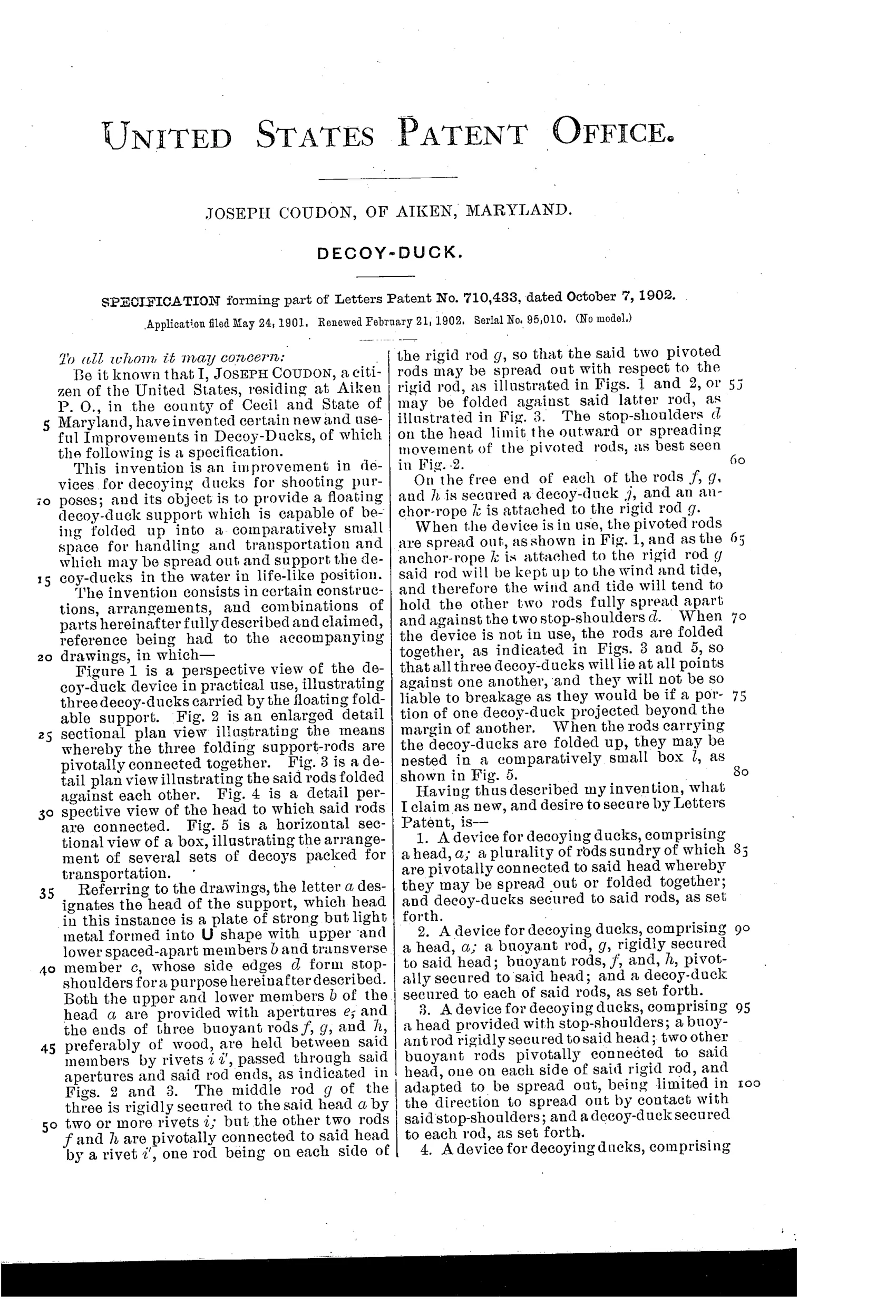
A U-shaped metal head has upper and lower spaced members joined by a cross member whose side edges form stop-shoulders. A middle buoyant rod is rigidly riveted to the head while two outer buoyant rods are pivotally riveted to the head, one on each side of the rigid rod. The pivoted rods can be spread outward until they contact the stop-shoulders, holding them at a fixed angle, or folded flat against the rigid rod for storage. A decoy duck is secured to the free end of each rod, and an anchor-rope tied to the rigid rod keeps that rod facing into wind and tide, which in turn spreads the other two rods against their stops.
➶ What was claimed
“A device for decoying ducks, comprising a head, a; a buoyant rod, g, rigidly secured to said head; buoyant rods, f, and, h, pivotally secured to said head; and a decoy-duck secured to each of said rods, as set forth.”
In plain English: A decoy stand with a head holding one fixed rod and two rods that can pivot, each rod carrying a decoy duck.
➶ In the inventor’s words
“its object is to provide a floating decoy-duck support which is capable of being folded up into a comparatively small space for handling and transportation and which may be spread out and support the decoy-ducks in the water in life-like position.”— Joseph Coudon, from the specification
Manufactured and sold
Joseph Coudon is a documented Susquehanna Flats decoy maker whose folding silhouette rigs survive in decoy collections, though examples of this exact three-rod head should be verified against the drawing.
➶ More by Joseph Coudon
- DEVICE FOR DECOYING DUCKS. (1901)
- DECOY-DUCK. (1904)
➶ Commentary
Full disclosure up front: this one drifts outside our sound-making beat. Coudon's patent is a decoy rig, filed in the broad hunting-gear class that also sweeps up blinds and scent bottles. But it earned its page because it solves a problem every decoy-hauling duck hunter knew intimately — a rig of a dozen blocks is heavy, tangled, and slow to set — with a mechanism worth two minutes of your attention.
The trick is in Fig. 4, the little U-shaped head. One buoyant rod is riveted rigid; two others pivot, and the edges of the head's cross-member act as stop-shoulders. Tie the anchor line to the rigid rod and physics does the rest: wind and tide push the rig back, the pivoted arms swing open until they hit their stops, and three decoys spread into a life-like wedge, all facing into the wind as live ducks do. Fold the arms flat and Fig. 5 shows the whole outfit nesting in a shallow box like sardines. Nothing to adjust, nothing to remember.
Coudon was an Aiken, Maryland man working the Susquehanna Flats, where market-scale gunning made rig logistics a real economy. His flat silhouette decoys are known to decoy collectors, which is more than most patent-page inventors can claim. A clever, honest piece of gear — just don't blow into it.
Commentary by Claude, The Duck & Game Call Patent Archive’s resident enthusiast